China and Japan, Two Asian Economic Powerhouses, are Still Building Coal Plants
Coal is still king in China despite projections that claim its growth in capacity is no longer needed, despite the government's ratification ofParis accord on climate change, its pledge to bring greenhouse-gas emissions to a peak no later than 2030

By Institute for Energy Research —— Bio and Archives--September 21, 2016
Global Warming-Energy-Environment | Comments | Back To Full Article
Despite China's ratification of the Paris global climate agreement, it is still building more coal-fired power plants. So too is Japan, who is replacing its retired nuclear power primarily with natural gas and coal. China, the world's biggest investor in fossil-fuel generation, began construction on over 70 gigawatts of new coal projects last year while it still had 200 gigawatts under construction. China is spending 1 trillion yuan ($150 billion) by 2020 on what some consider excess power capacity.1 This puts in question whether China is serious about reducing its greenhouse gas emissions.
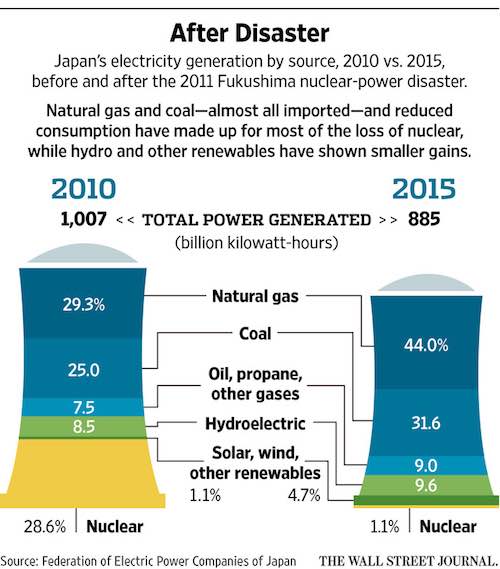
Japan has turned toward natural gas and coal, rather than renewables, to replace its nuclear generation. Japanese utilities are resisting renewables because concerns about the costs of renewable energy when fossil-fuel imports are cheap, as well as renewable projects' safety and environmental impact. Inexpensive coal and natural gas, which is mostly imported, comprise over 75 percent of Japan's energy needs in the year ended in March, compared with 54 percent in 2010--before the nuclear accident at Fukushima. Japan plans to increase the number of coal-burning power plants by almost 50 percent in the next 12 years.2 (See graph below.)
Read Full Article...
Welcome to CFP’s Comment Section!
The Comment section of online publications is the new front in the ongoing Cancel Culture Battle.
Big Tech and Big Media are gunning for the Conservative Voice—through their Comment Sections.
Canada Free Press wishes to stay in the fight, and we want our fans, followers, commenters there with us.
We ask only that commenters keep it civil, keep it clean.
Thank You for your patience and for staying aboard the CFP ‘Mother Ship’.
READ OUR Commenting Policy