Khamenei’s Son Says No to Nuclear Deal
Khamenei’s son, the new Supreme Leader of Iran, said there will be no nuclear deal. He has doomed Iran’s oil industry and his people;

Chet Nagle , Bio and Archives--May 3, 2026
World News | Comments | Reader Friendly | Subscribe | Email Us
On Thursday, 30 April, Khamenei’s son had a Dubai state television anchor read a defiant statement that said he would defend Iran’s nuclear and missile programs. The son, Ayatollah Mojtaba Khamenei, also said in his statement that the only place Americans belonged in the Persian Gulf is “at the bottom of its waters” and that a “new chapter” is being written in the region’s history. Khamenei also referred to the U.S. as the “Great Satan,” an insult used by Iranian leaders since the 1979 Islamic Revolution.
The 56- year-old has not been seen in public after the killing of his father in the Iran war initial airstrikes.
The previous weekend, Iran’s foreign minister Abbas Araghchi, offered an end to attacks in the Gulf the war if the U.S. would end its blockade of Iranian ports. In that offer Iran would control the Strait of Hormuz and any talks about Iran’s nuclear program would be held sometime in the future. That offer was despite President Trump’s insistence that Iran, a state sponsor of terrorism, should end its search for nuclear weapons by disposing of its enriched Uranium stockpile and verify the end of the program with inspections by the UN’s International Atomic Energy Agency.
The takeaways of Ayatollah Mojtaba Khamenei’s statement:
- He is the new Supreme Leader of Iran.
- He has the approval of the Islamic Revolutionary Guard Corps (IRGC) and that of the regular army.
- He is willing to destroy Iran’s oil industry and the Iranian economy by continuing the war.
The CENTCOM Blockade
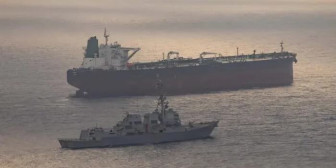
CENTCOM is using the U.S. Navy blockade to halt tankers from getting out to sea from all Iranian ports. The Navy is also stopping Iran’s shadow fleet of tankers as far from Iran as the Indian Ocean. As a result, Iran’s economy and its oil industry and the global economy remain under pressure as Iran maintains its hold on the Strait of Hormuz, through which 20% of all crude oil is transported. On Thursday 30 April, the benchmark for oil, Brent crude, traded as high as $126 per barrel. That shock to oil supplies and prices puts significant pressure on Trump, who is floating a plan to reopen the Strait of Hormuz.
Under the new plan the U.S. will continue to blockade Iranian ports and coordinate with allies to impose even higher costs on Iran’s attempts to disrupt the flow of oil through the Strait of Hormuz. The State Department sent a cable on 28 April that instructs its diplomats to seek their host government’s assistance to establish a “maritime freedom construct” that will ensure free access to shipping through Hormuz.
The Associated Press obtained a copy of the cable. It said, “This commitment reflects broad international consensus on the need for coordinated action to counter Iranian maritime provocations and ensure navigational rights and freedoms in the Strait of Hormuz.” It also said, “This is a fundamentally defensive response to protect the rights of all countries to navigate international waters freely and safely and to hold Iran accountable for its aggressive and illegal actions to impede the free flow of commerce.”
Trump also floated potential changes to the number of U.S. troops in allied nations in Europe at the same time. The day after Trump announced his administration was conducting a review of reducing the U.S. troop presence in Germany, he was asked if he would pull U.S. forces out of Italy and Spain, two countries that have made it impossible for the U.S. to use their bases for Iran war operations. “Why shouldn’t I,” Trump said. “Italy has not been of any help to us, and Spain has been horrible, absolutely horrible.”
As of 30 April the CENTCOM blockade has turned back 44 commercial vessels, creating a situation in which Iran must shut off production because it has nowhere else to store the oil it is producing and cannot sell.
Iran’s Oil Production Dilemma
Iran is restoring run down sites known as “junk storage” and is also using improvised storage containers. Iran is also attempting to ship crude oil by rail to China. These steps are directed at slowing down its oil infrastructure crisis and curtailing the U.S. blockade advantage in the current standoff over the Strait of Hormuz.
Commodity analytics firm Kpler said Iranian crude oil and condensate loadings averaged 2.1 million barrels a day between April 1 and April 13. Only five cargoes have been observed since the CENTCOM blockade, bringing the average down to only 567,000 barrels a day between April 14 and April 23. Kpler has also said that Iran has been using empty tankers to store excess oil offshore. There are still several large tankers in the gulf with a capacity of about 15 million barrels. An Iranian official said those tankers cannot sail out of the Persian Gulf because of the blockade, so the Iranian government has been using tanks in oil hubs like Asaluyah to store crude, even though those tanks have been previously avoided because of their poor condition.
Hamid Hosseini, spokesman for Iran’s oil-exporters union, said that Iran is also moving oil by rail to China. Railways now link Iran to the Chinese cities of Yiwu and Xi’an. The trip is shorter than ship voyages, but it still takes weeks. Railway deliveries are more costly than ocean tankers for “teapot refineries,” the principle Chinese buyers of Iranian crude. All that makes the drive to rail less of a solution than a signal of agony in the oil production system.
The Fragile Iranian Oilfields
President Trump’s blockade is mounting a siege on the shipping of Iranian oil production, and he is cheerfully watching oil production facilities filling offshore tankers, decrepit tanks and its attempt trying to ship crude by rail to China – just one of Iran’s previous customers.
Iran’s old carbonate oil fields cannot survive forcing its wells into long shut-ins. Keep the wells closed and the underground damage starts immediately.
1. Sediment clogs the flow paths
2. Asphaltene and paraffin build up and plug everything
3. Fines migrate and block the productive zones
4. Water coning cuts production capacity
5. Pressure swings wreck the formation
6. The reservoir compacts and crushes the pores
7. Permanent permeability loss - often 25-50% or worse
Iran will lose 300,000 to 500,000 barrels per day forever, and $20-50 billion in annual in revenue will disappear. Its oil fields will see 20-50% drops in long-term capacity and the damage will last for decades.
Miad Maleki, who played a role in Treasury Department sanctions against Iran and its group of terrorist proxies, said in an interview that the Iran war reflects a rare combination of economic, political and diplomatic leverage against Iran. "We’ve never had the level of leverage that we have today with Iran in the history of our conflict … since 1979," he said.
Maleki added that Iran may run out of oil storage capacity in two or three weeks, forcing production cuts and its damage to their oilfields. Gasoline shortages will hit at the same time because Iran relies heavily on gasoline imports.
Iran’s new Supreme Leader is bluffing or insane
Gasoline quotas have already been set, and it now takes 1.8 million rials to buy one U.S. dollar. When that is combined with $435 million in daily economic losses the pressure will spill into the domestic financial system, leaving the government unable to pay salaries of government officials, the IRGC, and the army, raising the risk of renewed unrest by the Iranian population.
Maleki said, "Iranians run out of patience again, as they did before, and they’re back on the street. I’m not quite sure if you’re going to have unpaid IRGC forces willing to go back on the street and kill their fellow Iranians who have the same grievances that they have now, which is a collapsed economy." He also said, “Iran’s economy relies on the Strait of Hormuz more than any other economy," calling its closure "economic self-sabotage."
Final Thoughts
Iran’s new Supreme Leader is bluffing or insane when he refuses to end his nuclear program that can only be described as a race to the bomb. In a few weeks his bluff or his insanity will begin to destroy his oil fields. When the IRGC is starving, like the rest of the population, will they be willing to gun down protesters again? Or will they take off their uniforms and join the rioters? I bet the bombastic Supreme Leader will ultimately leave Iran on his always-ready plane and visit Switzerland to enjoy the loot that his father stashed there.
That’s what dictators do.
View Comments
Chet Nagle is an experienced analyst and commentator on international commerce, geopolitics, national security matters, the Middle East, and strategic communications. He has been on radio, has appeared in documentary films and has been a guest on television news programs. His columns have appeared in the Daily Caller, The Hill, Roll Call, and many other publications. He is a contributing editor for ANDmagazine.com and the European Security & Defense magazine.