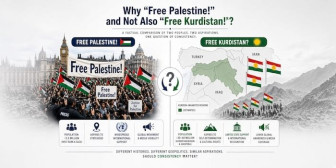
Why does the Palestinian plight provoke wall-to-wall outrage across the West, while the Kurds are treated as a geopolitical footnote?
What you won't see or hear during your walk or campus visit are flags, painted signs, or chanted slogans for the Kurds; that's assuming you're even aware they're also stateless. While Western outrage rallies in support of Palestinian self-determination, over 40 million Kurds remain the largest ethnic group without a country of their own. Spread across Turkey, Iran, Iraq, and Syria, they've spent more than a century fighting for the same rights as Palestinians: basic human rights and a homeland.
Why does the Palestinian plight provoke wall-to-wall outrage across the West, while the Kurds are treated as a geopolitical footnote?
It's certainly not for lack of human suffering. After the Ottoman Empire collapsed, the 1920 Treaty of Sèvres promised the Kurds a state of their own, only for Western powers to renege three years later, carving up their homeland into four pieces to satisfy newly drawn borders, without consulting a single Kurd. What followed was a century of horror: Saddam Hussein's chemical attacks in Halabja, brutal military campaigns and language bans in Turkey, execution squads in Iran, and forced displacement in Syria.
None of this horror moves the Western conscience. The silence isn't accidental; it’s a calculated mix of geopolitical self-interest, media-driven algorithms, and an open secret: antisemitism rebranded as moral virtue.
Let's start with the geopolitical game: NATO's convenience. Turkey, a key NATO ally guarding Europe's southern flank, treats any hint of Kurdish self-rule as a threat that must be crushed. When Western armies needed ground forces to fight the Islamic State in Syria, they armed Kurdish fighters and praised them as heroic defenders of democracy. Kurdish men and women died by the thousands doing the West's dirty work. But once ISIS was defeated, Western leaders discreetly withdrew their support, effectively turning their backs on the Kurds and handing the keys back to Turkey.