Knife Rights, Inc. v Blanche and The Saxons’ Knives
The Saxons understood that. They were named after their knives;

Douglas V. Gibbs , Bio and Archives--October 29, 2026
American Politics, News | Comments | Reader Friendly | Subscribe | Email Us
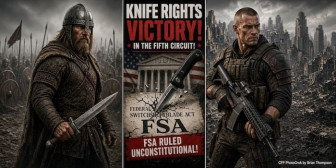
Last week the Fifth Circuit handed down a Second Amendment win that ought to be framed, not filed. The Fifth Circuit just reminded us that "arms" never meant "guns." But the deeper truth is older than the Republic: the right to keep and bear arms exists because of a duty to the security of a free state.
The Saxons, the Germanic people whose speech and law seeded England and provided the very concept of Natural Rights, took their very name from a blade
In Knife Rights, Inc. v. Blanche, a panel led by Chief Judge Jennifer Walker Elrod held that the federal Switchblade Act's interstate ban (15 U.S.C. § 1242) violates the Second Amendment. The government could not produce a founding-era tradition of banning the manufacture and sale of a common blade, and the court noted, dryly, that "knives have been used for defense throughout human history, including the American founding." Colonial America, the opinion observed, was a place where "everyone had a knife."
Good news. But not the point.
The point is what the ruling quietly concedes: "arms" does not mean "guns." It never did. And the moment we forget that, we forget why the right exists at all.
The Saxons, the Germanic people whose speech and law seeded England and provided the very concept of Natural Rights, took their very name from a blade.
The seax (Old English sēax, from an ancient root meaning "to cut") was a single-edged knife or short sword worn across the belt. The word runs through every old Germanic tongue: Old High German sahs, Old Norse sax, Old Frisian sax. To be a Saxon was, almost literally, to be a man of the seax. The knife-people. Three of them still sit on the flag of Essex.
The word "arms" itself is no more firearm-specific. It descends from the Latin arma. Implements of war and defense in the broadest sense. When the Founders wrote "arms," they meant swords and dirks and tomahawks and bayonets and bowie knives and hunting muskets and the dueling pistol. The firearm was simply the newest arrival in a lineage that ran back through the seax to the first sharpened edge a free man ever hung at his belt.
Even Heller, the case that "settled" this, refused to narrow the term. The Court reached back to the founding-era definition of arms as "any thing that a man wears for his defence, or takes into his hands, or useth in wrath to cast at or strike another," and confirmed that the Amendment extends "prima facie, to all instruments that constitute bearable arms."
It’s an old arrangement. A free people, responsible for their own defense, holding their own arms
But the real grammar of the Amendment is duty:
- "A well regulated Militia, being necessary to the security of a free State, the right of the people to keep and bear arms, shall not be infringed."
That first clause is the reason. It tells you what the right is for. We do not have the right to keep and bear arms as a lifestyle accessory, or because the Founders liked hunting. We have it because of an obligation and duty to the security of a free state.
The militia was never a standing army or a select corps of professionals. It was the body of the people. George Mason put it plainly: the militia "is the whole people." Blackstone described the right of having and using arms as a right held for self-preservation and defense, exercised by a people who were themselves the last line of their own security.
The Anglo-Saxon fyrd, the militia that predated the Norman yoke, imposed military service on every able-bodied free man. He did not merely have the right to bear arms. He had the duty to show up armed, at his own expense, when the shire called. For the free man, arms were both a right and a duty, fused into one. And the Supreme Court said it in 1939, in United States v. Miller, almost as an aside: when called for service, these men were "expected to appear bearing arms supplied by themselves."
Right and duty, welded. That is the inheritance the Second Amendment enumerates. It’s an old arrangement. A free people, responsible for their own defense, holding their own arms.
The modern gun-control narrative depends on one linguistic trick: shrinking "arms" until it means "the guns we currently tolerate." If arms means guns, then every new weapon is a fresh permission slip – something the government may graciously allow rather than something the people already possess.
It begins with a man, a blade, and a duty
But the courts are catching up, one category at a time. Suppressors. Body armor. Now, blades. In Blanche, the Fifth Circuit went further still, holding that the right to keep and bear necessarily implies the right to acquire, because the right "wouldn't mean much" without the corresponding right to buy, sell, and carry across state lines. You cannot have a right to keep a thing and no right to obtain it.
That is ordinary good sense. But good sense, as the case itself seems to note, is not always a requirement in court.
The Left has spent a century insisting the Second Amendment is a collective relic; a militia clause with a footnote about personal ownership. Every decision like this one strips that away. Bruen forces the government to prove its modern regulations match the America's history and tradition. And the history is uncomfortably long. It does not begin in 1958, when Congress banned switchblades in a fit of hysteria over juvenile delinquency. It does not begin in 1934, or 1791, or even 1689.
It begins with a man, a blade, and a duty.
The seax came before the musket. The musket before the rifle. The rifle before whatever the next century invents that we cannot yet imagine. The technology will keep moving. The word, “arms,” was chosen precisely so that it would not have to.
The duty underneath it is the load-bearing wall. A free state is not secured by a standing army alone, no matter how large. It is secured by a people who are themselves armed, and therefore themselves responsible. Strip the arms, and you strip the responsibility. Make the right a privilege, and the duty becomes somebody else's job – which is exactly how a republic slides into a client state of its own bureaucracies.
So keep the word whole. Arms. All of them. The knife before the gun, and whatever comes after.
Because the right was never the beginning. It was the tool. The duty came first – the duty to the security of a free state – and the right exists to make that duty honorable and real.
The Saxons understood that. They were named after their knives.
View Comments
Douglas V. Gibbs of Political Pistachio Conservative News and Commentary, has been featured on “Hannity” and “Fox and Friends” on Fox News Channel, and other television shows and networks. Doug is a Radio Host on KMET 1490-AM on Saturdays with his Constitution Radio program, as well as a longtime podcaster, conservative political activist, writer and commentator. Doug can be reached at douglasvgibbs [at] yahoo.com or constitutionspeaker [at] yahoo.com.