A Shining Light on the Hill
Mining for Treasure in the Word of God

Dr. Lawrence Sasaki , Bio and Archives--October 7, 2026
American Politics, News | Comments | Reader Friendly | Subscribe | Email Us
2Timothy 2:15 Study to shew thyself approved unto God, a workman that needeth not to be ashamed, rightly dividing the word of truth.
John 1:1 In the beginning was the Word, and the Word was with God, and the Word was God.
When reading scripture, oftentimes, I just look at the surface text and do not explore much below that. I suspect many Christians read the Bible in that manner. However, every once in while, I want to go below the surface and see what lurks there. I want to share with you some tools that I use to better understand the Bible, and I hope they will be a help to you.
Layers of Meaning
In Judaism, there are four layers of meaning[1]: Peshat, plain meaning, the surface text; Remez, hints, metaphorical meaning; Derash, inquire or seek, a midrashic meaning and Sod, mystery, mystical meaning. I only consider the first two. The third I leave to the Rabbis and the fourth is truly esoteric and of little use.
Peshat - The Surface Text
Much can be learned by a closer examination of the surface text. I will go through a few methods to gain more understanding:
Names: You can gain much by looking up the meaning of the names of people in the Bible. For example, Abraham means "Father of many nations". From his loins would come the Jewish nation out of which would come Messiah. Abraham was his new name, given by God when he entered into covenant with Him. After covenant, his wife, Sarai, also was given a new name, Sarah. His old name was Abram which means "High Father", married to Sarai which means “My Princess”, and after Covenant, Abraham was to become the father of many nations, along with his wife Sarah which means “Mother of Nations”.
In "The Gospel in Genesis"[2], Chuck Missler expounded on the genealogy given in Genesis chapter 5, extracting a prophetic message from the list of names:
- Adam: Man
- Seth: Appointed
- Enosh: Mortal, frail, or miserable
- Kenan: Sorrow, dirge, or fixed
- Mahalalel: The Blessed God
- Jared: Shall come down
- Enoch: Teaching or dedicated
- Methuselah: His death shall bring
- Lamech: The despairing or lamenting
- Noah: Rest or comfort
Putting the names together he derived the following encrypted message: "Man (is) appointed mortal sorrow; (but) the Blessed God shall come down teaching (that) His death shall bring (the) despairing rest."
Next, we come to Jesus. What does the name Jesus mean? Jesus is a transliteration from the Greek Iesous (Ἰησοῦς} which a transliteration from the Hebrew Yeshua (ישׁו) which means “Salvation”. The man set free when Jesus was crucified was named Barabbas. The name Barabbas is from the Aramaic Bar-Abba which means “Son of the Father”. Some manuscripts have his full name as Yeshua Bar-Abba, which may have arisen due to a copying error[3]. However, it is intriguing to think that the full name of the man set free while Jesus went to the cross could be Yeshua Bar-Abba, “Saved by the Son of the Father.”
Asking Questions: Another interesting technique is to ask questions. For example, when Jonah arrived at Nineveh, why did the Ninevites respond with sackcloth and ashes? They were a pretty haughty bunch. They could have told Jonah to take a hike, but they didn’t. Why?
For a while, my wife and I were members of a Messianic congregation. One Yom Kippur, a messianic rabbi expounded on the book of Jonah. The story is very simple. God told Jonah to go to Nineveh and prophesy against the city. He didn’t want to do it lest they be saved and he fled by boat to Tarshish. God brought up a mighty wind and the sailors were afraid for their lives. They determined that the fault lay with Jonah. He told them to toss him overboard and the sea would calm. They did and it did.
Both were now bound for Nineveh, but the sailors got there first. The rabbi explained that sailors are great gossips, and news of what happen on board – Jonah had rebelled against God, the sea raged, was calmed when he was tossed overboard and then he was swallowed by a great fish – spread like wildfire throughout the city, even reaching the ears of the King. So, when the prophet arrived at the city gates, covered in fish vomit, all the inhabitants knew that doom would be upon them unless they repented. They did, from the King to the least subject, and God gave them another 150 years, that is, until their sin grew great and the city was destroyed.
Context: It is important to know the context of the portion of the Bible that you are studying. The book of Hebrews is a good example. Some bible studies on the book wonder why the book suddenly veers into the Hall of Faith in chapter 11. What Paul was doing, and I believe that the book was written by Paul, was using the forebearers of the current generation of Hebrews, to show that faith was part of their makeup.
To understand what the book is about, we need to know what was happening at the time. The date of the book coincides with the first persecution of Christians under Nero which included, being fed to the lions, crucifixions, and being used as human torches. Since the Jews were not being persecuted, many Hebrew believers began hiding in synagogues. They thought that they could disguise their faith in Yeshua in this manner. Paul was admonishing them for their lack of faith, arguing that Christ is greater than anything they could imagine. Their hiding away in plain sight was an afront. They must stand bold in the faith.
Original Greek or Hebrew: A very useful tool is an interlinear Bible, that is one with the original Hebrew and Greek along with word-for-word English translations. I use the Interlinear Scripture Analyzer available for download at scripture4all.org,
For example, in chapter 22 of the Gospel of John, there is an exchange between Jesus and Peter. Three times Jesus asks "Do you love me?", Three times Peter answers "You know I love you." But the third time Peter gets angry. Why?
The answer comes when looking at the Greek. In Greek, there are 4 words for love.
- Eros – physical love, akin to lust.
- Phileo – brotherly love, love between friends.
- Storge – familial love, love between parent and child.
- Agape – unconditional love, love from God.
Jesus asks "Do you agape me?" Peter answers "I phileo you". Again Jesus asks "Do you agape me?" Again Peter answers "I phileo you." The last time Jesus asks "Do you phileo me?" And when Peter answers, he is ashamed. Then he sees John, who truly agapes Jesus, gets jealous and explodes in anger.
Proper Lexical Analysis: Sometimes there are lapses in lexical analysis. A prime example is the faulty analysis of Daniel chapter 9. The whole chapter is about Messiah, until we get to verse 27, when the subject suddenly turns to the anti-Christ.
Dan 9:26 And after threescore and two weeks shall Messiah be cut off, but not for himself: and the people of the prince that shall come shall destroy the city and the sanctuary; and the end thereof shall be with a flood, and unto the end of the war desolations are determined.
Dan 9:27 And he shall confirm the covenant with many for one week: and in the midst of the week he shall cause the sacrifice and the oblation to cease, and for the overspreading of abominations he shall make it desolate, even until the consummation, and that determined shall be poured upon the desolate.
Bible prophecy teachers say that the antecedent for the pronoun "he" starting verse 27 is "the prince who is to come", which they assert is the anti-Christ King. The problem is that phrase is part of a larger adjectival phrase, "of the prince who is to come" which is a modifier. Fowler’s Dictionary of English Usage[4] says that is incorrect. No modifier can alter the meaning of the text. In fact, one should be able to remove all modifiers and not alter the meaning of the text.
If we remove the phrase "of the prince who is to come" what are we left with? The next antecedent in verse 26 is "the people", but people is plural and he is singular so that is not correct. Looking back further, we hit Messiah.
Does verse 27 make sense if Messiah is the subject? It says that in the midst of the week Messiah will put an end to sacrifice and oblation, which He did with His atoning death on the cross. What then do we make of the second part the verse? There is only one other part of the Bible that talks of a three and a half year period, and that is the book of Revelation. Remember that Daniel is prophesying to Israel. The second part could signal the start of the Great Tribulation with a Great Awakening in Israel – the fulfilment of the 144,000 in chapters 7 and 14. This would put the first half of the verse during Jesus’ earthly ministry and the second during the Great Tribulation. In between is a comma of about 2000 years, the period of the gentile church.
Connections: Often when I read the Bible, I read a specific book in isolation. However, the Bible is a book of connections. In fact, almost everything in the Bible is connected to everything else. When you begin to see the connections, it opens up the rich tapestry that is the Word.
A simple example concerns the Law of Moses, outlined in Exodus chapter 20. In the Gospels, Jesus would refer to the Law "You have heard Moses say …” and then add “but I say to you..." Jesus was making commentary on the Law. In fact, most of the Bible is commentary. The historical books are commentary on a people that would keep the Law of God or rebel against the Law. Paul’s writings are commentary on the Law and the Gospels. There is a preacher who said that his basis for accepting or rejecting any new doctrine is the book of Genesis. If he cannot find the doctrine in the book of Genesis, he considers it false doctrine.
Another connection comes with the woman at the well (John 4). During the conversation Jesus talked of living water:
John 4:10 If thou knewest the gift of God, and who it is that saith to thee, Give me to drink; thou wouldest have asked of him, and he would have given thee living water.
Later at Sukkot, the Feast of Tabernacles, He extends the invitation to those at the Temple.
John 7:37-38 In the last day, that great day of the feast, Jesus stood and cried, saying, If any man thirst, let him come unto me, and drink. 38He that believeth on me, as the scripture hath said, out of his belly shall flow rivers of living water.
He would have done this during the water libation ceremony, when the priests would be running back and forth to the Pool of Siloam and pouring water on the altar and the water streaming from the altar.
Another connection can be made from Jesus saying "I am the door" in John 10:9. He is not saying that He is a literal wooden door, but that he is the gatekeeper. However, this connects to the first Passover in Exodus chapter 12 with a literal door. The Israelites were to take the blood of the slain lamb and paint the door posts and the head jamb with the blood. They were then to partake of the Passover meal behind the door while the angel of death passed by. The placement of the blood on the door are the exact spots where Jesus bled when He hung on the cross, the spikes through His hands and the crown of thorns on His head. Staying behind the door, they were saved.
Connections like these are more evident in the next section.
Remez - Allegorical or Metaphorical
It is at this level, just below the surface text, that things get interesting. An example of how this works is found in the Gospel of John chapters 2 and 3. Chapter 2 begins with the wedding in Cana. The wedding feast runs out of wine and Jesus performs His first miracle. He tells the servants to fill six waterpots with water. He told them to draw from the pots and present it to the governor of the feast, and, when the governor tasted the wine, he declared that they had saved the best for last. It then switches to Jesus driving the moneychangers out of the Temple, which occurred at the end of His ministry. Chapter 3 begins with Jesus’ discourse with Nicodemus on the new birth.
These are three seemingly unrelated stories taken from different times in His earthly ministry, until you look below the surface. The changing of the water to wine is a metaphor for the new birth. Isaiah 64:8 likens us to clay vessels. Like the servants pouring water into the clay pots, the Holy Spirit pours living water into us. At the moment of decision, the water becomes the blood of Christ and we are born again. The next section is an illustration of the Holy Spirit invading our lives, driving sin from our lives. It is interesting that this occurred at the end of His ministry, showing that this is a lifelong process. Chapter 3 does commentary on the metaphor of the wedding with Jesus’ discourse with Nicodemus. A fellow parishioner commented that the Holy Spirit is a gentleman, that He reveals our sin one at time and then deals with it. He doesn’t rip the veil off, like Dorian did in "The Portrait of Dorian Gray", revealing the true horror of our sinful nature.
There is another connection here. Jesus is at a wedding. He will be at another wedding as described in Revelation chapter 21, the wedding feast of the Lamb. The theme of a wedding points to another metaphor of the new birth, the wedding of Issac and Rebekah. Rebekah means "to tie firmly". She is the intended bride for Issac. Issac sent his servant, Eleazer which means "God is my help", to secure the wedding between Rebekah and himself. Eleazar goes to Rebekah’s family and, arrayed with gifts, he makes the proposal. In the ancient eastern wedding custom, the wedding contract is placed on the table and a cup of wine is set before the intended bride. If she picks up the cup and drinks the wine, the contract is sealed. She can also refuse to pick it up. The choice is hers.
This happens to us. The Holy Spirit, the Helper, woos us to Christ. The contract, that is the New Covenant, is before us. The gift of salvation and eternal life in Christ is presented and we can pick up the cup of wine, the blood of Christ, or we can reject it. The choice is ours. When we do pick it up, we enter into the New Covenant and become part of the Bride of Christ, looking forward to the marriage supper of the Lamb.
Structural Analysis
2Timothy 2:15 Study to shew thyself approved unto God, a workman that needeth not to be ashamed, rightly dividing the word of truth.
This the most complex of the methods. It is dividing the passage and assigning a theme to the divisions based on a fixed pattern of themes. The method I use is called "The Study of Sevens"[5], where each passage is divided into seven parts. It is not strictly seven, as some passages only comprise 6 parts, some 8, some even more. The Gospel of John divides nicely into 50 parts with 2 major divisions. The first is the prologue, John 1:1-18. The remainder divides into 49 parts forming a 7x7 matrix.
The seven themes are:
- Creation, or Glory of God, Glory of Christ, etc.
- Tribulation.
- Victory at Calvary, essentially victory.
- Faith, preaching of the Gospel, etc.
- Victory at Armageddon, victory often connected with Jesus’s second coming.
- Resurrection and Judgement.
- New Creation.
The pattern applies to all levels of the Bible, from the seven major divisions, to books, chapters, verses. In "The Prisoner 6 – Recovering the Word"[6], I included an example of the pattern applying to 2 Chronicles 7:14, which talks of repentance and restoration.
If my people, which are called by my name, | Glory of God |
| shall humble themselves, | Tribulation |
| and pray, and seek my face, | Victory |
| and turn from their wicked ways; | Faith |
| then will I hear from heaven, | Victory/Feast of Trumpets |
| and will forgive their sin, | Resurrection |
| and will heal their land. | New creation |
The pattern also applies to the seven major divisions of the Bible:
- The Pentateuch--Creation.
- The historical books, the ups and downs of Israel – Tribulation.
- The poetic and wisdom books – Victory at Calvary "I know my redeemer liveth" Job 19:25.
- The Prophets--faith.
- The Gospels – Victory at Armageddon.
- The Epistles – Resurrection and Judgement.
- Revelation – New Creation.
Let us return to the Gospel of John. In this book, the Study of Sevens does not strictly apply, rather it uses the menorah structure[7]. Let us look at the first theme which covers John 1:19-3:36. John 1:19-34 is the testimony of John the Baptist, "the voice of one crying in the wilderness". John 1:35-51 sees Jesus calling His disciples. John 2:1-12 is the wedding at Cana. John 2:13-22 describes Jesus cleansing the Temple. John 3:1-15 is Jesus discussing the new birth with Nicodemus. John 3:16-21, Jesus saying "For God so loved the world". John 3:22-36, John the Baptist exalts Jesus, "behold the Lamb of God, that taketh away the sin of the world."
We see with the menorah structure, the relationship between the branches. In the first, John the Baptist is introduced. In the seventh, he is proclaiming Jesus as the Lamb of God. In the second, Jesus is calling His disciples, In the sixth, He is proclaiming God’s love. The third is the wedding at Cana, a metaphor for the new birth, In the fifth, Jesus is discussing the new birth with Nicodemus. The middle sees Jesus driving the moneychangers from the Temple. The branches are related to each other, folding in the middle.
With this analysis, we can see directly the relationship between the wedding at Cana and Jesus discourse with Nicodemus. The third theme is Victory at Calvary--the new birth. The fifth is Victory at Armageddon--a commentary on the new birth.
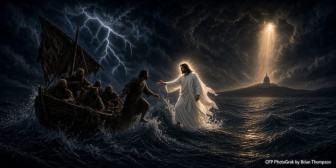
An intriguing finding is what appears at the fourth column of the second row, where faith meets tribulation. It is the story of Jesus walking on the water, John 6:16-21. It is a very short account. A longer account appears in Matthew 14:22-33. In that account, Peter calls out to him and, with his eyes firmly on Jesus, he walks out on the water to meet Him. When he took his eyes off of Jesus, he began to sink and Jesus pulled him out of the water. There are many sermons about Peter’s failure of faith. The point is he got out the boat. The rest of the disciples did not.
One Last Word
We are now facing a world that is in trouble. Are our eyes on Jesus? Do we get out of the boat and walk toward him in the midst of the storm? Or do we remain in the relative safety of the boat until the storm blows over? There is a problem with that. Before the storm blows over, there is a good chance the boat will capsize.
References
- “The Four Levels of Interpretation”, The Culture of the Bible, Dec 5, 2012.
- Chuck Missler, "The Gospel in Genesis", Koinonia House, 1996.
- Dr. Dirk Jongkind, "Was Barabbas called Jesus Barabbas?", Tyndale House, April 14, 2022.
- Fowler's Dictionary of English Usage, Oxford University Press, Feb 29, 2016 (first pub 1926).
- A.K.D. Brown, An Analysis of the Book of Revelation, Private Monograph (c) Brown, 1993.
- Dr Lawrence Sasaki, '"In the beginning was the Word..." John 1:1', Canada Free Press, Sep 20, 2026.
- J.R. Church and Gary Stearman, The Mystery of the Menorah, Prophecy Publication, 1993.
View Comments