America frantically playing “indigenous science” catch up with Canada
But when two neighbouring countries accept pre-scientific concepts as equal partners with scientific ones, intellectual and political chaos are bound to be the only outcomes

Hymie Rubenstein , Bio and Archives--December 30, 2024
American Politics, News | Comments | Reader Friendly | Subscribe | Email Us
America’s game of catching up to Canada’s preferential treatment of indigenous people is a reminder of our neighbour’s treatment of its aboriginals.
In 1884, Theodore Roosevelt, a well-educated and ambitious reformist politician who later became his country’s 26th president (1901-1909), uttered the following despicable words: “I don’t go so far as to say the only good Indian is the dead Indian. But I believe nine out of every ten are, and I shouldn’t like to inquire too closely about the tenth.”
Federal Agencies for recognizing and including “Indigenous Knowledge,” a term always capitalized, in federal research, policy, and decision making
Such words reflected America’s 19th century behaviour towards its indigenous peoples. In settling the West, for example, Americans chronically waged war with various tribes from the 1780s to the 1890s, occasionally engaging in ethnic cleansing to achieve their goals.
As for Canada, though there were some minor battles, the indigenous peoples were mainly treated as economic partners in the fur trade and as military allies in high casualty inter-tribal and anti-American warfare.
Overall, Canada’s dealings with its aboriginals seem altruistic by comparison, at least up to the last few decades.
In a remarkable and unusual imitation of Canadian government policy, there has recently been a steady transformation in American official policies governing its original inhabitants.
On December 1, 2022, the White House Council on Environmental Quality (CEQ) and the White House Office of Science and Technology Policy (OSTP) jointly released new government-wide guidance and an accompanying implementation memorandum for Federal Agencies for recognizing and including “Indigenous Knowledge,” a term always capitalized, in federal research, policy, and decision making.
According to the Biden administration, ‘Indigenous Knowledge” is “a body of observations, oral and written knowledge, innovations, practices, and beliefs developed by Tribes and Indigenous Peoples through interaction and experience with the environment.” The Biden-Harris Administration “formally recognized Indigenous Knowledge as one of the many important bodies of knowledge that contributes to the scientific, technical, social, and economic advancements of the United States and our collective understanding of the natural world.”
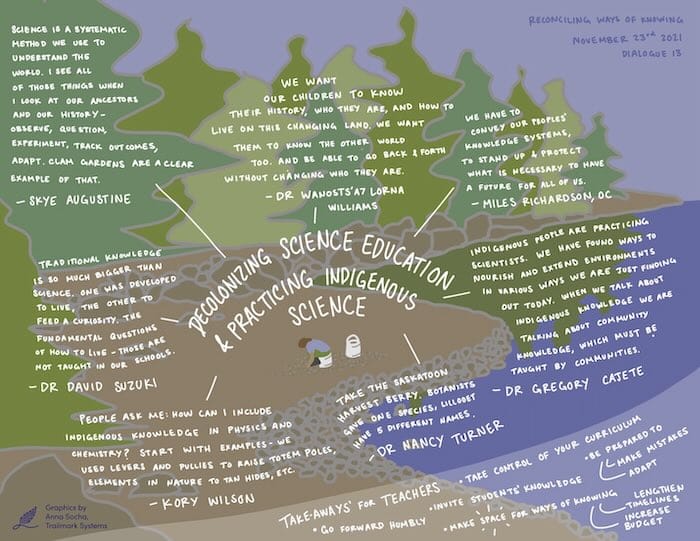
These claims about “Indigenous science” need to be closely examined, something that has never been attempted
We have heard all this before in Canada, where indigenization has long been entrenched.
Still, the institutionalization of a radical Indigenous assault on Western science, aided and abetted by the Trudeau Liberal government, took a dramatic leap in July 2022 with the appointment of Myrle Ballard, an Anishinaabe woman from Lake St. Martin Indian Reserve, as first director of Environment and Climate Change Canada’s (ECCC) new permanent division of Indigenous Science.
The marginalization of Western ways of knowing was reinforced on September 18, 2023, when the House of Commons’ science and research committee adopted a motion to “undertake a study of how best to integrate Indigenous Traditional Knowledge and science into government policy development; how to resolve conflicts between the two knowledge systems.”
Terming the relation between both “knowledge systems” as “conflicts” that need resolution denies the elementary observation that the two systems are irreconcilable because they are rooted in competing paradigms based on very different systems of knowing.
Much of what is termed If “indigenous” science is not conducted according to scientific methodology that relies on factual, verifiable evidence for its findings and explanations. Rather, it is based on opinion, hearsay, imagination, and faith ungrounded to empirical evidence or an objective theoretical framework.
Ballard implicitly denied this in her testimony before the House science committee when she argued indigenous and Western science are “both sciences.”
“For example, when we develop traditional medicines, we have the traditionalists, the medicine-makers who take the medicines from the land,” she said. “They know they have to take the plant or whatever it is they’re using from as far away from human contamination as they can. They have recipes that they use as well. That’s the same as in a lab. There are recipes that have to be tested. There’s the colour and the consistency. That’s the same as Western science.”
A close reading of the committee’s mandate on Indigenous Traditional Knowledge and the new Indigenous Science division in the environment department, together with their uncritical – read: “unscientific” – acceptance of the comments from witnesses, suggests that the government of Canada also accepts Western science as just one version of science.
These claims about “Indigenous science” need to be closely examined, something that has never been attempted. This is no easy task, not the least because there must be at least 50 different systems of “Aboriginal science” in Canada corresponding to the country’s 50 different cultural and linguistic groups.
As for the content of “Indigenous science,” Jamie Sarkonak’s National Post analysis of the committee witness testimonies shows “Indigenous science, perhaps intentionally, is a difficult concept to pin down.”
“Advocates can’t define it in any consistent way, and frequently confuse science conducted by Indigenous people (i.e., long-term observational evidence on phenomena like caribou migration patterns) with non-scientific cultural beliefs that are somehow upheld as equivalent to the scientific method,” Sarkonak wrote. “There’s often a political, anti-colonial element to ‘Indigenous science.’”
This is not to deny the fundamental importance of Indigenous Traditional Knowledge
This is not to deny the fundamental importance of Indigenous Traditional Knowledge, systems of practical understanding based on trial-and-error and careful observation that allowed aboriginal people to cope with a harsh northern climate that restricted population survival and expansion, at least compared to many other regions of the world. Still, based on the relatively rapid population growth in Europe and elsewhere over the same 15,000-year period, it is reasonable to hypothesize that the absence of genuinely scientific farming systems limited the number of indigenous people the land could support.
This begs the question of what is meant by the term “genuinely scientific.”
Sarkonok contends, “In reality, the scientific method is just a way of testing hypotheses about the world to determine what corresponds to reality and what does not. The truth is not dependent on ethnicity. If a plant has medical benefits, it ultimately doesn’t matter whether they were discovered in a lab or by the people who have used it for thousands of years. All that matters is that it works.”
But there is much more to scientific investigation than this. Scientific laws are not culturally limited; they are universal in scope. Sir Isaac Newton’s laws of motion, which he discovered in 1666, are just as valid in Canada as in Croatia. And they are just as correct in 2024 as in 1666 because they have never been disproven.
Sarkonok’s claim that “All that matters is that it works” is a practical issue, not a scientific one. And it is far less scientifically critical than knowing exactly why something works: what about some plants that indigenous specialists employ in healing give them their medical benefits? Science continually asks and often succeeds in answering questions like this using the tools of modern chemistry and other techniques.
Still, employing the scientific method using observation, experimentation, and the testing of hypotheses cannot prove theories to be true, including old ones like those of Newton; it can only show them to be false.
None of these requirements are met by Indigenous Knowledge, a culturally variable system of practical understanding and supporting mythology based on everyday experience, buttressed by appeals to the teachings of indigenous authorities and the power of supernatural forces. It is subject to constant change, variation, and disappearance because it is transmitted orally by competing knowledge keepers: “indigenous science” in 2024 and “indigenous science” in 1024 could never be identical.
What all this means is “indigenous science,” a term used liberally in the HCSCSR’s hearings, is a logical and empirical oxymoron because privileging common sense visual understandings by labelling them scientific to score political or sectarian points makes a mockery of the foundational concept called Western science.
None of this matters when juxtaposed against post-modern notions of wokeness, diversity, equity, and inclusiveness in either Canada or America
None of this matters when juxtaposed against post-modern notions of wokeness, diversity, equity, and inclusiveness in either Canada or America.
As Bruce Gilley, Presidential Scholar-in-Residence at the New College of Florida, has argued, the U.S. Federal government (like its Canadian counterpart) “is now officially committed to the veracity of hieratic native mythologies” and that:
Gilley also rightly pointed out, “Ask someone to explain precisely what indigenous knowledge is and you will be swarmed by a word salad of European romanticism about community relationships and ancient expertise. As a Canadian journalist noted: ‘Usually, Indigenous science advocates give the awfully convenient answer that their craft simply does not conflict with formal science, and then run out the clock before any meaningful follow-ups can be asked.’”
The most recent push to marginalize Western science in the United States occurred on December 9 when the White House ordered the National Oceanic and Atmospheric Administration (NOAA), a federal regulatory agency, to expand its use of "Indigenous Knowledge" as part of a last-minute push in the federal government to embrace what trained scientists rightly call pseudoscience and traditional anthropologists call “ethnoscience” to distinguish it from European science.
According to its press release, the agency signed a formal memorandum of understanding with the American Indian Higher Education Consortium to "advance Indigenous Knowledge" and "achieve strong climate resilience for our tribal nations."
The straightforward mission of NOAA is “to provide daily weather forecasts, severe storm warnings, climate monitoring to fisheries management, coastal restoration, and the supporting of marine commerce.”
Could this ever happen if indigenous knowledge is fully integrated with Western science?
According to C. Douglas Golden, NOAA’s mission should be executed impartially using the scientific method. Given the unscientific and highly variable nature of indigenous knowledge, this is an impossible task.
According to a December 10 report from the Washington Free Beacon, the new Biden amalgamation of indigenous and scientific knowledge is what writer Joseph Simonson described “as part of a last-minute push in the federal government to embrace what scientists call pseudoscience.”
“‘Indigenous Knowledge’ is a discredited belief system posting that native-born peoples possess an innate understanding of how the universe works,” Simonson noted in his piece.
“President Joe Biden issued a memo in November 2022 that directed more than two dozen federal agencies to apply ‘Indigenous Knowledge’ to ‘decision making, research, and policies,'” Simonson continued. “The memo called on agencies to speak with ‘spiritual leaders’ and reject ‘methodological dogma.'”
What “Indigenous Knowledge” will be considered at the NOAA?
Considering that forecasting whether it’s going to rain hard or whether the sun will shine brightly requires a whole lot of “methodological dogma,” that is indeed a critical issue.
And what “Indigenous Knowledge” will be considered at the NOAA?
The Partnership With Native Americans noted in a 2017 article the rain dance is still widespread among indigenous American Indian tribes. “As a Lakota, I always found it stereotypical when asked about the rain dance. In all my life, I had never heard of any rain dance taught in Lakota culture. Why? Because we don’t practice it,” the writer noted.
He also said “It was only recently, for instance, that I learned the rain dance is actually a fairly common practice among southern tribes. These tribes typically reside in dry climates, where water is essential to life, making it something of a cornerstone in those cultures. Rain, specifically water, is important to sustaining life for all communities, but for some this precious resource is scarce.”
“One of the tribes that practices the rain dance still today is the Ohlone, located in a small town in the southern central part of California. And in a small town, it is said, ‘When you call a rain dance, word gets around.’ In Ohlone culture, the dance is greatly respected, with pure intent and high significance. After a three-year drought, they attributed the returning rain to their dances.”
Will the NOAA hold discussions with Ohlone? After all, this is part of the body of “Indigenous Knowledge” which encompasses a wide variety of cultures and traditions lumped under the label of “Native American.” Who is to say that tribes which place a strong emphasis on traditions that use rain dances or whose views on the environment are entwined with animism, say, have beliefs that are less valid than the Lakota, who don’t practice those things?
All these potential conundrums and contradictions should be familiar to Canadian readers, including those who may feel flattered by the way the Americans are now imitating our very own indigenous policies and practices.
But when two neighbouring countries accept pre-scientific concepts as equal partners with scientific ones, intellectual and political chaos are bound to be the only outcomes. This is because even though science and mythology are two systems of knowing, they are so incompatible that their comingling will inevitably and invariably destroy both.
View Comments
Hymie Rubenstein, a retired professor of anthropology at the University of Manitoba, is editor of —REAL Indigenous Report.