America’s Constitutional Foundation of Biblical Covenant
Origin of American Constitutionalism

Kelly O'Connell , Bio and Archives--June 13, 2010
Cover Story | Comments | Reader Friendly | Subscribe | Email Us
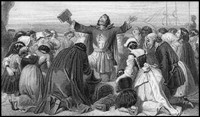 Outlined in this essay is a brief description of how the biblical concept of covenant became the foundation for America's Constitution. While this history is now an almost unknown, sub rosa embarrassment to modern eyes, yet the development of American political theory was once highly regarded by most of the world. Seminal colonial American historian Donald Lutz, in his Origin of American Constitutionalism, explains the importance of the Bible's covenant concept to our Pilgrim and Puritan forbears.
As opposed to being the result of the crazed imposition of a small band of religious zealots, the covenant approach to creating new communities was simply an outgrowth of their Christian world view. These immigrants wanted to protect their right to worship, and create a foundation for proper civil society. Overall, the US Constitution is simply the logical result of adding together all the early colonial covenants, compacts and charters, which summed up their novel government ideas. Of course, when Thomas Jefferson and James Madison drafted the Declaration and Constitution, they created a new and unique masterpiece of political philosophy. Yet our Founders would never have achieved these great heights without the earliest American immigrants creating the foundation of the first colonies via biblically inspired covenants.
I. What is a Covenant?
The word “covenant” is an ancient Jewish term (Hebrew brit). Covenant is generally defined as a special kind of agreement or contract, between men, or man and God (Hebrew Yahweh). There are two aspects of the biblical covenant that should be born in mind. First, the covenant between Yahweh and Israel, recorded in Exodus and Deuteronomy, is not a bargain or a negotiated agreement. Instead, it is a “disposition or arrangement which originates unilaterally with the superior party.” The lesser party can accept or reject the offer, since it contains a reciprocal, bilateral design, but persons cannot barter or change the proposal in any way before acceptance. A second aspect, is a covenant between God and man resembles a marriage contract (see Ezekiel 16:8, 60; Hosea 2:16; Isaiah 54:5; Jeremiah 3:14; 31:32). This relationship is wholly initiated by God. So the choosing (ie “election”) of Israel as Yahweh's wife is an utterly divine act. Again, God's covenant is a unilateral offer, yet bilateral in function. God and His people are bound together by this covenant which operates like a marriage contract. Accordingly, the covenant is a “bond, an alliance, an agreement, a compact, a treaty, a pact, a contract.” The covenant makes a union between Yahweh and men, with God offering mankind a partnership with the Almighty. This also creates a binding legal contract. Ultimately, the purpose of a covenant is to create a foundation for fellowship between Yahweh and man, one derived from a legal basis. Yet, political covenant notions developed in Europe and then transferred to America are somewhat different than the Hebrew model, despite still being based upon Old and New Testament ideas.II. American History: From Covenant to Constitution
According to Daniel Elazar, in his “Covenant and Constitutionalism,” America's political formula was self-consciously modeled upon the biblical covenant model, albeit a secular version. Early American immigrants relocated from Europe to find a new life and religious freedom. These hardy Calvinists were most familiar with their own biblical world view. Nearly every incipient American town or settlement was founded by a formal covenant agreement. Writes Lutz, “Local government in colonial America was the seedbed of American constitutionalism—a simple fact insufficiently appreciated by those writing in American political theory.” Lutz goes on to explain how the American covenant tradition was used to explicitly create communities founded upon belief in God, the common good, and the popular will. And these covenants eventually morphed from religious to secular without losing their essential format.A. Early American Community Foundation: Covenant of the Charles-Boston Church The following is a typical founding colonial community charter: The Covenant of the Charles-Boston Church (1630) In the Name of our Lord Jesus Christ, and in Obedience to his holy Will and Divine Ordinance, We whose Names are here under written, being by his most wise and good providence brought together into this part of America in the Bay of Massachusetts, and desirous to unite ourselves into one Congregation or Church under the Lord Jesus Christ our Head, in such sort as becometh all those whom he hath redeemed, and sanctified to himself, DO hereby solemnly and religiously (as in his most holy Presence) promise and bind ourselves, to walk in all our ways according to the Rule of the Gospel, and in all sincere Conformity to his holy Ordinances, and in mutual Love and Respect each to other, so near as God shall give us Grace. John Winthrop | Thomas Dudley | Isaac Johnson | John Wilson | &c | &cAccording to Lutz, records show that typically the first thing these newly arrived Calvinist believers did was to establish a formal relationship with one another centered upon the church which also conferred community privileges. This is understandable given the amount of persecution they received back in England, via Bishop Laud's Starr Chamber, etc. Lutz identifies five foundational elements in the Charles-Boston Church covenant doctrine, which were typical of these kinds of documents, being: 1) It is sworn before God; 2) It describes the reason the document was necessary; 3) It creates “a people” – being the undersigned; 4) It creates a church; 5) It describes what kind of people the undersigned design to become (a people who follow God's Gospel and ordinances, etc). B. Early American Political Compact: The Mayflower Compact
Agreement Between the Settlers at New Plymouth (1620) IN THE NAME OF GOD, AMEN. We, whose names are underwritten, the Loyal Subjects of our dread Sovereign Lord King James, by the Grace of God, of Great Britain, France, and Ireland, King, Defender of the Faith, &c. Having undertaken for the Glory of God, and Advancement of the Christian Faith, and the Honour of our King and Country, a Voyage to plant the first Colony in the northern Parts of Virginia; Do by these Presents, solemnly and mutually, in the Presence of God and one another, covenant and combine ourselves together into a civil Body Politick, for our better Ordering and Preservation, and Furtherance of the Ends aforesaid: And by Virtue hereof do enact, constitute, and frame, such just and equal Laws, Ordinances, Acts, Constitutions, and Officers, from time to time, as shall be thought most meet and convenient for the general Good of the Colony; unto which we promise all due Submission and Obedience. IN WITNESS whereof we have hereunto subscribed our names at Cape-Cod the eleventh of November, in the Reign of our Sovereign Lord King James, of England, France, and Ireland, the eighteenth, and of Scotland the fifty-fourth, Anno Domini; 1620.One can see here the almost identical formula between the Mayflower Compact and Charles-Boston Church covenant. But instead of creating a church, it establishes a Body Politick. C. Pilgrim Code of Law (1636) The Pilgrim Code of Law of the Plymouth Colony was officially based upon the Mayflower Compact as a legal precedent, and also the royal charter, claims Lutz. The document asserts all former covenants and compacts, turning it into a larger covenant. It then makes an extraordinarily important claim – the colonists assert all rights due Englishmen, which is now known as the “Plymouth Agreement.” This then establishes a foundation for the legal resistance to England when the Founders claim their rights are being trampled. But the Pilgrim Code of Law adds a description of the institutions by which the people will assert their rights and also establish a government. In doing this, the Code becomes the first American constitution. Of course this document influenced the US Constitution we still use today.
III. General Aspects of Early Colonial American
Some other aspects of early America are notable. First, the covenant mindset of colonial Americans was a direct reflection of the overall seriousness with which they regarded their Christian religion. Further, these covenants were a reflection of the Puritan's well-organized and disciplined minds regarding their beliefs as to the proper interaction between God, man and society. Second, the nature of America's famed “federal” government resulted from the need for these hardy colonists to establish self-rule when so far from mother England. But the ideas behind the federal form of government – being a healthy mix of both local and national rule – were also taken from a biblical world view. The original source being Puritan federal theology. Third, the early expressions of bills of rights were an excretion of some very commonly held views about the rights of man versus government. These ideas were related to the strong 17th century interest in virtue which held being a good Christian was the best way to achieve a good life and be happy. The common good was seen as being permanently wedded to the desires of the majority. The idea that votes should be traded for special interest politicking, or that the desires of the political minority should be coddled, would have outraged virtually all colonial Americans.Conclusion
The shrill demand for a wholly secular government in America has never been stronger. But it is those same people most ignorant of America's roots who shout loudest for making religion completely off limits in the US. Yet, can this position be prudent given our past successes and considering our religious foundations? Ironically, the first wholly secularized American covenant – the Providence Agreement of 1637 – resulted not from Rhode Island supporting atheism, but from their fear of offending God by swearing to him an oath. Wouldn't it be wonderful if politicians, professors and journalists were once again interested in real American history? If these did their homework on the development of our remarkable experiment in democracy, they might be much slower to demand total secularism. These typically liberal people might even be forced to ponder if America's great luck might not actually be the result of special providence instead of blind chance!View Comments
Kelly O’Connell is an author and attorney. He was born on the West Coast, raised in Las Vegas, and matriculated from the University of Oregon. After laboring for the Reformed Church in Galway, Ireland, he returned to America and attended law school in Virginia, where he earned a JD and a Master’s degree in Government. He spent a stint working as a researcher and writer of academic articles at a Miami law school, focusing on ancient law and society. He has also been employed as a university Speech & Debate professor. He then returned West and worked as an assistant district attorney. Kelly is now is a private practitioner with a small law practice in New Mexico.