An Italian echo across America
Vittoria Italiana in America

Greg Maresca , Bio and Archives--October 12, 2026
Cover Story | Comments | Reader Friendly | Subscribe | Email Us
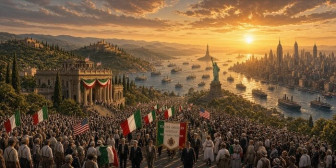
The traditional Columbus Day observance has splintered like a broken pallet of cultural perspectives. Columbus Day remains in place federally, but the holiday has frayed into a patchwork of competing interpretations of American history. The result is a single date with multiple personalities each reflecting a different take of America’s past.
Growing up, Columbus Day always celebrated the great Genoese Italian explorer Christopher Columbus and his discovery
Some states and cities mark the day as Indigenous Peoples’ Day, while others use Native American Day or First People’s Day. Hawaii observes Discoverers’ Day. This shift underscores a broader debate over how the country chooses to remember its origins and whose stories get told.
Growing up, Columbus Day always celebrated the great Genoese Italian explorer Christopher Columbus and his discovery. It also celebrates the great wave of Italian immigrants who crossed the Atlantic in search of work and a promising future for their families.
Italian-American identity is not monolithic.
Depending on the state you call home today, each are a branch of the diaspora that nurtures its own customs, its own culinary traditions and its particular lexicon of endearments, invectives and unmistakable accents.
This diversity is no weakness.
Rather, it is the very thing that made ItalianAmerican culture so durable, so adaptable and so beloved.
The divide between Northern and Southern Italians predates Ellis Island by centuries. The comparison to America’s own North/South tensions helps explain why the Italian migration was not a single wave of identical families arriving with identical stories. It was a mosaic of regions, dialects and traditions that collided, blended and eventually became the Italian American identity we know today.
In the spirit of Columbus Day with a celebration of the journey, the grit and the identity Italians carried into America here is a lighthearted look at the differences that emerged.
With apologies to Jeff Foxworthy …
You might be an Ohioan-Italian if you think nothing is wrong with serving antipasto alongside store bought rolls from a plastic bag.
You might be a Massachusetts-Italian if you call your ancestors “Italians from Itlee.”
You might be a New Jersey-Italian if you utter “medigan” or “stunad” more than once a day.
You might be a North Carolina-Italian if you have at least one jar of storebought tomato sauce shamelessly displayed in your pantry.
You might be a Rhode Island-Italian if you think “gabagool” is a character on The Sopranos.
You might be a Philadelphian-Italian if you confuse Rocky Balboa with Rocky Marciano.
You might be a West Virginian-Italian if you refer to Fettuccini Alfredo as macaroni and cheese.
You might be a Connecticut-Italian if you think “wedding soup” is about nuptials rather than the marriage of vegetables and meatballs.
You might be a Pittsburgh-Italian if you insist Gelato was some fat guy who played left tackle for the Steelers.
You might be an Illinois-Italian if you refer to the friendly man down the block who always says hello as a “goodfella.”
You might be a Kansan-Italian if you never knew Tony Bennett was baptized Anthony Benedetto and Dean Martin was baptized Dino Crocetti.
You might be a Floridan-Italian if you left the faith of your fathers and have no clue when or why.
You might be a Manhattan-Italian if you have multiple pieces of living room furniture wrapped in plastic.
You might be a Bronx-Italian if you know Sacco and Vanzetti is anything but a clothing line.
You might be a Staten Island-Italian if all you can remember in your family are the grudges--better known as Italian Alzheimer’s.
You might be a Brooklyn-Italian if the aroma of grilled sausage, peppers, onions, parmigiano, prosciutto di Parma and grilled escarole brings you to tears.
You might be a Queens-Italian if you find this comical: Why did the baccalà bring an attorney to the Feast of the Seven Fishes? Because every year someone tries to batter it without consent.
You might be like most Americans of Italian descent if you don't know that FDR’s Executive Order 9066 branded 600,000 Italian-Americans as “enemy aliens.”
Italians have provided the world an army of influencers: Dante, Verdi, Fellini, Columbus, Amerigo Vespucci, Michelangelo, Leonardo da Vinci, Garibaldi, Puccini, Marconi, Versace and Sophia Loren among a plethora of others including holy saints and popes and the greatest culinary experience the world over.
The world loves Italy because she is old and still glamorous. Italy eats and drinks well but is rarely fat or drunk much like its people.
Vittoria Italiana in America.
View Comments
Maresca is a New York City native and a Marine Corps veteran living in Flyover, Pennsylvania.