At The End of a Classic Bubble, the Stock Market and Economy Fail Together
It seems that financial speculation becomes so pervasive that when it fails it takes the economy down with it

Bob Hoye , Bio and Archives--August 6, 2024
World News | Comments | Reader Friendly | Subscribe | Email Us
It seems that financial speculation becomes so pervasive that when it fails it takes the economy down with it.
Otherwise, the stock market leads at peaks by some 10 to 12 months. Which is why the S&P 500 is included in the Leading Indicators.
The following chart shows a record back to the “Roaring Twenties” with that example climaxing in September 1929. Of interest is that according to the NBER the US economy peaked that August. The previous Great Bubble also completed in September and the NBER determined that that business cycle peaked in that October.

At the Oversold into December, we reviewed the long history of uniquely strong rallies completing in January. Silver in 1980 was cited as was the NYSE’s big peak in January 1973. With that strength we noted that the “Good Stuff” could prevail into Mid-Year.
This worked out, but in noting the incredible speculative excesses concluded that the collapse of both stocks and that could be evident – maybe by late-September.
Well, to use an outdated term – the tocsin has sounded.
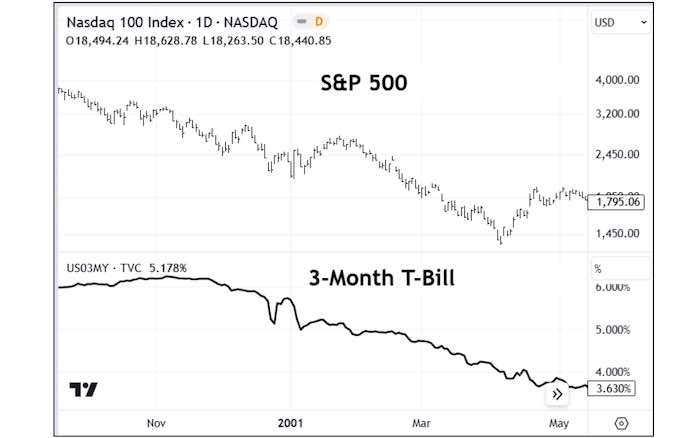
There have been attempts to counter the startling report with the positive notion that “Fed Cuts” are good for the markets.
Not so.
On September 4, 2007, Harris Private Bank boasted “Lowering interest rates will certainly help the stock market. There is no question about it.”
Wrap:
The stock market breaking dramatically, with a suddenly weak economic report is a sign that the greatest Financial Bubble in history has completed. The consequence will likely be another Great Depression.
The earliest use of the term was with the prolonged weakness after the 1873 Bubble.British economists began using the term “Great Depression” in 1884. It ended in 1895.
Four out of five Great Bubbles were followed by Depressions that ran for some twentyyears.
On the tout about “Fed Cuts” – all severe contractions featured falling short rates.
Close Up on One Example
View Comments
Bob Hoye (BobHoye.com) has been researching investments for decades, which eventually included the history of financial and political markets. He considers now to be the most fascinating time for both since the Great Reformation of the 1600s. Bob casts a caustic eye on all promotions and, having a degree in geophysics, is severely critical of the audacity that a committee can “manage” not just the economy, but also the temperature of the nearest planet. He has had articles published in major financial journals and, as a speaker, has amused assemblies in a number of cities, from London to Zurich to Tokyo.