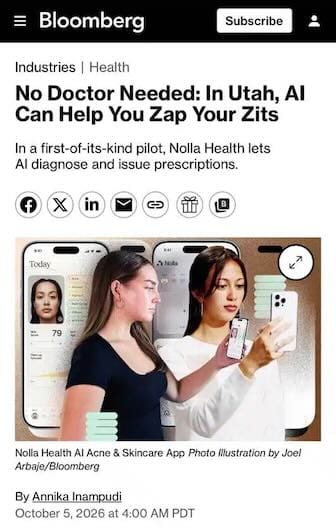
Really, then, how is this system operational, and how can you make that claim when the state’s Office of Artificial Intelligence Policy and the Division of Professional Licensing co-signed the agreement permitting it?
In January of this year, Utah approved a startup called “Doctronic.” That decision allows AI to process prescription renewals across around 190 drugs--covering chronic conditions like hypertension, diabetes, and thyroid disease--with physician review required only for the first 250 prescriptions in each drug class before full automation took over.
Utah’s Medical Licensing Board was never consulted. They learned of it only when reporters called to ask about it.
They raised red flags, and yet regulators allowed the program to proceed.
An AI sandbox is a secure, isolated environment designed to run AI models, test prompts, or safely execute code generated by artificial intelligence systems, such as large language models and autonomous agents. This setup ensures that these activities do not harm your main computer, network, or production data.
Utah’s sandbox is getting crowded. Beyond Nolla’s excursion into prescribing without a physician's consent, the sandbox now includes behavioral health prescriptions through Legion Health and pelvic floor therapy AI.
Congress is on the sidelines with this issue. The Healthy Technology Act of 2025 would officially define AI systems as licensed prescribers if a state authorizes them and the FDA approves them as a device. However, that bill is still on the shelf, awaiting passage.
In the meantime, more and more of these situations are being queued up to be squeezed through the system. Utah jumped the gun, but more are sure to follow.
AI has a place, but when it comes to human health, a disclaimer shouldn't be the Band-Aid a state applies to something this serious.