

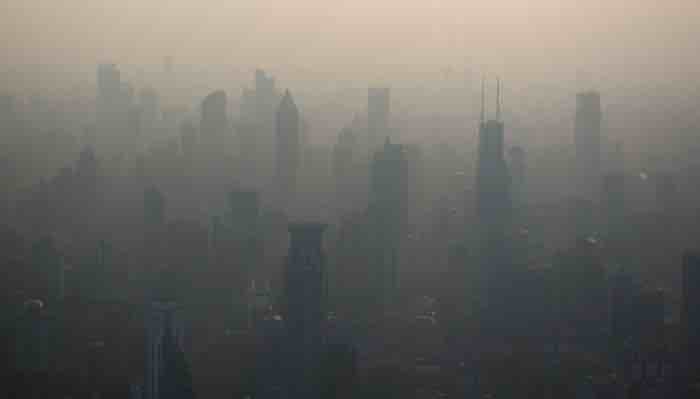
 Nothing horrifies the intelligentsia more than President Trump's withdrawal from the Paris Agreement on climate change. But based on China's emissions, it increasingly looks like the president made the right call, notes Liz Peek. (1)
China is continuing its coal reliance in spades:
China Energy Issues
 Nothing horrifies the intelligentsia more than President Trump's withdrawal from the Paris Agreement on climate change. But based on China's emissions, it increasingly looks like the president made the right call, notes Liz Peek. (1)
China is continuing its coal reliance in spades:
- In 2018, China's emissions of carbon dioxide, the leading heat trapping gas, rose roughly 2.5 percent. This was the largest annual increase in five years.
- In 2018, roughly 30 GW of new coal fired power capacity was added in China (roughly 6 midsized coal plants). Capacity additions for coal fired power plants continued at the same pace in the first half of 2019.
- China's public financial institutions continued to lead the world in financing new coal fired power plants abroad (44GW). 2
China's transition to a green economy is imploding
Green corporate and financial bonds totally $1.1 billion were issued by 13 coal projects in the first half of the year. They involved power plants fueled by coal or coal bed methane as well as coal to chemical projects. Cutting coal and encouraging cleaner forms of energy is a major part of China's effort to reduce smog and greenhouse gases. The share of coal in the country's total energy mix fell to 59% last year, down from 68.5% in 2012, and it aims to cut that share to around 50% by 2030. 4 But overall capacity is still set to grow even as it falls as a share of the total, and China needs to upgrade existing mines and plants. Thus, while many global financial institutions have said they will no longer fund coal projects, their Chinese counterparts have not followed suit. Last year, more than a quarter of the green bonds issued in China failed to meet international criteria, according to the Climate Bind Initiative (CBI), a non-profit group that promotes global green bond standards. 4 China's transition to a green economy is imploding as the economic growth needed to pay for the massive state funded subsidies hits its slowest pace in three decades. Over the last eighteen months as the Sino-US trade war ratcheted up, China's after inflation 'real' gross domestic product growth withered from 8.8 percent in the first quarter of 2018 to 3.7 percent in the third quarter of 2019. During the same period, industrial production growth fell from 5.5 percent to -1.1 percent. 5Solar
The sun's shining on the world's largest solar industry, but experts warn that there could be problems brewing on the horizon. China is now the world's biggest solar market in terms of money spent, panels, manufactured, and energy produced. But despite the country's sunny outlook, there are dark clouds looming. PV panels, which convert solar energy into electric energy, have a lifespan of around 30 years. Experts say that millions of aging panels could have significant environmental impacts, especially since China doesn't have specific regulations on solar panel recycling. The International Renewable Energy Agency predicted that by 2050, about 20 million tons of PV panel waste could be accumulated in China, the largest amount of solar trash worldwide. And according to a 2018 study from Tsinghua University's School of Environment in Beijing, the panels have been piling up since 2015. 6 Solar panels contain toxic metals like lead, chromium, and cadmium, which can be harmful to humans, and are likely to leak from electronic waste dumps into drinking water supplies. The world's solar industry is currently dominated by silicon-based PV panels. While 90 percent of the materials used in them are nonhazardous, the remaining toxic elements can be a problem when recycling. In June 2018, Europe's first PV panel recycling plant began operating in France, reusing all of the materials from the panels to make new solar panels. In the past, the panels were recycled in glass recycling plants, and only the glass and aluminum components could be recovered. But in China, no recycling facilities are in sight, despite the government's push to promote solar energy. By 2030, China's aged solar panels will have created 3,570,550 tons of waste. 6References
- Liz Peek, “China' rising emissions prove Trump right on Paris Agreement,” thehill.com, June 5, 2018
- Robert L. Bradley, Jr., “China is erasing the Paris climate accord,” instituteforenergyreseard.org, September 23, 2019
- Chris Buckley, “China burns much more coal than reported, complicating climate talks,” The New York Times, November 3, 2015
- David Stanway, “China provides $1 billion in 'green' finance to coal projects in first half of the year,” reuters.com, August 18, 2019
- Chriss Street, “China's green future implodes as economy hits stall speed,” theepochtimes.com, October 21, 2019
- Bibek Bhandari and Nicole Lim, “The dark side of China's solar boom,” sixthtone.com, July 17, 2018
Read next: Energy Issues in Australia
Email Us | Reader Friendly | Comments
Jack Dini——Bio and Archives
John William Dini, know to all as ‘Jack’, passed away at the age of 89 on June 17, 2026. He was born in Cleveland, Ohio on Nov. 14, 1936.
He published two books, a technical book on materials science and coatings and another on environmental issues. In retirement, he wrote extensively on various environmental issues for online publications.
He was a skilled leaded glass hobbyist, creating more than 20 lamps and many panels. He was a jogger for many years, competing in over 300 long distance races. He was a slow runner, not wanting to take the glory away from others. His secret was to start slow and taper. He and Anne traveled extensively, visiting over 70 countries.
He is survived by his wife, Anne, of 67 years, and sons Mike, Steve, and Paul. If you were to meet him somewhere, he would sum up his life as ‘peaches and cream’.