Climate and Radiation Misinformation
What if the public’s fears about common exposure to radiation were not only baseless, but the product of epic science fraud?
Jack Dini , Bio and Archives--August 22, 2024
Global Warming-Energy-Environment | Comments | Reader Friendly | Subscribe | Email Us
Climate and radiation misinformation are rampant these days. It is the intentional dissemination of false information and can take many forms, from hard denial and conspiracy theories to softer, more insidious disinformation that seeks to muddy the waters. It is responsible for untold fears and in some cases many of dollars.
Here are three examples of ongoing climate and radiation misinformation.
Example 1- Roger Pielke, Jr., Professor University of Colorado
“Why is it that the expert climate community has been unable or unwilling to correct rampant misinformation about extreme weather with some even promoting that misinformation?”, asks Roger Pielke, Jr. One answer he says, is that the “end justifies the means, or. in other words, doing the right thing for the wrong reasons is OK,” even if that means downplaying or even misrepresenting one’s own research. (1)
He participated in a roundtable discussion hosted at the headquarters of the National Academy of Sciences (NAS) with a group of US Senators, the Secretary of the Treasury and about one-half dozen other researchers.
When the roundtable was announced, Pielke experienced something new in his professional career. Several of his much more senior colleagues contacted him to downplay or even to misrepresent his research on the roles of climate and society in the economic impacts of extreme weather. Pielke had become fairly well known in the atmospheric sciences research community for his work showing that increasing US hurricane damage could be explained entirely by more people and more wealth.
One colleague explained to Pielke that his research, even though scientifically accurate might distract from efforts to advocate for emissions reductions. The colleague said, “I think we have a professional, or moral, obligation to be very careful what we say when the stakes are so high.”
This is where the end justifies the means comment mentioned earlier in this article comes from. Pielke asks the question, “Why is it that the expert climate community has been unable or unwilling to correct rampant misinformation about extreme weather with some even promoting misinformation?” The most important explanation is that many in the climate community appear to believe that achieving emissions reductions is so very important that its attainment trumps scientific integrity. (1)
Example 2- Al Gore- Major fearmonger
“Scare the public to get their attention, truth be damned. The world, for all its imperfections, is in a much better shape then we might think. That doesn’t mean there aren’t real concerns. But when we worry about everything all the time instead of embracing a worldview based on facts, we can lose our ability to focus on the things that threaten us most. In large part, it is because of our negative thoughts, our cascade of negative news from the media and fearmongers.” Says Hans Rosling. (2)
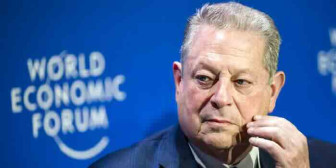
Rosling, author of the book ‘Factfulness’, was on a program with Al Gore. His book suggested the world was much better off than most folks realized, but Al Gore suggested that he should add some fear to his presentation. Rosling reacted to this as being against his principles. Not so with Gore who thrives on bad news and fear mongering.
Al Gore played very loose with the real facts in his award-winning documentary, an Inconvenient Truth. Christopher Moncton itemized 35 inconvenient truths in the documentary. (3)
As a result of a lawsuit in England, teachers have to make clear that the film is a political work and promotes only one side of the argument.
One could go ad nauseum about Gore but clearly his comment to Rosling covers his pronouncements.
Example 3-Ed Calabrese- University of Massachusetts
A very egregious example of misinformation is cancer risk assessment. This is a critical feature of environmental health and regulatory policy used by governments to determine the environmental risks of chemicals and radiation. It answers the question as to what the risk is, at the population level, of developing cancer at different exposure levels. Fraudulent cancer risk assessment science has been behind the linear non-threshold (LNT) dose response model adapted by practically all US agencies for chemical and radiation assessment.
- The LNT model assumes that every increment of a chemical or radiation dose, no matter how small, constitutes an increased cancer risk for humans.
- The contrasting threshold dose response model assumes an exposure level below which there is no increased cancer risk.
Professor Edward Calabrese of the University of Massachusetts, Amherst. Has spent the last 20 years researching the historical foundations of cancer risk assessment, showing the fraudulent science behind the linear non-threshold (LNT) dose response model adapted by practically all US agencies for chemical and radiation assessment.
He recently presented a comprehensive summary of the development of the linear non-threshold model of cancer risk assessment contained in about 100 papers in peer reviewed industrial hygiene, toxicology, health physics and radiation scientific literature. Included are examples of scientific misrepresentations and misconduct that were offered to support the conclusions and perspectives offered. (4)
In spite of the science, governments continue to use the LNT model. Misuse of this model has produced spending in excess of $1 trillion in the United States alone for negligible health benefits just for governmental environmental cleanup programs, while truly significant measures that would protect public health remain unfunded. It’s long overdue that serious reconsideration be given to the LNT model.
What if the public’s fears about common exposure to radiation were not only baseless, but the product of epic science fraud? And what if the people we have trusted with setting radiation safety standards have knowingly suppressed that reality for decades, including up to the present day?
JunkScience.com recently presented for the first time, emails uncovered via the Freedom of Information Act that expose the inner workings of a little-known bureaucracy dedicated to keeping in place the LNT model used by regulatory agencies to set permitted exposure standards for radiation. (5)
So, if you have been concerned of anything associated with radiation, from medical diagnostics to TSA screening to radon in your basement to nuclear power plants, you have been an unwitting victim of the LNT. which has been responsible for producing crippling fear of low-level radiation.
References
- Roger Pielke, Jr., “Why climate misinformation persists,”, rogerpielkejr.substack.com, July 25, 2024
- Hans Rosling et al., Factfulness, (New York, Flatiron Books, 2018)
- Christopher Moncton, “35 inconvenient truths: the errors in Al Gore’s movie,” scienceandpublicpolicy.com, October 19, 2007
- Edward J. Calabrese, “Cancer risk assessment: it’s wretched history and what it means for public health,” Journal of Occupational and Environmental Hygiene, March 7, 2024
- Steve Milloy, “Emails reveal: bureaucrats censor radiation risk science fraud by cancelling whistleblowers: huge implications for nuclear power and more,” junkscience.com, April 30, 2024
Exposed: EPA Radiation and Chemical Risk Assessment Fraud
View Comments
John William Dini, know to all as ‘Jack’, passed away at the age of 89 on June 17, 2026. He was born in Cleveland, Ohio on Nov. 14, 1936.
He published two books, a technical book on materials science and coatings and another on environmental issues. In retirement, he wrote extensively on various environmental issues for online publications.
He was a skilled leaded glass hobbyist, creating more than 20 lamps and many panels. He was a jogger for many years, competing in over 300 long distance races. He was a slow runner, not wanting to take the glory away from others. His secret was to start slow and taper. He and Anne traveled extensively, visiting over 70 countries.
He is survived by his wife, Anne, of 67 years, and sons Mike, Steve, and Paul. If you were to meet him somewhere, he would sum up his life as ‘peaches and cream’.