Close Calls
I loved fighting fires in those busy days & nights of my technicolor youth. I seemed to be tireless then, but not so much any more, deep in my dotage. Betsy is happy that I’m no longer awakened by the tones. I guess in a guarded retrospect, so am i;

John Burtis , Bio and Archives--August 20, 2026
Lifestyles | Comments | Reader Friendly | Subscribe | Email Us
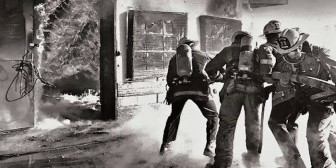
I began as a firefighter in Port Crane, NY, in August of 1967, just a month before my senior high school year began. Port Crane received its name, just as Port Dickinson did, by being stops on the long defunct Chenango Canal which once connected Binghamton to Utica, NY, in those 19th century days before the advent of the railroad, the proverbial Iron Horse.
The use of the canal was a leisurely transportation method with its locks, flooding gates, its lengthy times of deliveries depending on the speed of the mules pulling the barges from the banks and the languid filling or emptying of the locks. Railroads moved at considerable greater speed with far greater payloads and soon their economies of scale ended the canal system.
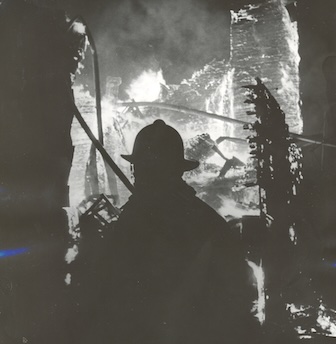
Should you care to, there is a great book on this man made water conveyance which ran adjacent to the Chenango River. It is called 'Limestone Locks and Overgrowth: The Rise and Descent of the Chenango Canal' by Michael A. McFee, which is available on Amazon (Limestone Locks and Overgrowth: The Rise and Descent of the Chenango Canal).
There used to be visible canal remains adjacent to the Chenango River in the deep expanse of the Chenango Valley State Park which lies near the new Port Crane Fire Station 37 on NY Rte 369. I served on the cusp of “the old days” and the modern firefighting era. The former featured low band single or two channel radio dispatching with often repeater systems boosting the base station signal from hilltops but were were dispatched by tones broadcast over the fire channel.
Our turn out gear was treated canvas for the most part with the gradual integration of reflective striping and company names sewn on the back of our coats. Our traditionally styled fire helmets had moved from aluminum, to fiberglass and then to lightweight dielectric phenolic plastic. Gloves were often regular “work” gloves, the pig skin gloves would come later. Our pumpers and truck companies (ladder companies) had moved from open to closed cabs and firefighters still “rode on the back step.”
Today, we have computer aided dispatching, remote receiver voting systems, multiple transmit sites with computer controlled timing, and trunked radio systems with hierarchical talk groups. The Incident Command System (ICS) now mandates command and control, common terms, hierarchy and its span of control. I had gotten my old man to order Fire Engineering, a periodical, with a long history, centered on the harnessing of the changing firefighting technology and most effective fire ground evolutions, when I was 12 years old. I devoured every issue. It was a common staple at fire stations. (Fire Engineering )
It has gone through many iterations including news letters and today it even offers articles on the, gasp, say it ain’t so, mental health of firefighters, a topic never broached once during my firefighting years. Post-traumatic Stress Syndrome (PTSD) would have been seen as weird science back then. Fighting fires is a dangerous business and every firefighter has endless stories of "close calls,” the common description of capers in the firefighting parlance, and of the injuries thus sustained. I was extremely lucky though I took a few hits and narrowly missed serious injuries.
I'll offer a few close calls in no particular order as my memory no longer operates chronologically following the severe head injuries I suffered later when serving as a cop in Los Angeles. We had a barn fire, a not uncommon occurrence in rural firefighting, particularly in the environs of Broome County, and I was checking for fire extension in the loft when I noticed that the hay covered floor was becoming “bouncy,” as I clomped along.
Suddenly, without warning, I dropped through the floor, an unnerving business of sudden weightlessness, followed shortly by gravity winning as I crashed through a pile of glass paned storm windows piled chest high. After extricating myself from the pile I found I was unhurt and it had failed to even cut my gear. Whew, I wiped my steaming brow and shook my head. The Motorola 100® tones which were sent out in two distinct and separate wavering notes, made famous in the Emergency TV show, were broadcast for a house fire. I knew the address and I knew that an acquaintance had built the house. I pulled the first line to the front door, waved my right arm letting the chauffeur know he could send water to me.
As I stood there waiting, I heard the crash and the tinkle of breaking glass above me. Suddenly, a long thin shard of plate glass fell between my thumb and forefinger on my gloved right hand and then smashed to pieces on the step. Although it merely left a miniscule cut in the leather on my right glove, it could’ve taken off my thumb, finger or a good part of my hand had I moved a bit. Whoa! Radio sent us to a huge farmhouse way out in the country to a town called Tunnel due to its lying on the other side of a huge concrete railroad overpass.
I was sent inside with another firefighter. We took a line to the third floor and entered a bedroom where the fire was burning down through the attic. We opened the line and blasted the water into the fire. Within a few minutes, after suddenly hearing my little faint internal voice of doubt, I turned to the other jake and said we’ve gotta get out. As we pulled the hose into the hallway the whole blazing ceiling fell into that bedroom landing across the bed--exactly where we had been standing moments before.
At another fire, Chief E.S. Youngs hollered to Don Shelley and me to take down the ladder we were standing on while Don directed the water from our attack line through a second storey window and I stood below him clutching the hose. We shut off the water, climbed down and when we raised the ladder to drop it the entire façade of the burning house fell back into the flames sending a fireworks display of sparks up into the frigid air in a mushroom cloud of angry dark smoke. We had been holding up the front of the house with our weight on that wooden ladder.
“We followed the hose, ya dope”
I was pleased as punch that the chief noticed this growing danger. An 18 wheel semi-truck trailer was on fire on the highway facing westbound. We pulled up facing eastbound and I began pulling the attack line across the wide grassy divider which featured a low ground fog that evening. Suddenly, the pump operator later told me, I just simply disappeared. Concentrating on the burning rig and where I was going to position myself, I had walked into a large open catch basin with no grate and I fell, still holding the line, some six or seven feet into a concrete cube.
I could look up and see the narrow pencil beams from the flashing red lights beating the fog. In a few moments two or three other firefighters were looking into the hole and yanking me out. I asked how they had found me. “We followed the hose, ya dope,” they replied in seeming unison, “now let’s put the fire out!” Wow, I felt like an imbecile. I later became the starring actor headlining in another firefighting fable.
With the flames blowing around over my head
I had pulled a line deep into a working house fire. Suddenly my right knee poked through the floor, trapping me in place from thigh to ankle. With the flames blowing around over my head while I was trying to see through my steamed over face mask attached to my MSA® air pac, I began to feel a bit more nervous with every passing second. I began deftly waving my right arm around in the increasingly hot inky black darkness trying to find something to grab to pull myself up and out. Suddenly I felt a wire. As I slowly pulled it taut - kablam! Flash! I had grabbed a “hot” electrical line. The jolt bounced me up and out and I quickly bailed out.
When I got outside I pulled my mask off and saw the captain lying on the ground by the pole which held the electric meter. He had stepped into a pool of water when he went to remove the meter, a common practice which immediately cuts the power. However, he, too, had received a severe shock from a live wire hidden in the turbid water.
We all felt glad when we put that joint in the rearview mirror. I used to ride with the local forest ranger assigned to our county. I’d pack a lunch and meet him in his red Dodge Power Wagon Unit 68 at Fire Station 37. Charlie was a great guy. We later received tones directing us to a brush fire way out in the boondocks of the county.
We had no problems entering the brush on foot with the heavy water filled metal Indian Tanks® on our backs, which I pumped with the hand sprayer. We doused the flames, took a blow, and then walked out in the growing twilight. As the group of us walked around the trees I suddenly had a thorn from an invisible thorn tree poke me in the center of my right cornea. The pain was so intense that I began to drool. After the ER that night I visited an ophthalmologist the next day. The decorated Vietnam doc simply touched my eye with a small piece of paper and the pain instantly disappeared. What the hell was that, I asked? “Cocaine,” he said smiling. It took years to get over that particular “vegetable matter” injury and I had to apply a salt based ointment every time it began to water so the new cells wouldn’t slough off.
Tom pulled me back to the land of the living with the hook on his pike pole
We responded to a fire in a big triple decker on a main street in Port Dickinson. I had first been sent inside and then, after a blow, to the slate roof where the snow and ice made footing precarious. I joined two pals, Tom Vroman who designed the current county wide radio system with Motorola® and would later become the county fire coordinator, and Pat Grace who I had shown how to operate the pump on Engine 35-1 at Fire Station 35 in Port Dickinson before he later became the Escambia County fire chief in Florida.
We had axes and pike poles and we were ventilating, er, chopping holes through the slate to vent the hot gases and super heated smoke stalling the interior attack. Suddenly I slipped and fell on my ass and started to slide slowly on the ice toward the edge of the roof. You try everything you can think of to stop. Finally after dragging my axe down the unforgiving slate I called to Tom asking for his pike pole to grab and none too soon.
My ankles were hanging over the edge and I was looking at a 40 foot drop to the frozen ground, even with the exposed basement on that side of the house. Tom pulled me back to the land of the living with the hook on his pike pole as I had been, for just a few agonizing moments, like Schrödinger’s cat, both alive and dead at the same time until I grabbed that metal tip.
I loved fighting fires in those busy days and nights of my technicolor youth. I seemed to be tireless then, but not so much any more, deep in my dotage. Betsy is happy that I’m no longer awakened by the tones. And, I guess in a guarded retrospect, so am I.
John Burtis is a third generation Broome County, NY, firefighter and often responded from Fire Stations 37, 35 and 55. John is happily married to Betsy and resides in Derry, NH. He majored in German history, German language and culture at Boston University and he can be reached at letters@canadafreepress.com.
View Comments
John Burtis is a former Broome County, NY firefighter, a retired Santa Monica, CA, police officer. He obtained his BA in European History at Boston University and is fluent in German. He resides in NH with his wife, Betsy.