Cold Deaths Far Outnumber Heat Deaths
As hydrocarbon use pulls billions out of grinding poverty, so fortunate humans can use the extra wealth to protect themselves against all the nature throws at life on Earth.;

Jack Dini , Bio and Archives--May 1, 2026
Global Warming-Energy-Environment | Comments | Reader Friendly | Subscribe | Email Us
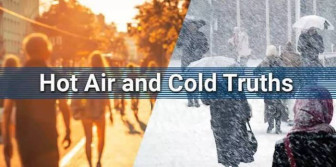
Headlines from around the world tell us of hundreds of deaths caused by heat waves. The stories invariably blame climate change and admonish us to tackle it urgently. But they mostly reveal how one-sided climate alarms reporting leaves us badly informed.
There’s a reason we’ve heard so much about extreme heat deaths over last summer. United Nations Secretary-General Antonio Guterres made a call to action on extreme heat that prompted mandarins across his vast organization to issue warning without letting the facts get in the way of a good story. Guterres added to his alarmism by pointing out that heat deaths of old people globally increased 85% over the past decades, but didn’t reveal that almost all of this increase was because the world now has 79 percent more old people, reports Bjorn Lomborg. (1)
There are many papers reporting that cold weather is much worse than heat. (2-6). Let’s look at some recent studies:
A global analysis showed that 9.4% of all deaths can be attributed to both cold and hot non-optimal temperatures, corresponding to about 5 million deaths. In most epidemiological studies, excess cold deaths far outnumber heat deaths. In that same global analysis, of the 9.4% attributable temperature-related deaths, 8.5% were cold-related and only 0.9% were heat-related, which corresponds to approximately 4.6 million deaths from cold and 489,000 from heat, a ratio of roughly 9 to 1. This pattern is also consistent in regional studies. (7)
Another paper, covering the period from 2000 to 2020, analyzes data from over 1,500 counties and more than 33 million deaths. The most striking result is that cold weather remains by far the dominant temperature-related killer in the United States. The authors estimate that, on average, about 72,361 deaths per year are attributable to cold temperatures, compared to only about 6,129 deaths per year from heat. (8)
In other words, cold-related mortality is roughly twelve times higher than heat-related mortality.
This alone challenges the common perception that warming temperatures will necessarily lead to a surge in deaths. If anything, the data suggest that cold remains the far more significant public health risk.
Even more surprising is the study’s observation that cold-related deaths have been increasing over time. Cold-related mortality has risen by approximately 9% per year since 2000 in the United States. This trend is counter to the expectation that a warming climate would reduce cold-related risks. (9)
So, take your pick, one paper says 9 to 1 while the other says 12 to 1, and two of the earlier papers reported a 20 to 1 (6) ratio and 30 to 1 ratio (1). These variations are probably due to the regions sampled. Regardless, clearly there are a multitude of cold deaths to heat deaths.
Another interesting fact: The risks of extreme weather are the number one weapon used by activists, yet the first half of 2025 of 2025 saw the smallest number of deaths related to extreme weather since records began, while the media would have you believe millions are fleeing from climate disasters. (10)
It is a long-term trend that has seen weather fatalities plunge by over 99 percent during the last 100 years. As hydrocarbon use pulls billions out of grinding poverty, so fortunate humans can use the extra wealth to protect themselves against all the nature throws at life on Earth.
In contrast to apocalyptic sermons, at no point in human history have humans had less risk of death related to extreme weather and climate,” concludes Roger Pielke Jr. (10)
References
- Bjorn Lomborg, “UN chief overstates extreme heat deaths, cold kills 30X more,” principia-scientific.com, December 2, 2024
- Antonio Gasparrini et al., Mortality risk attributable to high and low ambient temperature: a multi-country observational study,” The Lancet, May 2015
- Sarah Bosely, “Moderately cold temps more deadly than heat waves,” climatecentral.org, May 24, 2015
- David Strom, ”More cold deaths than heat deaths everywhere,” climatedepot.com, The Lancet, December 30, 2022
- Joshua P. Cohen, “Excessive heat can kill, but extreme cold still causes many more fatalities,” forbes.com, July 19, 2023
- Antonio Gasparrini et al., Mortality risk attributable to high and low ambient temperature: a multi-country observational study,” The Lancet, May 2015
- Barrak Alahmad et al., “Are there more cold deaths than heat deaths?”, The Lancet, Issue 3, March 2025
- Pedro Salerno et al., “Social vulnerability and mortality attributable to non-optimal temperature in the United States: a county-level ecological analysis” Current Problems in Cardiology, Volume 51, Issue 4, April 2026
- Anthony Watts, “In a warming world, rising cold deaths outnumber heat deaths 12 to 1,” clintel.org, April 2, 2026
- Chris Morrison, “Lowest six-month weather-related deaths since records began,” principia-scientific.com, August 5, 2025
View Comments
John William Dini, know to all as ‘Jack’, passed away at the age of 89 on June 17, 2026. He was born in Cleveland, Ohio on Nov. 14, 1936.
He published two books, a technical book on materials science and coatings and another on environmental issues. In retirement, he wrote extensively on various environmental issues for online publications.
He was a skilled leaded glass hobbyist, creating more than 20 lamps and many panels. He was a jogger for many years, competing in over 300 long distance races. He was a slow runner, not wanting to take the glory away from others. His secret was to start slow and taper. He and Anne traveled extensively, visiting over 70 countries.
He is survived by his wife, Anne, of 67 years, and sons Mike, Steve, and Paul. If you were to meet him somewhere, he would sum up his life as ‘peaches and cream’.