Dismantling the Deep State
President Trump and Elon Musk and the rest of us cannot stop until the last vestiges of the bureaucracy are rubble and the ground sown with salt to prevent its regrowth

David Robb , Bio and Archives--March 5, 2025
American Politics, News | Comments | Reader Friendly | Subscribe | Email Us
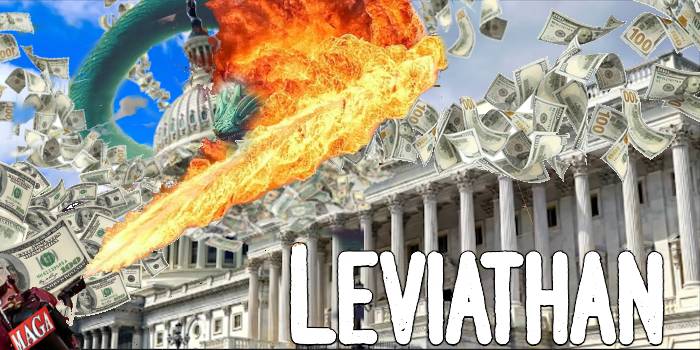
Keep in mind that none of the Deep State agencies, no part of the apparatus that is the administrative state is mandated in the Constitution. When the Left talks about how President Donald Trump is shredding the Constitution by eliminating agencies that are part of the Executive branch, he is actually working to restore Constitutional values to government.
The bureaucracy is actually the enemy of the Constitution
Read the Constitution. Nowhere does it mention the FBI, or DHS, or DOT, or IRS or any of the huge number of government agencies that make up the Deep Administrative State. Even the functions behind those names aren't mentioned. That alone should show that, far from being the implementation of the Constitution, the bureaucracy is actually the enemy of the Constitution.
What you will find are the principles of a small, efficient, limited government designed to prevent the growth of entrenched power that is the true enemy of the people.
Let's take a look as some of what the Constitution actually requires of our government:
At the very beginning, Article I, Section 1 states that only Congress can make laws. Not regulatory agencies, not judges—not even the President—only the Senate and House of Representatives. Even if they delegate authority, they are still responsible.
Article I, Section 8 lays out the powers and duties of Congress. Nowhere does it say anything about health, agriculture, criminal investigations, energy, homeland security, or many other things that have grown up in the swamps of DC.
Article II, Section 3 states that the President shall ensure that the laws of the country are faithfully executed. You know, like the laws that say a person must have proper permission to enter and stay in the country.
Article III, Section 1 establishes the Supreme Court and allows congress to set up lower courts whose justices shall serve so long as they follow good behavior. Unfortunately, what constitutes good behavior is not spelled out, but we could probably find general agreement that some of our courts today exhibit anything but good behavior.
The Bill of Rights are among the most despised provisions of our Constitution, at least by Deep State minions
An interesting set of provisions are found in Article IV, Section 1 which says that any laws, records and court findings of one state shall be accepted in every other state, and Section 2, which says that the rights and privileges of a citizen of any state shall be available to citizens of every other state.
That is why a drivers license from one state is honored in every other state, and why marriages and divorces are recognized everywhere. Why, though, are such things as concealed carry also not recognized, even though an Amendment to the Constitution specifically acknowledges the right of citizens to keep and bear arms? In his job of ensuring laws are upheld, could President Trump simply issue an executive order that, consistent with our Constitution, every state must recognize the right of citizens to carry concealed arms regardless of where issued?
Ten amendments were added to the original draft of the Constitution when it was ratified. Many felt that these were unnecessary and were so obvious that no one would need to have them spelled out. Others felt that unless they were specifically included, then some future "authority" would decide that the Founders had left the door open by design, and they could pass some law forbidding or limiting the specific rights.
Imagine that some future legislature might consider that certain words or statements might be construed as hateful and that freedom of speech did not protect them. They could then pass "hate speech" laws that would remove entire classes of speech from protected status. Oops.
The ones who wanted these rights spelled out were smart fellows, and understood well how future generations might look for "loopholes" in the Constitution that they could exploit to increase their power and authority. These ten amendments, known as The Bill of Rights are among the most despised provisions of our Constitution, at least by Deep State minions.
The Deep State has had to work hard for decades to overcome this barrier to their consolidation of power
It has taken over two hundred years of effort for authoritarians in government to undermine and abridge those rights. Even the third Amendment, if the term "soldier" could be interpreted as "agent of the government" and "quartering" as establishing a presence", would be subverted by spy devices, wiretaps, and other intrusions on a citizen's home.
A particularly important Amendment, the Tenth, is often studiously ignored by those opposed to a constitutionally constrained government, in hopes that it will simply go away. That Amendment says that there are only a few specific powers granted by the Constitution to the central government, and that all other powers are relegated to the States. The Deep State has had to work hard for decades to overcome this barrier to their consolidation of power.
Since its ratification, there have been only seventeen more amendments added in almost 250 years. One of those amendments required another amendment to repeal what proved to be a monumentally bad idea.
Numerous laws have been passed, and countless judicial proceedings conducted in the years following ratification. Books have been written describing how this law or that case have modified, limited, expanded, or reinterpreted some provision of the Constitution, usually to suit some particular special desire. Its language has been attacked by critics to suggest that a modern reader cannot understand the actual meaning of something written so long ago.
The idea of a "living" constitution is not freedom or flexibility--It is the condition of slaves
Terms such as "natural born" and "freedom of speech", and "right" and many others have been challenged and debated and had meanings imputed to them that are far different from what was previously clearly understood, and which are usually what is commonly understood today.
Still, our Constitution has weathered these storms, standing as a rock on which a Nation can be built. The Deep State hates it!
The idea of a Constitution is that it provides a set of fundamental ground rules on which all others are built. It provides a stable foundation that citizens can count on to build their lives and livelihoods, knowing that they will change only slowly, if at all, during their lifetimes and even the lifetimes of their children and children's children so long as the Nation endures.
The idea of a "living" constitution that changes with the tides of fashion is an idea dearly loved by supporters of the administrative state. A living constitution offers no stability, no certainty, no protection at all. What was legal one day might be illegal the next. Citizens would live insecure in whatever an administrator might declare. Their lives would be subject to the whims of whomever had power at any time. That condition is not freedom or flexibility. It is the condition of slaves.
The Deep State, the administrative state must be thoroughly dismantled
There are some who will object that I am not a constitutional lawyer or scholar and therefore don't know what I'm writing about. To them I would respond that if a citizen needs the services of an attorney to understand the laws they are responsible for following, there is something seriously wrong.
This is why the Deep State, the administrative state must be thoroughly dismantled. We cannot afford cosmetic "surgical" changes that simply remove some of the administrators while leaving the structure largely intact. After sufficient time, the vacancies will be refilled, the structures repaired, and the new administration, aware of their prior vulnerabilities will emerge even stronger and more powerful.
This is why President Trump and Elon Musk and the rest of us cannot stop until the last vestiges of the bureaucracy are rubble and the ground sown with salt to prevent its regrowth. Government may need assistance from time to time, but let that be provided by the States, or by private services engaged as needed, and terminated when their services are done. A permanent bureaucracy is incompatible with liberty, no matter how benign it might seem in its infancy.
Mark Twain said: “No man's life, liberty, or property are safe while the legislature is in session”. I would modify that to include "... and while an administrative state exists."
View Comments
David Robb is a practicing scientist and CTO of a small firm developing new security technologies for detection of drugs and other contraband. Dave has published extensively in TheBlueStateConservative, and occasionally in American Thinker.