DOGE, Spending and Reality
Cutting spending seems to be the easy way to demonstrate progress, but will DOGE actually do the hard work?
Dr. Sam Clovis , Bio and Archives--January 3, 2025
American Politics, News | Comments | Reader Friendly | Subscribe | Email Us
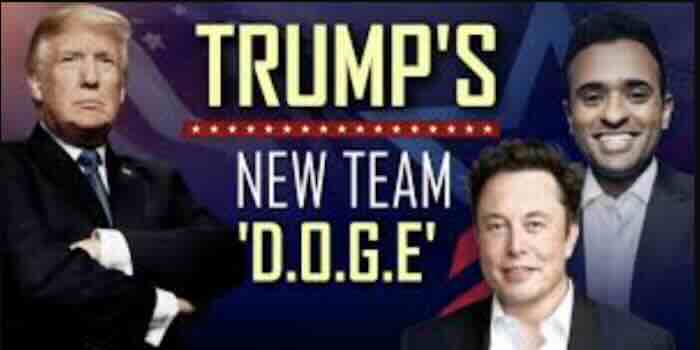
The president-elect has cobbled together a group of outsiders to help government gain efficiency. I support that on the surface this looks like a good idea, but I worry that what we will see will be a lot of flash but not a lot of heat. It will be smoke left after all is said and done, and the American people will be no better off. I hope I am wrong.
My experiences in government are not positive in this area of examination
The late, great Rush Limbaugh (Oh, how we miss him!) used to say that words have meaning. He was absolutely right, and as a former college professor who spent most of my academic career teaching economics, business and public administration courses, certain words have specific meanings that are inviolate.
I’ll not deal with the word effectiveness quite yet, but I will discuss the words productivity and efficiency. To increase productivity, one is looking to increase output given the same set quantity of resources available for production. To increase efficiency, one is expected to maintain current levels of production with fewer resources. I think it’s important for Americans to understand what the Department of Government Efficiency (DOGE) is looking to do. Hopefully, the new president and his billionaire buddies will hold to the generally accepted definition.
The quandary for those associated with DOGE is understanding what exactly the output—”productivity”—of the government really is. I was struck recently by a published mission statement for an organization. What piqued my interest was whether or not this organization had any idea if it was achieving its mission.
My experiences in government are not positive in this area of examination.
Leaving the same structures in place will eventually lead to re-expansion of mission space
Most federal departments and agencies have no way of measuring their mission achievements because their missions are ill-defined, have expanded far beyond legislative bounds or are so ambiguous as to leave one incapable of measuring mission success. If Musk, et al, are unable to determine what government output should be, how in the world are they going to be able to recommend what changes need to be made?
Cutting spending seems to be the easy way to demonstrate progress, but will DOGE actually do the hard work of finding those inefficiencies and then correct them through legislative and cultural changes? Leaving the same structures in place will eventually lead to re-expansion of mission space, more spending and any attempts at efficiency will be lost along the way.
Worse, the American people will be poorer for it.
I have little confidence DOGE will do anything but put up a smoke screen and offer the president and congress a way to cut spending without accountability for the consequences of those spending cuts. Do I think the spending needs to be curtailed? You bet. However, I want real spending cuts that have real impact on the organizations that are left in the wake of DOGE plowing through.
View Comments
Samuel H. Clovis, Jr., Doctor of Public Administration
Liston to Sam on LATalkRadio, Sundays: 1:00 to 3:00 PM (PST)
(Impact With Sam Clovis)
Sam Clovis was raised in Kansas and attended the United States Air Force Academy, serving for 25 years on active duty as a fighter pilot. He retired as a Colonel and the Inspector General of NORAD and the United States Space Command.
Sam served as a Fellow at the Homeland Security Institute, contributing in national preparedness and immigration policy. He recently served as a tenured full professor of economics at Morningside College.
Sam has a BS from the Academy, an MBA from Golden Gate University and a doctorate from the University of Alabama. He served as national co-chair and chief policy advisor for the Trump for President Campaign, was a policy director during the transition period and served as the Senior White House Advisor to the US Department of Agriculture. He currently lives in rural Iowa.