EPA hits the heartland
EPW Policy Beat
EPW Blog , Bio and Archives--October 18, 2010
Global Warming-Energy-Environment | Comments | Reader Friendly | Subscribe | Email Us
Link to Inhofe EPW Press Blog
Link to Credit Suisse Report
We call your attention to a recent analyst report by Credit Suisse, titled "Growth from Subtraction: Impact of EPA Rules on Power Markets." The bottom line: EPA's Clean Air Transport rule and utility MACT will help shutter at least 60 GW of coal-fired electricity (out of a total 340 GW) between 2013 and 2017.
Remarkably, this is Credit Suisse's expected outcome not counting the additional multitude of EPA rules set to hit coal-fired generation over the next five years, including tighter standards for coal ash and cooling water intake structures, new source performance standards, and more stringent national ambient air quality standards. Activist groups care little for the 60 GW identified by Credit Suisse, dismissing the plants as, among other things, unimportant for reliability purposes. But according to the report, that's wrong. "The conventional wisdom that small plants don't run is not broadly accurate," Credit Suisse notes. "Remarkably...[these plants] are significant contributors to our electricity needs: on average they are dispatched at 48%, only 15% lower than US average (63%)." In future posts, we will examine how EPA's rules could affect reliability, as well as threaten jobs by pushing plants to shut down. For now, we want to highlight where, according to Credit Suisse, EPA's policies would have the most impact. Credit Suisse finds that MISO, the independent transmission operator for the Midwest, "has the biggest exposure to EPA policy." States such as Pennsylvania and Virginia (PJM) also will be hit, as will large parts of the South (SERC), Southwest (SPP), and Great Plains (parts of which are in MISO). Below, we provide maps (as supplied by the Federal Energy Regulatory Commission) illustrating the regions where EPA's regulatory onslaught will hurt most.
MISO
States covered: All or most of North Dakota, South Dakota, Nebraska, Minnesota, Iowa, Wisconsin, Illinois, Indiana, Michigan and parts of Montana, Missouri, Kentucky, and Ohio.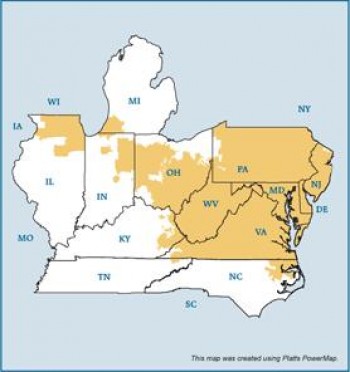
PJM
States covered: All or most of Delaware, District of Columbia, Maryland, New Jersey, Ohio, Pennsylvania, Virginia, and West Virginia. Parts of Indiana, Illinois, Kentucky, Michigan, North Carolina, and Tennessee.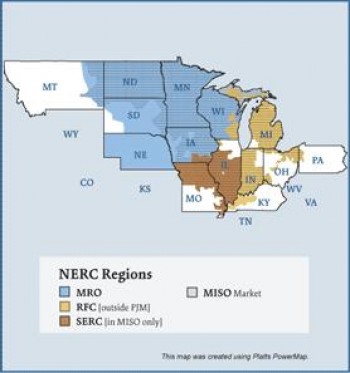
SERC
States covered: Arkansas, Louisiana, Mississippi, Alabama, Georgia, Tennessee, North Carolina, South Carolina and parts of Missouri, Kentucky, and Texas.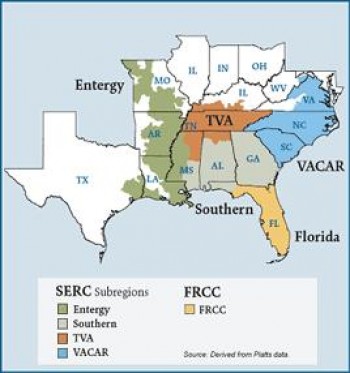
SPP
States covered: Kansas, Oklahoma, most of Nebraska, and parts of New Mexico, Texas, Louisiana, Missouri, Mississippi, and Arkansas.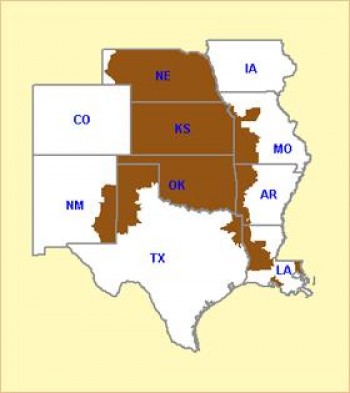
View Comments
EPW Blog——Bio and Archives
Inhofe EPW Press Blog