EPA’s Absurd Justifications for Its Power Plant Regulations
Carbon dioxide, climate change, co-benefits, Coal, EPA, Gina McCarthy, power plant regulations

Institute for Energy Research , Bio and Archives--June 16, 2014
Global Warming-Energy-Environment | Comments | Reader Friendly | Subscribe | Email Us
Earlier this month, the Obama Administration released its 645-page proposal that mandates existing U.S. power plants reduce their greenhouse gas emissions at least 30 percent below 2005 levels by the year 2030. Before the exact proposal was announced, the US Chamber of Commerce had commissioned a study of hypothetical regulations (based on the likely nature of the new proposal), and found the costs to be quite high, with the hypothetical regulations to fail even the Administration’s own cost/benefit criterion for carbon policies.
Now that the EPA’s (massive) proposal is available for public scrutiny, outside groups can begin their analyses of its likely economic impacts. In the meantime, we can go through the EPA’s own cost/benefit assessment to see just how dubious it is. In particular, the speech given by EPA Administrator Gina McCarthy is filled with demonstrably false statements seeking to justify this enormous federal intervention into energy markets.
The EPA’s Formal Regulatory Impact Analysis
The people at the EPA know they have to go through the motions of making their power plant proposal appear to pass a cost/benefit test, and—lo and behold—they do indeed mange to put up numbers seeming to indicate success. But let’s walk through one of their tables to see just how contrived the argument is.The following table comes from the EPA’s “Regulatory Impact Analysis” of the proposed power plant rules, showing the estimated costs and benefits for one version of the rules in the year 2030:
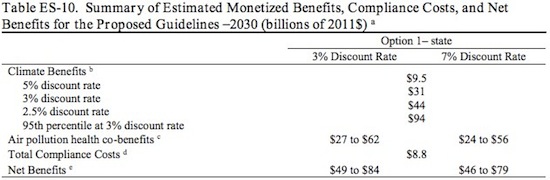 SOURCE: Page ES-23 of EPA “Regulatory Impact Analysis…for Power Plants.”
The table shows that EPA has broken the benefits from the proposed regulations into two main components: (1) “Climate Benefits,” referring to the reduction in future climate change damages because now US power plants won’t be emitting as many tons of greenhouse gases; and (2) “Air pollution health co-benefits,” referring to the reduction in human health problems (including premature mortality) stemming from the reduction in power plant contributions to the everyday-sense of the term “air pollution.” In other words, it doesn’t hurt anybody’s lungs when power plants emit carbon dioxide, so EPA is segregating climate-change damages (and hence benefits) into the first category, while reserving the second category of benefits for things like soot that actually might harm people when they breathe.
Because the benefits from both categories (i.e. reduction in climate change damage and also commonplace air pollution) are spread out over many years into the future, their present-discounted-value can only be expressed once we’ve picked a discount rate. The lower the discount rate, the greater weight we place on futureevents, which is why the reported benefits shown in the table go up.
In case the reader is puzzled, let’s review the odd construction of the table, where the numbers for climate benefits seem to exist in a column all their own, in between the column headers of “3%” and “7%” discount rates. The reason for this is that the Office of Management and Budget guidelines specify that federal cost/benefit analyses should be reported at both a 3% and 7% rate. However, the Obama Administration Working Group never bothered to report the “social cost of carbon” at a 7% rate—presumably because the number would be too low. Therefore, the table above reports the “social cost of carbon” values for the year 2030, from a 2.5% discount rate up through a 5% discount rate, forcing the reader to use an incorrect calculation if he or she wants to conduct a cost/benefit analysis at 7%.
This is a crucial issue. Look again at the table above: Going from a 3% to a 5% discount rate, the 2030 estimated climate benefits of the power plant rules drop from $31 billion to $9.5 billion. If instead we used a discount rate of 7%, the benefits would drop even further still. We can’t know by exactly how much, because the Administration won’t release the necessary numbers to make such a calculation, but they would probably be below the EPA’s own estimated compliance cost (in the year 2030) of $8.8 billion (also shown in the table, near the bottom) for the power plant rules.
Let me repeat that: Using the EPA’s own estimate of the compliance cost of its power plant rules,[1] the proposed regulations would probably fail a cost/benefit test, if we only looked at the climate change impacts and used one of the OMB’s required discount rates for federal regulatory analysis. The reason for this is that even on the Administration’s own terms, the majority of climate change benefits would occur many decades into the future, when most of the people who have paid the costs of this rule during this generation are dead.
Now we see why EPA is placing so much weight on the air pollution health “co-benefits.” EPA knows that its power plant rules are on very shaky ground, if EPA were to rely solely on climate change analysis. Indeed, look again at the table, to see how much bigger the “co-benefits” are, relative to the climate benefits. At a 3% discount rate, the climate benefits are reported at $31 billion, while the “co-benefits” range from $27 billion to $62 billion, meaning that co-benefits account for about one-half to two-thirds of the total gross benefits.
Things are worse if we look at the EPA’s handling of the 7% discount rate. Even using the 5% figure for the climate benefits of $9.5 billion (which is actually too generous since the climate benefits would be lower at the correct 7% discount rate), in the 7% case EPA tells us that the co-benefits range from $24 billion to $56 billion. Putting the two numbers together means that in the 7% scenario, the co-benefits account for somewhere between 72% and 85% of the total gross benefits of the rule.
This should be quite disturbing to anyone who wants federal regulations to have some basis in economic logic: Far from being icing on the cake, the air pollution “co-benefits” are the main course. The Administration touts its new power plant rules as part of the valiant fight against climate change, but its own analysis shows that climate change considerations may account for as little as 15% of the gross benefits, using one of OMB’s required discount rates for such analyses. Any reasonable person should be suspicious that the EPA’s own numbers show such a small contribution coming from greenhouse gas reductions, when that’s supposedly what the crackdown on power plants is all about.
SOURCE: Page ES-23 of EPA “Regulatory Impact Analysis…for Power Plants.”
The table shows that EPA has broken the benefits from the proposed regulations into two main components: (1) “Climate Benefits,” referring to the reduction in future climate change damages because now US power plants won’t be emitting as many tons of greenhouse gases; and (2) “Air pollution health co-benefits,” referring to the reduction in human health problems (including premature mortality) stemming from the reduction in power plant contributions to the everyday-sense of the term “air pollution.” In other words, it doesn’t hurt anybody’s lungs when power plants emit carbon dioxide, so EPA is segregating climate-change damages (and hence benefits) into the first category, while reserving the second category of benefits for things like soot that actually might harm people when they breathe.
Because the benefits from both categories (i.e. reduction in climate change damage and also commonplace air pollution) are spread out over many years into the future, their present-discounted-value can only be expressed once we’ve picked a discount rate. The lower the discount rate, the greater weight we place on futureevents, which is why the reported benefits shown in the table go up.
In case the reader is puzzled, let’s review the odd construction of the table, where the numbers for climate benefits seem to exist in a column all their own, in between the column headers of “3%” and “7%” discount rates. The reason for this is that the Office of Management and Budget guidelines specify that federal cost/benefit analyses should be reported at both a 3% and 7% rate. However, the Obama Administration Working Group never bothered to report the “social cost of carbon” at a 7% rate—presumably because the number would be too low. Therefore, the table above reports the “social cost of carbon” values for the year 2030, from a 2.5% discount rate up through a 5% discount rate, forcing the reader to use an incorrect calculation if he or she wants to conduct a cost/benefit analysis at 7%.
This is a crucial issue. Look again at the table above: Going from a 3% to a 5% discount rate, the 2030 estimated climate benefits of the power plant rules drop from $31 billion to $9.5 billion. If instead we used a discount rate of 7%, the benefits would drop even further still. We can’t know by exactly how much, because the Administration won’t release the necessary numbers to make such a calculation, but they would probably be below the EPA’s own estimated compliance cost (in the year 2030) of $8.8 billion (also shown in the table, near the bottom) for the power plant rules.
Let me repeat that: Using the EPA’s own estimate of the compliance cost of its power plant rules,[1] the proposed regulations would probably fail a cost/benefit test, if we only looked at the climate change impacts and used one of the OMB’s required discount rates for federal regulatory analysis. The reason for this is that even on the Administration’s own terms, the majority of climate change benefits would occur many decades into the future, when most of the people who have paid the costs of this rule during this generation are dead.
Now we see why EPA is placing so much weight on the air pollution health “co-benefits.” EPA knows that its power plant rules are on very shaky ground, if EPA were to rely solely on climate change analysis. Indeed, look again at the table, to see how much bigger the “co-benefits” are, relative to the climate benefits. At a 3% discount rate, the climate benefits are reported at $31 billion, while the “co-benefits” range from $27 billion to $62 billion, meaning that co-benefits account for about one-half to two-thirds of the total gross benefits.
Things are worse if we look at the EPA’s handling of the 7% discount rate. Even using the 5% figure for the climate benefits of $9.5 billion (which is actually too generous since the climate benefits would be lower at the correct 7% discount rate), in the 7% case EPA tells us that the co-benefits range from $24 billion to $56 billion. Putting the two numbers together means that in the 7% scenario, the co-benefits account for somewhere between 72% and 85% of the total gross benefits of the rule.
This should be quite disturbing to anyone who wants federal regulations to have some basis in economic logic: Far from being icing on the cake, the air pollution “co-benefits” are the main course. The Administration touts its new power plant rules as part of the valiant fight against climate change, but its own analysis shows that climate change considerations may account for as little as 15% of the gross benefits, using one of OMB’s required discount rates for such analyses. Any reasonable person should be suspicious that the EPA’s own numbers show such a small contribution coming from greenhouse gas reductions, when that’s supposedly what the crackdown on power plants is all about.
Air Pollution Health “Co-Benefits” Very Speculative
In addition to providing the lion’s share of the putative benefits of the power plant rules, the alleged “air pollution health co-benefits” are dubious because of their speculative nature. In particular, the claimed public health benefits from reduced emissions of “particulate matter” have little quantitative evidence. Back in 2011 Anne Smith of NERA Economic Consulting performed an analysis of an EPA Regulatory Impact Analysis regarding a different set of regulations on utility emissions, which also included benefits from reduced “particulate matter” emissions. On pages 6-7 of her analysis, Dr. Smith explains just how tentative these numbers are:[R]eaders unfamiliar with the literature on PM2.5 health risks should be aware that the estimates of PM2.5-attributed deaths (such as the 6,800 to 17,000 that EPA is attributing to the Proposed Rule [in 2011 on utilities—RPM]) are based entirely on statistical associations between total mortality rates in various locations of the US and their respective monitored, region-wide ambient PM2.5concentrations….EPA’s estimate of 6,800 to 17,000 PM2.5-related premature deaths avoided in 2016 as a result of the [2011] Proposed Rule [on utilities—RPM] is based on an assumption that 130,000 to 320,000 deaths, respectively, of 2005’s US deaths were hastened by breathing ambient PM2.5….And yet, EPA identifies not a single death during 2005 that was attributed, even in part, to exposure to ambient PM2.5. If PM2.5 is indeed having this estimated effect on the public health, there is no evidence indicating when or where these events occurred, or who was affected. Rather, these mortality estimates are merely inferences drawn after making a host of assumptions about how to convert a statistical association into a concentration-response function. No one really even knows what types of deaths might be implicated. A common belief among researchers is that the deaths are primarily cardiovascular in nature, but this is far from an established fact: everything from cardiovascular causes to diabetes to lung cancer has been mentioned as having such an association in one paper or another. There is no clinical evidence to inform these inferences either, despite at least 15 years of efforts by researchers to find a clear physiological mechanism to explain and lend credibility to these estimates based solely on statistical correlations.Thus we see that the deeper one delves into the EPA’s justifications for its various rules on electricity producers, the more it becomes obvious that they rest on quicksand.
Administrator McCarthy’s Outlandish Claims
If the EPA’s formal Regulatory Impact Analysis is dubious, at least it pretends to be scientific and fact-based. In contrast, in a speech touting the new power plant proposals, EPA Administrator Gina McCarthy threw out outlandish justifications for the regulations that we would expect from, say, Sheryl Crow or Barbra Streisand in an unguarded moment. Here we’ll walk through just two of the howlers. For example, McCarthy claimed, “For the sake of our families’ health and our kids’ future, we have a moral obligation to act on climate.” But this claim isn’t true, even if we accept every technical document on climate change issued by the Obama White House. According to their own computer models and parameter choices, government restrictions on greenhouse gas emissions will impose net economic costs on today’s Americans for the benefit of future generations of Earthlings. According to one of the Administration’s chosen computer models (that of Richard Tol), climate change actually confers net benefits on Earththrough about the year 2065. Furthermore, using the Obama Administration’s own 2010 report from its Working Group on the Social Cost of Carbon, the domestic benefits from climate policies are only 7 to 23 percent of the global benefits. What does this awkward fact do? It means that in the EPA table we reproduced above, the ostensible climate benefits from the power plant rules—which range from $9.5 billion up to $44 billion, depending on the discount rate—would be more like $1.4 billion up to $6.6 billion, if we focus just on Americans. And these figures includes Americans living up through the year 2300, which was the window of the Working Group’s analysis. Putting all of this together, the actual climate benefits to the next generation of American children—taking the EPA’s own (inflated) numbers at face value—is quite small, and nowhere near the EPA’s estimate of an $8.8 billion compliance cost in the year 2030 for the power plant rules. So no, even using her agency’s own numbers, McCarthy’s statement about “our kids’ future” is a demonstrably false emotional appeal. If she wanted to claim something congruent with her agency’s own published materials, McCarthy could have said, “My fellow Americans: These proposed rules on power plants would impose net harms on this generation of Americans, and would impose net harms on our kids, in order to confer net benefits on non-Americans. Also, according to computer simulations, it is possible that by hurting ourselves and our kids, these power plant regulations will confer net benefits on Americans who will be born a few decades from now, thereby allowing them to fly around in their hover cars in air that is imperceptibly cooler than it otherwise would be.” Yet this formulation doesn’t have quite the same ring as “the sake of our kids’ future,” does it? After framing the issue as one of saving our children, McCarthy went on to claim, “Climate inaction is costing us more money, in more places, more often. 2012 was the second most expensive year in U.S. history for natural disasters.” McCarthy’s implication here is utter nonsense, and we only need to consult the latest report from the United Nation’s IPCC to see why. As I showed in my critique of the National Climate Assessment, the “consensus science” is very modest about our ability to attribute current events to manmade climate change. Here are some excerpts from the IPCC’s latest report on the physical science of climate change:- “There is limited evidence of changes in extremes associated with other climate variables since the mid-20th century”
- “Current datasets indicate no significant observed trends in global tropical cyclone frequency over the past century … No robust trends in annual numbers of tropical storms, hurricanes and major hurricanes counts have been identified over the past 100 years in the North Atlantic basin”
- “In summary, there continues to be a lack of evidence and thus low confidence regarding the sign of trend in the magnitude and/or frequency of floods on a global scale”
- “In summary, there is low confidence in observed trends in small-scale severe weather phenomena such as hail and thunderstorms because of historical data inhomogeneities and inadequacies in monitoring systems”
- “In summary, the current assessment concludes that there is not enough evidence at present to suggest more than low confidence in a global-scale observed trend in drought or dryness (lack of rainfall) since the middle of the 20th century due to lack of direct observations, geographical inconsistencies in the trends, and dependencies of inferred trends on the index choice. Based on updated studies, [the previous IPCC Report] AR4 conclusions regarding global increasing trends in drought since the 1970s were probably overstated. However, it is likely that the frequency and intensity of drought has increased in the Mediterranean and West Africa and decreased in central North America and north-west Australia since 1950” [Bold added.]
Conclusion
Proponents of aggressive government intervention into energy markets have spent years of berating skeptics as “deniers,” and telling everyone that the “science is settled.” It is therefore ironic that the EPA’s Administrator and official cost/benefit analysis have to grasp at straws to justify their proposed rules on power plants. To see just how dubious these justifications are, we don’t need to draw on unorthodox data sources; we just need to read the published literature, including the Administration’s own Working Group reports and the IPCC’s latest report. If even the EPA has to bend over backwards to make these power plant rules “work” on paper, imagine the inefficiencies and harm to the economy that will result in the real world if they are actually implemented. [1] It’s worth pointing out that the EPA estimates of the compliance costs with its proposal are a mere fraction of the compliance costs estimated in the US Chamber study. However, the Chamber study assumed a policy with stricter emission targets, so the compliance numbers do not allow for an apples-to-apples comparison.View Comments
Institute for Energy Research——Bio and Archives
The Institute for Energy Research (IER) is a not-for-profit organization that conducts intensive research and analysis on the functions, operations, and government regulation of global energy markets. IER maintains that freely-functioning energy markets provide the most efficient and effective solutions to today’s global energy and environmental challenges and, as such, are critical to the well-being of individuals and society.