Essential Science Ground Water and Glaciation
I Wonder What the Poor Folks Are Having Tonight? We must have water to live. Although there are many ways to get water, there are none so satisfying as to tap the gift of the glaciers beneath our feet

Dr. Bruce Smith , Bio and Archives--May 8, 2022
HeartlandLifestyles | Comments | Reader Friendly | Subscribe | Email Us
 Britannica tells us the Pleistocene epoch, the great ice age, began about 2.5 million years ago and ended about 11,000 years ago. There were four glacial advances during the Pleistocene, illustrated in the chart below.
The last great glacial advance of the Pleistocene began about 75,000 years ago and ended (way up in the True North) about 9,000 years ago. That last glacial advance, the one that built the moraine where my family lived, we call the Wisconsin Glacial Stage or the Wisconsin Glaciation. That’s the one that shows the green moraine areas on last week’s map. It’s the one that is most recognizable on the landscape today. Go to southern Illinois or southern Iowa to see the remains of the Illinoian glaciation. Trust me, the Wisconsin deposits are way more interesting.
Britannica tells us the Pleistocene epoch, the great ice age, began about 2.5 million years ago and ended about 11,000 years ago. There were four glacial advances during the Pleistocene, illustrated in the chart below.
The last great glacial advance of the Pleistocene began about 75,000 years ago and ended (way up in the True North) about 9,000 years ago. That last glacial advance, the one that built the moraine where my family lived, we call the Wisconsin Glacial Stage or the Wisconsin Glaciation. That’s the one that shows the green moraine areas on last week’s map. It’s the one that is most recognizable on the landscape today. Go to southern Illinois or southern Iowa to see the remains of the Illinoian glaciation. Trust me, the Wisconsin deposits are way more interesting.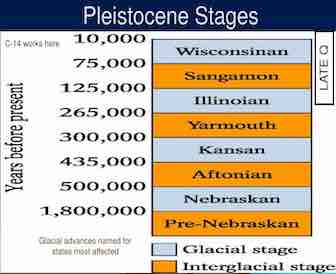 It’s hard to wrap one’s mind around the very concept of continental glaciation or its duration. For 65,000 years, let’s say, thick ice lay on and moved across the landscape of Canada and the upper Midwest. The first human civilization began about 3500BC. Egyptian civilization began about 3300BC. We’ve had human civilizations for about 5500 years. They didn’t start until 7000 years after the end of the Wisconsin glaciation. We’re pretty new here.
The novelty of civilization as compared to even the most recent glaciation makes a gift of some perspective. We live in the greatest civilization in the miraculous and short history of civilizations. Industrialization began only about 270 years ago, bringing us the lives of relative ease we enjoy now. Things change fast now, but things have not always been as they are today. I digress.
The landscape we see in Canada and the upper Midwest was under ice until just a few thousand years ago. The moraines and surface features like drumlins and eskers mostly formed as the glacial lobes retreated. They left much behind. Beneath the surface there are boundless deposits of sand and gravel with their many uses in building, roads, concrete, glassmaking, etc. We take sand and gravel deposits out of gravel pits. There’s almost always a lake or pond there afterwards, giving the additional gift of ground water. Gravel pits are different from stone quarries. In my part of the world, the stone quarries are usually below the level of the glacial deposits. There will be found deposits of sedimentary or other rock in beds or layers. These have to have the overburden removed before the stone can be broken loose with blasting or grading, then crushed to desirable sizes. Up around Sudbury, it isn’t far down to the bedrock. That makes mining for minerals a little easier, but brings another problem.
It’s hard to wrap one’s mind around the very concept of continental glaciation or its duration. For 65,000 years, let’s say, thick ice lay on and moved across the landscape of Canada and the upper Midwest. The first human civilization began about 3500BC. Egyptian civilization began about 3300BC. We’ve had human civilizations for about 5500 years. They didn’t start until 7000 years after the end of the Wisconsin glaciation. We’re pretty new here.
The novelty of civilization as compared to even the most recent glaciation makes a gift of some perspective. We live in the greatest civilization in the miraculous and short history of civilizations. Industrialization began only about 270 years ago, bringing us the lives of relative ease we enjoy now. Things change fast now, but things have not always been as they are today. I digress.
The landscape we see in Canada and the upper Midwest was under ice until just a few thousand years ago. The moraines and surface features like drumlins and eskers mostly formed as the glacial lobes retreated. They left much behind. Beneath the surface there are boundless deposits of sand and gravel with their many uses in building, roads, concrete, glassmaking, etc. We take sand and gravel deposits out of gravel pits. There’s almost always a lake or pond there afterwards, giving the additional gift of ground water. Gravel pits are different from stone quarries. In my part of the world, the stone quarries are usually below the level of the glacial deposits. There will be found deposits of sedimentary or other rock in beds or layers. These have to have the overburden removed before the stone can be broken loose with blasting or grading, then crushed to desirable sizes. Up around Sudbury, it isn’t far down to the bedrock. That makes mining for minerals a little easier, but brings another problem.
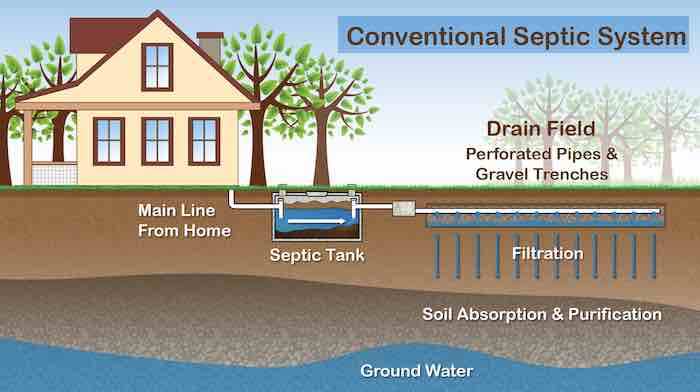
If you think about it, a mineshaft is about the same thing as a well, except the mineshaft is bigger. Below a certain level in the ground, below the top of the water table, water will move into a well and also into a mineshaft. In the years before the start of the Industrial Revolution, the problem of mines filling with ground water became a serious problem. The first application of steam engines such as the Newcomen engine and, later, Watt’s engine was for pumping water out of mines. Sometimes ground water is a mixed blessing. In sand and gravel deposits there will be found the abundant ground water we discussed last week. Because there is so much sand and gravel, it acts as a filtering system for ground water. A new well produces muddy water because the ground has been disturbed, but in most parts of our glaciated landscape, a driven or drilled well will soon pump nothing but crystal clear water. It’s beautiful. On a hot day, the water feels like it will freeze the hands. That’s because where the ground water rests it’s about 56 degrees Fahrenheit year round. Depending on how it’s used, the water is either preheated or precooled to that temperature. Consider geothermal HVAC systems. Remember spring houses where milk would be placed in cans in a bath of ground water? That water takes the milk from 101 degrees Fahrenheit down to 56 degrees in very short order. Before mechanical refrigeration it served as a natural cooler. Because the ground deposits serve as a natural filter, we have learned to make our lives pleasanter still with waste treatment systems. For cities and towns there are big treatment plants that operate above ground. For individual homes in suburban and rural areas, there are small treatment facilities called septic systems. These consist of a divided holding tank made of concrete or plastic and a drain field of pipes and gravel beds. They look something like this.We place these systems in the ground where soil and deposits act as filters. Beneficial bacterial activity in the tank breaks down waste so that most of what is left is just water. That water flows out into the drain field where it is filtered naturally, eventually returning it to the ground water. The water moves laterally through the ground using it as a filtering medium. It’s a blessing.
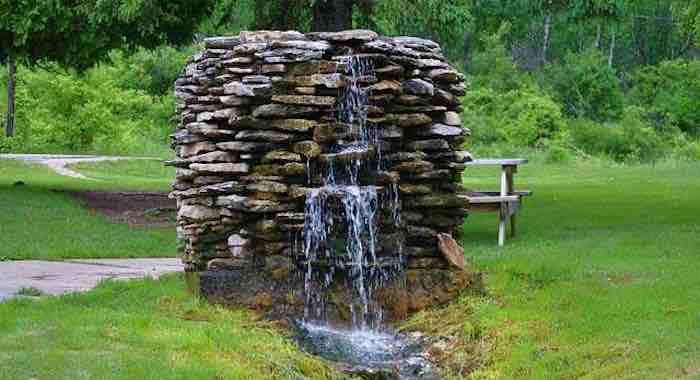
We call water the universal solvent because it dissolves more substances than any other liquid. This also plays a part in ground water. You may have had the misfortune to drink well water that contained iron or had a sulfur smell like rotten eggs. Ground water will dissolve and carry substances and odors we don’t like, at least not in a drinking glass. These same substances may have medicinal or curative powers which make them desirable for spas. People generally like the taste of certain minerals in drinking water. These minerals also affect ph levels. Ground water can carry oil, chemical solvents, fertilizer, and pesticides which can take many years to dilute and disperse. Always be a steward of our ground water. Notice the difference between a bottle of spring water (desirable mineral content) and a bottle of distilled water (no mineral content). The best wells and springs become famous for their desirable qualities. If you ever go to the Iron Mountain, Michigan area, be sure to fill a jug or two at the Norway Spring at Norway, Michigan. It has been filtered through miles of stone and glacial deposits. There’s no finer water anywhere for drinking or making the finest tea or ale.
There’s one final gift we rarely consider. When the Wisconsin ice sheet retreated, it left deposits of sand and gravel on the surface. Then for the last 9,000-10,000 years plants reestablished themselves, covering the ground completely. For all those years, there has been an annual production of leaves and stems and roots clinging to rocky soil at first, but gradually depositing a layer of organic material that has built up slowly over time. As the layering continued, the root systems held the litter to prevent it being washed away with rains and snowmelt. Year after year it accumulated. In the forested areas it was leaves and decaying wood. On the prairies it was lush grass, bending low in the winter only to be supplanted by new growth in the following spring and summer. For a thousand years it accumulated, and still it was only 7000BC. Then there were 3,500 more years to reach the first riverine civilizations. There have been more than 5500 springs and summers since that time, and we have another each year. That accumulation brought us the gift of so much productive topsoil above the glacial gift and the ground water. It’s humbling to even consider. If you’re further blessed with the ability to find deposits of ground water with a stick, then you’re over into the realm of the sacred and magical skills of those who acknowledge the gift of glaciation. We must have water to live. Although there are many ways to get water, there are none so satisfying as to tap the gift of the glaciers beneath our feet.
View Comments
Dr. Bruce Smith (Inkwell, Hearth and Plow) is a retired professor of history and a lifelong observer of politics and world events. He holds degrees from Indiana University and the University of Notre Dame. In addition to writing, he works as a caretaker and handyman. His non-fiction book The War Comes to Plum Street, about daily life in the 1930s and during World War II, may be ordered from Indiana University Press.