Feminist Icon Billie Jean King Needs a Man—FAR More Than a Fish Needs a Bicycle
And, I guess, this is why the world needs activists such as Billie Jean King, champions of a most selective “equality."

Selwyn Duke , Bio and Archives--September 19, 2026
American Politics, News | Comments | Reader Friendly | Subscribe | Email Us
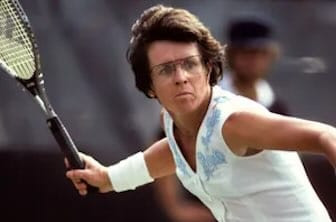
Feminist sports icon Billie Jean King is at it again, oblivious to economics and banging on about “equal pay” for female tennis players. It apparently never occurs to her that there’s one way to get the men’s money.
The same way the men do: Compete on the men’s tour and succeed.
Oh, that’s too much to ask? The women couldn’t cut it there?
Well, look at that: You just learned, Billie, why they’re not making the men’s money.
I know how the gals feel, too. A long-retired tennis pro, I also couldn’t cut it on the men’s tour (and in my day there was no such thing as donning a dress and identifying as Billie Jean Duke to cash in). So I didn’t get their money, either.
See how that works?
The story here is that ex-tennis champion King, 82, who is “married” (ahem) to another woman, needs a man—badly. In fact, she just recently criticized former men’s number one Roger Federer, 45, for not helping the women get prize money the market says they don’t deserve. Apparently, her cause is his obligation.
“‘I wish he would fight harder for equality, because I keep telling him: ‘You have two sons and two daughters. There is equality in your home,’” Tennis World quoted King as saying. “Do you think he would ever do something to create a stir? He doesn’t want to. I would like to earn more too.”
Well, nothing proves you’re an “independent woman” like needing a man to help you make bank.
Really, though, how does King know there’s equality in Federer’s home? I mean, there’s equality hardly anywhere else, as it’s not this world’s norm. If he’s like most parents, too, chores may be sex specific (even if servants perform them), with daughters more likely to load the dishwasher and sons to mow the lawn.
But King really, really cares about equality. That’s why she has highlighted how female fashion models are paid substantially more than their male counterparts, right?
Actually, no—she hasn’t made a peep about that.
It is, however, why she has complained about only men being subject to draft registration, no? I mean, that’s the big inequality tamale, requiring just one sex, when the situation demands it, to fight, bleed and possibly die for the country.
Actually, though, no—King does a great impression of crickets on that one, too.
Oddly, she only complains about “inequality” when perceiving a disparity that redounds negatively upon the group she feels allegiance to.
My, how rare, how self-sacrificing—how noble!
A cynic, however, could get the crazy idea that this isn’t about equality at all. He could suspect that an equality argument, rather, is used as a ruse to gain leverage and achieve feminist goals. These aims are, at bottom, about winning special dispensations and preferential treatment for women—even if this means advocating unfairness and injustice. It’s good I’m not a cynic.
The Federer overture isn’t the first time King has called on a prince in shining armor to rescue her from the dragon of economic reality, either. Decades ago she was upset that tennis legend Arthur Ashe wouldn’t do the same. He explained himself, responding with economic facts on The Dick Cavett Show in 1980 (video below; relevant portion begins at 2:23).
Yet 46 years later, in her ninth decade of life, King still doesn’t get it—because she doesn’t want to. But female tennis players earn less than opposite-sex colleagues for the same reason male fashion models do. It’s for the same reason lightweight boxers command less than heavyweights: Their market isn't as large and lucrative. This isn't esoteric knowledge, either—it's Economics 101.
And what if a lightweight complained he should get the heavyweights’ purses? The answer should be: Then fight in the heavyweight ranks. If you can take those anvil-like blows and prevail, you’ll be rich beyond imagination. If you can’t, then please, do shut up.
In the tennis world, the men are the heavyweights. King, most famous for beating quasi-decrepit, 55-year-old hustler Bobby Riggs in 1973’s Battle of the Sexes, ought to know this better than anyone. Long before she played Riggs, she locked horns with Eugene Scott, a top amateur male player. He spotted her 10 points in a 21-point game, gave her a service advantage, and still won 21-17.
Lightweight status is why the Women’s Tennis Association (WTA—their tour) has been losing money in recent years and may not have liquidity in 2027. The kicker:
Equal-pay subsidies—the WTA’s own cash used to raise women’s prize money closer to the men’s at certain events—are part of the reason for these financial woes. In other words, King’s own equal-pay agitation, in the face of market realities, is helping to bankrupt the tour she purports to care about.
I’m sure, of course, that King would like the ATP (men’s tour) to subsidize the WTA just as the NBA does the WNBA (which wouldn’t exist without male ballers’ largesse). But here’s a different, radical idea:
Accept reality.
And as mentioned earlier, reality is that “equality” is not a thing of this world. Rather, disparities are the norm. Men are four times as likely as women to be struck by lightning. Men die younger. Men are more likely to be affected by hemophilia A and B, gout, abdominal aortic aneurysm and autism spectrum disorder; women are more likely to suffer with systemic lupus erythematosus, multiple sclerosis, osteoporosis after midlife and autoimmune thyroid disease. That’s just a short list, too.
So why do we identify just certain disparities as “unjust” and target only them for elimination? Why focus on, let’s say, equalizing the sexes’ workplace wages and not their workplace deaths (92 percent of which involve men)?
Well, now we’ve discovered the real unjust discrimination. Privilege is having only the disparities that affect you negatively noticed and cherry-picked for a DEI-style nixing.
Speaking of discrimination brings us to the “equal pay for equal work” fancy. Most fundamentally, how do you even determine equal work? It’s not easy. From experience, I know that the men tennis players train notably harder than the women, for example. Equal work?
Moreover, I was considered in my playing days a workhorse; few labored longer in the gym and elsewhere. I should’ve been compensated more handsomely than the big names if “work” were the determinant; instead, I was a “starving artist.”
And what of high-level junior boys? Not only can they beat the women (as ex-number one Garbine Muguruza admitted last year), but they’re paid nothing. Should the kids who work harder than the pros get the latter’s money?
What of cops and emergency-services workers? Their work is far more important than King’s was. (The world would survive just fine without tennis players.) Yet they make a relative pittance.
The point: Work seriousness or scale doesn’t determine pay scale. The market does.
That is, except when activists can browbeat society into trumping market forces in deference to a favored group. But this is a dangerous road. Upon accepting that market determinations should be subordinated to some notion of “fairness,” where does it end? It’s a communistic idea.
Lastly, feminists might blame the predominantly male sports-viewers market for women’s athletics’ relative unpopularity. But women outnumber men population-wise; they could tune in and make females’ sports bigger than men’s. They choose not to—which is, apparently, why men are supposed to go and fight that war for them, too.
And, I guess, this is why the world needs activists such as Billie Jean King, champions of a most selective “equality.”
View Comments
Selwyn Duke, follow him on:
• Gab (preferably) or
• Twitter, or log on to
• SelwynDuke.