Found!
The despair of being lost is suddenly replaced with an indescribable joy: I have been found--eucatastrophe! We replace despair and sorrow and feelings of failure with the knowledge of God’s love, and the lifting of the weight of sin off our shoulder;

Joseph J. Bucci , Bio and Archives--April 14, 2026
American Politics, News | Comments | Reader Friendly | Subscribe | Email Us
“We got him!” So dramatic this past week was the jubilation by President Trump and others over the finding and rescue of a lost US airman downed over hostile territory.
President Trump made the dramatic call in his Truth Social account as the missing US airmen was rescued from a mountain crevice deep inside a remote area of Iran (LaPorta, et al, 2026). The F-15 E pilot and his weapons system officer safely ejected from their downed plane while conducting a mission during Operation Epic Fury. The plane’s pilot was rescued within a few hours.
"God is Good" and Ghost Murmurs
But the weapons system officer was hurt in his ejection and sought to hide in the Zagros Mountain range from the Iranian Revolutionary Guard troops who had put a $60,000 bounty on his head (Reyes, 2026). While the airman evaded the Iranian forces, a significant manhunt was initiated to recover the missing officer before the Iranian army could capture him and parade him before the cameras.
What was so extraordinary about the rescue was the desolated area in which the airman was hiding. The US Air Force Colonel climbed a 7,000-foot ridge, hid in a crevice in the mountains for safety; and submitted a short, unusual message over the radio: “God is good” (Reyes, 2026).
So how did we find him? The Central Intelligence Agency (CIA) deployed an incredible new device called a Ghost Murmur to locate the missing airman (Nelson, 2026b). This incredible technology uses long-range quantum magnetometry to find the electromagnetic signal of a human heartbeat (Nelson, 2026a). The barren desert landscape provided an ideal opportunity to utilize this high-tech device, which experts suggested was like trying to isolate one voice in a stadium – except that stadium was a thousand square miles of desert (Nelson, 2026b).
The name of the device was coined because of how the tool is used – a ‘murmur’ is a clinical term for a heart rhythm. ‘Ghost’ refers to finding someone who, for all practical purposes, has disappeared (Nelson, 2026a). Imagine what such an incredible tool could do perhaps finding others who are lost in a similar fashion.
Have you ever been lost? Have you ever felt lost?
Have you ever been lost? Do you remember how that felt? You feel out of control, desperate to get things back in order. I have been lost in the woods. It was a horrible experience. The night before, a friend had shown me a beautiful vista just a few steps from the cabin in which we were staying. At least it seemed like a few steps. The next morning, up bright and early before the rest of the guests, I ventured out of the cabin to locate once again that beautiful view that I had seen the day before. It seemed like it was only a few steps from the cabin. Was I heading in the right direction? Some four hours later I was able to find my way out of the forest, literally 3 miles from where I started. But it was a horrible four hours!
Have you ever been lost? Have you ever felt lost?
Author John Coleman has written an entire book about historic individuals who were disoriented and got lost, needing help to be found by neighbors or by other strangers (Coleman, 2020). Coleman identified famous individuals who chose to use nature for vacation or for getting back in touch with the Earth or with themselves. These stories were significant to Coleman because he identified with the shock that normal human beings have with being totally lost and their disorientation to nature.
The scope of search and rescue efforts in the United States is often underestimated. Data from Yosemite National Forest Search and Rescue reveals an astonishing set of statistics: an average of 4,661 people become lost in wooded areas each year and require assistance—about 13 individuals every day. Nationwide, search and rescue teams are called out an estimated 50,000 times annually (Dotson, 2023).
Some of the more famous rescue efforts are listed below:
Aron Ralston (2003): Ralston, an experienced mountaineer and mechanical engineer, while hiking alone in Utah's Canyonlands, dislodged a boulder that trapped his arm. Unable to move, after five days he amputated his own arm with a multi-tool to survive, hiking out seven miles before being found (Hawk, 2023).
Cody Clawson (2001): Clawson, a 13-year-old Scout lost near Yellowstone, survived 18 hours in the wilderness and used his belt buckle to signal for help. The reflection was spotted by pilot and “Star Wars” actor Harrison Ford (Morgan, 2025)
John Newton and Amazing Grace
The concept of being lost and then found has a prominent place in Christian writing and in scripture. The famous hymn, Amazing Grace, was a poem first penned in 1772 by John Newton, a former slave trader who became a pastor. Newton’s life was a series of events in which he became lost in debauchery or lost in moral decline, and then was given second chances (Turner, 2003). Newton survived shipwrecks, near drowning, being abandoned by his crew, and nearly being killed several times. On one occasion Newton himself was lost in Africa on a hunting expedition. Just when the hunters had resigned themselves to death, suddenly the moon appeared, and they were able to find their way back to their camp (Turner, 2003).
And yet with all of his close calls, Newton‘s heart remained hardened. The author Steve Turner wrote that no matter how many times Newton was rescued, he would relapse into his old habits. In his later life, in an act of penance and repentance, Newton wrote of his exploits and inspired the landlord of a local congregation to offer Newton a church position, from which he would later be appointed an Anglican minister (Turner, 2003). Newton would continue his writing to pen over 280 hymns, including “Amazing Grace,” the most famous hymn in the English language (Piper, 2018).
There is an interesting dichotomy to the story of the US Air Force Colonel who was “lost” and then “found” by this incredible technology. While many of us might think that we were the ones who were “found,” and that this airman was “lost;” in actuality it was the badly wounded weapons system officer who struggled more than a mile up a mountain in order to boost his rescue radio signal and to proclaim to his search team that he was found – and found by God! In his radio message, strange to all of those who at first received it, he asserted “God is good!” While he was lost to the rest of us, he realized that he was found by God, and ultimately God’s love and mercy would allow him to be found by a world waiting to hear about his rescue.
The same would apply to all of us. While we may think that we are found, unless we are found by God, as John Newton wrote, we are the ones who are lost.
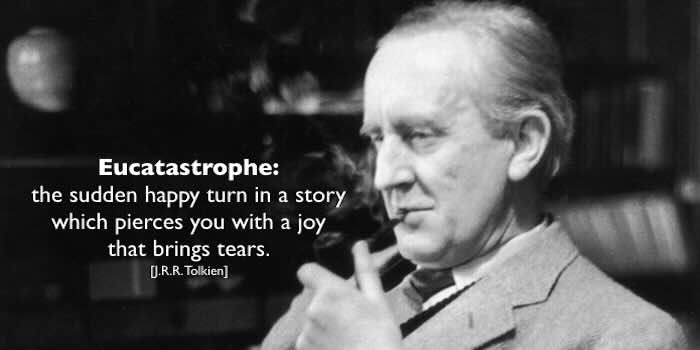
The author JRR Tolkien had a passion for words, which would often cause him to create different words that would apply to different circumstances (Nankervis, 2023). It did not seem to Tolkien that there were sufficient English words to address a sudden last minute unexpected change in a storyline that took a story from tragedy to unexpected good or joy. So Tolkien invented his own word: eucatastrophe (pronounced you-catastrophe). The author was convinced that the best stories involved a sudden twist, a last-minute unexpected turn from tragedy to triumph--something we might rephrase as snatching victory from the jaws of defeat (Nankervis, 2023) – or from being totally lost to wonderfully found!
That was the feeling when the weapons system officer was snatched from a perilous mountain crevice and brought back by his jubilant fellow soldiers! That was the feeling when Cody Clawson was plucked out of the wilderness by his rescuers after being spotted by Harrison Ford! And that is the only way to describe the transformation of John Newton from a wretched despicable slave trader to the pastor who along with William Wiberforce eradicated slavery from Great Britain--eucatastrophe!
The despair of being lost is suddenly replaced with an indescribable joy: I have been found – eucatastrophe! We replace despair and sorrow and feelings of failure with the knowledge of God’s love, and the lifting of the weight of sin off our shoulders. Suddenly the lost person is found, and there is unimaginable joy, relief, and satisfaction. Please today consider how “God is good” and confess your lostness and sin to Him; and be found in Him (Philippians 3: 8-9)
View Comments
Joseph J. Bucci has served as a Pastor, Author, HR Director, Director of Training, Professor and Consultant. He teaches in the College of Arts and Sciences at Regent University in Virginia Beach. He has written two books and numerous articles on the theme of integrating faith with life and our work. You can contact Dr. Bucci at: Joseph J Bucci