Germany’s Angst Over Hydraulic Fracturing and Emissions Reduction Targets
CO2 emission, gas, Germany, hydraulic fracturing, Oil Shale

Institute for Energy Research , Bio and Archives--July 14, 2014
Global Warming-Energy-Environment | Comments | Reader Friendly | Subscribe | Email Us
Although the Germans can now call themselves World Cup champions, they may be headed for a losing energy proposition. Last week, Germany’s energy and environment ministers announced that they were considering a ban on shale oil and gas drilling. Barbara Hendricks, minister for the environment, went so far as to say that these would be the “strictest regulations [Germany has] ever set” and that “there will be no fracking for economic purposes in Germany in the near future.”[1]
The dilemma Germany has created for itself is that the country has set ambitious carbon dioxide (CO2) emissions reduction targets—40 percent reductions of 1990 levels by 2020 and 55 percent by 2030.[2] Shale gas development could help with the emissions reduction since its production and displacement of coal in the generating sector has reduced emissions in the United States.[3] Although IER has frequently questioned the wisdom of setting emissions reduction targets[4], if Germany does insist on meeting its own CO2 goals, banning hydraulic fracturing would close the country off to a source of relatively low-emission energy and make meeting its stated targets more difficult. These significant and incompatible policy choices present Germany as a country internally conflicted and increasingly adrift from its historical position as a sober and serious nation.
Germany’s Energy Policy: A History of Fear of Technological Risks
Germany’s hydraulic fracturing ban comes on the heels of the fallout of “Energiewende,” the country’s energy transformation strategy, which aims to phase out hydrocarbon-based energy sources and to move towards renewable energy. Following the Fukushima nuclear accident, the German government quickly decided to phase out nuclear power and rely mostly on wind and solar power as the primary sources of new electricity production. As IER has already noted, the results have been devastating to German CO2 goals—without nuclear power as a steady source of reliable electricity and with added pressure from the high prices of natural gas in Europe, Germans have turned to coal to back up their intermittent renewable technologies and to ensure that they have adequate power to satisfy electricity demand.[5] By banning hydraulic fracturing, Germany is now considering closing itself off to shale gas – a viable source of relatively low-CO2 power. Despite rising electricity prices, public opposition to hydraulic fracturing has mounted based on worries that the practice could pollute drinking water.[6] As IER has already noted, however, there is no direct evidence that hydraulic fracturing has contaminated groundwater, according to studies by the Environmental Protection Agency (EPA) and the Ground Water Protection Council (GWPC).[7] This is after 60 years of its use throughout the US and over 1 million applications of the technology. BMW’s CEO, Norbert Reithofer, has referred to Germany’s paradox of simultaneously being able to innovate and being reluctant to embrace technological change as “German angst.” He explains,German Angst refers to how, when it comes to making radical changes, we in this country like to engage in long and fearful discussions, because we Germans tend to see more problems than opportunities.[8]This “German angst” is, according to Reithofer, a large part of the reason why Germany chose to immediately phase out nuclear power in the wake of the 2011 Fukushima accident that was caused by a tsunami. At that time, Germans saw more peril than promise in nuclear power.[9] Note that there have not been any nuclear accidents since then despite countries such as China building modern day nuclear plants, and Germany is highly unlikely to suffer from a tsunami. According to the Energy Information Administration, Germany possesses 79.5 trillion cubic feet (tcf) of in-place shale gas reserves [10] and 17 tcf of technically recoverable [11] shale gas reserves.[12]
German CO2 Reduction Targets
The German CO2 reduction targets exist against the backdrop of E.U. targets, as that organization gears up for the next climate conference in Paris in 2015. Heading into the conference, European countries are eager to prove that they have emissions reductions under their belts. Germany, in particular, is planning to support the E.U.’s CO2 reduction goals for 2050 of 85-90 percent compared to 1990 levels.[13] In the wake of the 2011 nuclear plant closures, however, German CO2 emissions have actually risen, and Germany is now the E.U. country with the highest level of CO2 emissions (at 760 million tons in 2013), according to the E.U.’s statistics arm, Eurostat. Eurostat also estimates that CO2 emissions have increased in Germany by 2 percent between 2012 and 2013–the fourth highest increase in the E.U. after Denmark, Estonia, and Portugal.[14]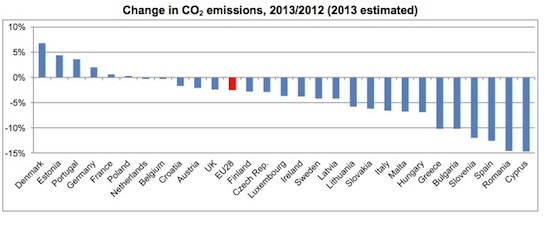 (Source: Eurostat)[15]
Data from BP’s Statistical Review of World Energy also make clear that German CO2 emissions have risen dramatically since the nuclear phase-out. Emissions have shot up from 802.3 million metric tons in 2011 to 842.8 million metric tons in 2013, a 5.1 percent increase.[16] Germany, thus, should not logically ignore a viable, low-emissions source of energy.
(Source: Eurostat)[15]
Data from BP’s Statistical Review of World Energy also make clear that German CO2 emissions have risen dramatically since the nuclear phase-out. Emissions have shot up from 802.3 million metric tons in 2011 to 842.8 million metric tons in 2013, a 5.1 percent increase.[16] Germany, thus, should not logically ignore a viable, low-emissions source of energy.
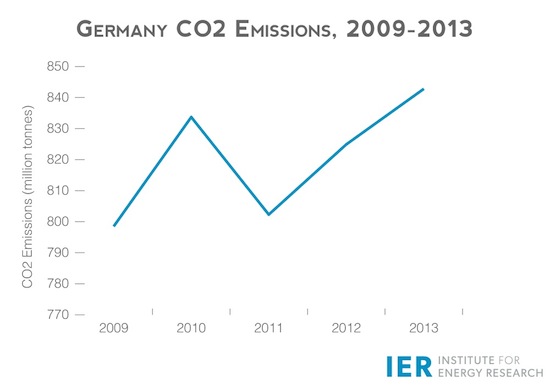 (Source: BP Statistical Review of World Energy 2014)[17]
The U.S. Hydraulic Fracturing Experience and CO2 Emissions
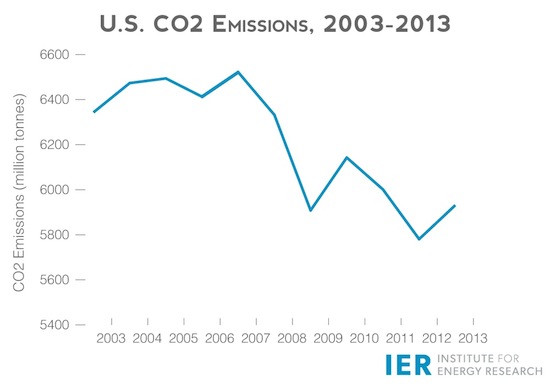
Hydraulic fracturing and horizontal drilling in the U.S. have increased natural gas production and decreased natural gas prices with the result that American CO2 emissions have declined by 6.5 percent over the past decade. Emissions have dropped from 6.3 billion metric tons in 2003 to 5.9 billion metric tons in 2013.[18]
Robert Bryce, a Senior Fellow at the Manhattan Institute, explicitly compares U.S. emissions reductions to German reductions. He explains,
The U.S. is leading the world in reducing its carbon dioxide emissions…Indeed, thanks to the soaring domestic production of natural gas—up by 27 percent…since 2003—the U.S. has been able to reduce the amount of coal it consumes for electricity generation…That reduced coal consumption has resulted in major reductions in carbon-dioxide emissions, even when compared to Germany, a country that many environmentalists consider an example to be copied.[19]
(Source: BP Statistical Review of World Energy 2014)[17]
The U.S. Hydraulic Fracturing Experience and CO2 Emissions
Hydraulic fracturing and horizontal drilling in the U.S. have increased natural gas production and decreased natural gas prices with the result that American CO2 emissions have declined by 6.5 percent over the past decade. Emissions have dropped from 6.3 billion metric tons in 2003 to 5.9 billion metric tons in 2013.[18]
Robert Bryce, a Senior Fellow at the Manhattan Institute, explicitly compares U.S. emissions reductions to German reductions. He explains,
The U.S. is leading the world in reducing its carbon dioxide emissions…Indeed, thanks to the soaring domestic production of natural gas—up by 27 percent…since 2003—the U.S. has been able to reduce the amount of coal it consumes for electricity generation…That reduced coal consumption has resulted in major reductions in carbon-dioxide emissions, even when compared to Germany, a country that many environmentalists consider an example to be copied.[19]
 Conclusion
Germany finds itself on the horns of a dilemma—it simultaneously wants to reduce CO2 emissions aggressively, but also wants to ban one of its most viable sources of relatively low-CO2 energy, along with all of its nuclear energy. The country can’t have it both ways. “Energiewende”’s insistence on using renewable sources of energy has already proven untenable. Combined with the nuclear phase-out, it has actually increased Germany’s reliance on coal generation, thus increasing CO2 emissions. Although banning hydraulic fracturing and pushing renewables may be a symbolic gesture before the Paris 2015 conference, the proof may be in the pudding— Germany may just give up one of its best chances to reduce CO2 emissions. Based upon their inchoate policy choices, Germany is placing itself in significant danger of failing to meet its carbon dioxide or energy goals. Their self-experiment will provide lessons for those interested in successful energy policy outcomes.
This post was authored by IER Policy Associate Kaavya Ramesh.
[1] Melissa Eddy, German Proposal Seeks to Sharply Curtail Fracking, The New York Times, July 4 2014, http://www.nytimes.com/2014/07/05/business/international/german-proposal-to-curtail-fracking.html?_r=0
[2] John McGarrity, Germany’s carbon targets in doubt as emissions rise in 2013Global Climate Change News & Analysis, March 12 2014,
[3] America’s falling carbon-dioxide emissions: Some fracking good news, The Economist, May 25 2012,
[4] Robert P. Murphy, RPS and Electricity Prices, Institute for Energy Research, November 29 2010,
[5] Germany’s Green Energy Failure: A Lesson for U.S. Policymakers, Institute for Energy Research, April 2014,
[6] Eddy, see note 1.
[7] Robin Millican, Hydraulic Fracturing—Is It Safe?, Institute for Energy Research, May 3 2011,
[8] Sheenagh Matthews, Germany CEOs Lament Lost Innovation as Fracking Angst Rises, Bloomberg, June 10 2014,
[9] Ibid.
[10] “In-place” reserves are the total estimated quantity of shale gas which is estimated, on a given date, to be contained in known accumulations, plus the quantities already produced from that estimate.
[11] “Technically recoverable” reserves are shale gas resources in accumulations that can be produced using current recovery technology, but without reference to economic profitability.
[12] Technically Recoverable Shale Oil and Shale Gas Resources: An Assessment of 137 Shale Formations in 41 Countries Outside the United States, June 10 2013, U.S. Energy Information Administration,
[13] Policy Brief Germany, Hill+Knowlton Strategies, Vol. 3, January 2014,
[14] Early estimates of CO2 emissions from energy use, Eurostat News Release, May 7 2014, Eurostat,
[15] Ibid.
[16] Ibid.
[17] BP, Statistical Review 2014 workbook, Statistical Review 2014,
[18] Ibid.
[19] Robert Bryce, The real energy revolution shrinking carbon dioxide emissions? It’s fracking, The Seattle Times, June 29 2014,
[20] BP Statistical Review 2014, see note 13.
Conclusion
Germany finds itself on the horns of a dilemma—it simultaneously wants to reduce CO2 emissions aggressively, but also wants to ban one of its most viable sources of relatively low-CO2 energy, along with all of its nuclear energy. The country can’t have it both ways. “Energiewende”’s insistence on using renewable sources of energy has already proven untenable. Combined with the nuclear phase-out, it has actually increased Germany’s reliance on coal generation, thus increasing CO2 emissions. Although banning hydraulic fracturing and pushing renewables may be a symbolic gesture before the Paris 2015 conference, the proof may be in the pudding— Germany may just give up one of its best chances to reduce CO2 emissions. Based upon their inchoate policy choices, Germany is placing itself in significant danger of failing to meet its carbon dioxide or energy goals. Their self-experiment will provide lessons for those interested in successful energy policy outcomes.
This post was authored by IER Policy Associate Kaavya Ramesh.
[1] Melissa Eddy, German Proposal Seeks to Sharply Curtail Fracking, The New York Times, July 4 2014, http://www.nytimes.com/2014/07/05/business/international/german-proposal-to-curtail-fracking.html?_r=0
[2] John McGarrity, Germany’s carbon targets in doubt as emissions rise in 2013Global Climate Change News & Analysis, March 12 2014,
[3] America’s falling carbon-dioxide emissions: Some fracking good news, The Economist, May 25 2012,
[4] Robert P. Murphy, RPS and Electricity Prices, Institute for Energy Research, November 29 2010,
[5] Germany’s Green Energy Failure: A Lesson for U.S. Policymakers, Institute for Energy Research, April 2014,
[6] Eddy, see note 1.
[7] Robin Millican, Hydraulic Fracturing—Is It Safe?, Institute for Energy Research, May 3 2011,
[8] Sheenagh Matthews, Germany CEOs Lament Lost Innovation as Fracking Angst Rises, Bloomberg, June 10 2014,
[9] Ibid.
[10] “In-place” reserves are the total estimated quantity of shale gas which is estimated, on a given date, to be contained in known accumulations, plus the quantities already produced from that estimate.
[11] “Technically recoverable” reserves are shale gas resources in accumulations that can be produced using current recovery technology, but without reference to economic profitability.
[12] Technically Recoverable Shale Oil and Shale Gas Resources: An Assessment of 137 Shale Formations in 41 Countries Outside the United States, June 10 2013, U.S. Energy Information Administration,
[13] Policy Brief Germany, Hill+Knowlton Strategies, Vol. 3, January 2014,
[14] Early estimates of CO2 emissions from energy use, Eurostat News Release, May 7 2014, Eurostat,
[15] Ibid.
[16] Ibid.
[17] BP, Statistical Review 2014 workbook, Statistical Review 2014,
[18] Ibid.
[19] Robert Bryce, The real energy revolution shrinking carbon dioxide emissions? It’s fracking, The Seattle Times, June 29 2014,
[20] BP Statistical Review 2014, see note 13.View Comments
Institute for Energy Research——Bio and Archives
The Institute for Energy Research (IER) is a not-for-profit organization that conducts intensive research and analysis on the functions, operations, and government regulation of global energy markets. IER maintains that freely-functioning energy markets provide the most efficient and effective solutions to today’s global energy and environmental challenges and, as such, are critical to the well-being of individuals and society.