Transjordan (renamed Jordan in 1950) has always been the key to resolving competing territorial claims by both Arabs and Jews in former Palestine.
Transjordan comprised 78% of the territory placed under the League of Nations Mandate for Palestine after being wrested from 400 years of Ottoman Empire sovereignty during World War 1. Mandatory Palestine was designated in April 1920 by the Principal Allied Powers at the
San Remo Conference and in August 1920 by article 95 of the
Treaty of Sevres as the location for reconstitution of the ancient and biblical homeland of the Jewish people.
Transjordan's first Hashemite ruler--Abdullah I--arrived there in
November 1920
Abdullah was en route by train from Hijaz to Syria with armed forces to assist his brother Feisal in his struggle with France to retain power in Syria. Winston Churchill--at France's request - offered Abdullah an Emirate in Transjordan--which Abdullah gratefully accepted on
11 April 1921.
Feisal was removed from Syria by the French and installed as ruler of Iraq under the
Anglo-Iraqi Treaty dated 10 October 1922. France became the Mandatory for the territory comprised in the
Mandate for Syria and Lebanon.
These British-Franco machinations cost the Jewish people dearly--when the Mandate for Palestine - adopted unanimously by all 51 members of the League of Nations on 24 July 1922 - denied the Jewish people the right to reconstitute the Jewish National Home in any part of Transjordan (Eastern Palestine) and restricted that right to the remaining 22% (Western Palestine).



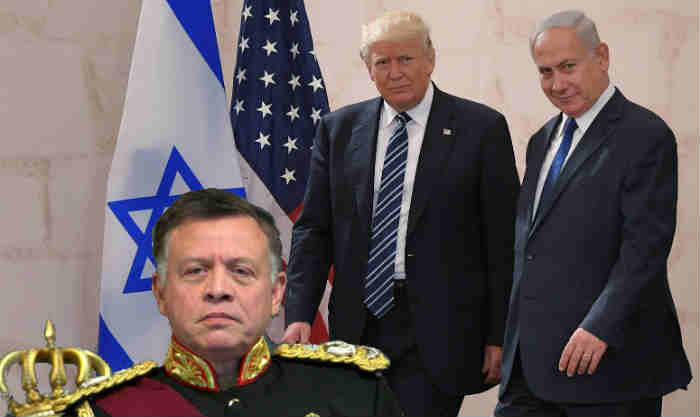 King Abdullah seems increasingly hell bent on ending 99 years of Hashemite-dynasty rule in Jordan.
This possibility is emerging as Abdullah is: