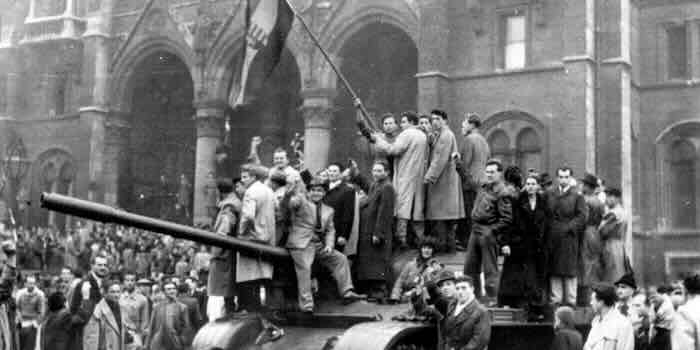
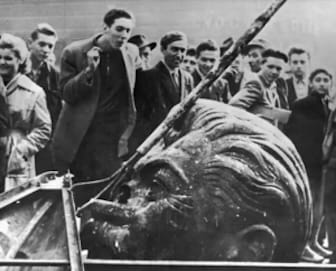
Over the next few days, the rebellion spread; factories were seized, Communist Party newspapers and headquarters were attacked, and known communists and secret police agents were murdered. The new prime minister released political prisoners and promised the establishment of democracy, with freedom of speech and religion.
For a time, Moscow seemed willing to accept change in Hungary, but when Nagy announced that his country would leave the Warsaw Pact and become neutral in the Cold War, that was a bridge too far for Khrushchev. Fearing the collapse of the entire Soviet bloc, he made plans for an invasion of Hungary. By Nov. 3, the Red Army had surrounded Budapest, and the next day heavy fighting erupted as armoured columns entered the city. Some units of the Hungarian army fought back, joined by thousands of civilians, but the end was predictable. After a week of battles, with over 20,000 dead and wounded, resistance crumbled. A new Soviet-approved government under János Kádár purged the army and Communist Party, arrested thousands, and executed rebel leaders including Nagy.
Hundreds of thousands of refugees fled, many of them settling in Canada and the United States. World condemnation of the USSR was strong; critics of the Soviets included many communists in the West who resigned their party membership. Not until the collapse of the Soviet hold on Eastern Europe in 1989 did Hungarians get another taste of freedom.
Published in the Epoch Times.
Gerry Bowler, historian, is a Senior Fellow at the Frontier Centre for Public Policy.