

IER Comment on the “Social Cost of Methane”
Another important difference between carbon dioxide and methane is that the latter has a shorter atmospheric life

Earlier this month, the Institute for Energy Research (IER) submitted a formal comment on proposed federal emission standards for new and modified sources in the oil and gas sector. The novelty of the government’s cost/benefit assessment of the rules was their use of the “social cost of methane,” which is analogous to the more familiar “social cost of carbon” but, of course, applied to a different greenhouse gas. We at IER have tirelessly documented the problems with the “social cost of carbon” as a tool for federal policymakers, and yet the “social cost of methane” is even more dubious.
The Devil’s in the Discount Rates
As with the social cost of carbon (SCC), the social cost of methane (SCM) seeks to quantify the present dollar value of the string of future climate change damages accruing from an additional ton of methane. To calculate such an estimate, analysts use the same “integrated assessment models” (IAMs), which are computer simulations over centuries to model the global climate and economy.
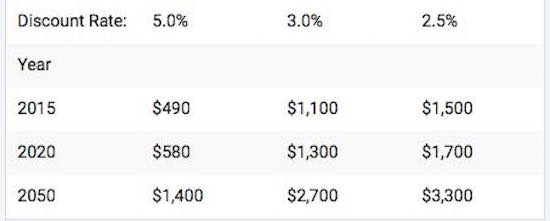
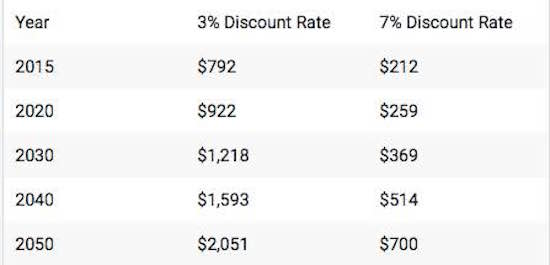
Among other problems, a huge issue here is that the discount rate chosen to turn those hypothetical future damage projections into present dollar figures is critical. This one decision can drive the entire analysis. The following table summarizes some of the estimates of the SCM varying by changing the discount rate:
TABLE 1: “SOCIAL COST OF METHANE” FOR VARIOUS YEARS, DISCOUNT RATES
Relatively Little Research on Methane
All of the problems with using the SCC for federal cost/benefit analysis apply to the SCM and the “social cost” of other greenhouse gases. However, as bad as the SCC is, the case for using an SCM is even weaker. First, there is a paucity of research in this area; there are far more studies looking at carbon dioxide, rather than methane. As a pioneering paper in the SCM literature explains:Many estimates of the social cost of CO2 emissions (SCCO2) can be found in the climate economics literature. However, to date far fewer estimates of the social costs of other greenhouse gases have been published, and many of those that are available are not directly comparable to current estimates of the SCCO2.[3]
Methane Shorter-Lived Than Carbon Dioxide
Another important difference between carbon dioxide and methane is that the latter has a shorter atmospheric life. Indeed as Marten and Newbold explain: “the relatively short lifespan of CH4 causes the temperature impact of a perturbation in 2010 to drop from its peak level by nearly an order of magnitude by 2100, while an analogous effect for a CO2 perturbation does not occur before the end of the 300 year time horizon” (p. 14). Given the large uncertainties of our current understanding of methane, the fact that it is relatively short-lived is an additional reason to defer the use of “the social cost of methane” in federal regulatory analysis. To put the argument differently: If proponents of a carbon tax and other regulations want to stress the longevity of carbon dioxide in the atmosphere as reasons for immediate action—and they do—then by consistency they should admit that humans have more flexibility when it comes to methane. Although it is a more powerful greenhouse gas (as measured by its Global Warming Potential), changes in future policy regarding methane emissions will be more effective than analogous policies regarding carbon dioxide.Conclusion
All of the problems plaguing the use of “social cost of carbon” in federal policymaking likewise apply to the more novel “social cost of methane,” but on top of these the SCM is even more dubious because it has received less research attention and because it is shorter-lived in the atmosphere than carbon dioxide. It is particularly inappropriate to use such an amorphous concept when justifying regulations that could impose billions of dollars of compliance costs on the U.S. economy. [1] Marten, A.L., E.A. Kopits, C.W. Griffiths, S.C. Newbold & A. Wolverton (2014, online publication; 2015, print publication). Incremental CH4 and N2O mitigation benefits consistent with the U.S. Government’s SC-CO2 estimates, Climate Policy, DOI: 10.1080/14693062.2014.912981. [2] David Kreutzer and Kevin Dayaratna, “Another Useless EPA Regulation That’ll Cost Americans More Money,” Daily Signal, December 3, 2015, available here: [3] Marten and Newbold, “Estimating the Social Cost of Non-CO2 GHG Emissions: Methane and Nitrous Oxide,” February 2012 update.Email Us | Reader Friendly | Comments
Institute for Energy Research——Bio and Archives
The Institute for Energy Research (IER) is a not-for-profit organization that conducts intensive research and analysis on the functions, operations, and government regulation of global energy markets. IER maintains that freely-functioning energy markets provide the most efficient and effective solutions to today’s global energy and environmental challenges and, as such, are critical to the well-being of individuals and society.