Introducing JunkScience.com’s Global Thermometer
Global mean temperature

Steve Milloy , Bio and Archives--April 20, 2011
Global Warming-Energy-Environment | Comments | Reader Friendly | Subscribe | Email Us
Everyone's talked about it for years. Politicians and activists have tried to change the entire Western economy and social order because of it. Some have made a fortune or become famous ranting about it.
But no one has ever known what it is. Not only has the technology not existed to calculate it but, truth be told, it doesn't even really exist in any meaningful manner in the first place! Yet it is quite possibly the hottest single metric in the history of humanity. Forget the number of home runs that Babe Ruth, Hank Aaron and Barry Bonds hit, George W. Bush's margin of victory over Al Gore in Florida and the number of angels that can dance on the head of a pin, What "it" is could result in poets 1,000 years from now singing Al Gore's praises. So what is "it"? (Drum roll, please...) "It" is the global mean temperature and... (more drum roll please…) now for the first time in world history, the near real-time, near-surface global mean temperature can be seen on JunkScience.com's Global Thermometer. Now the JunkScience.com Global Thermometer is not a "thermometer" per se — i.e., we're not simply taking measurements of the contraction/expansion of mercury in a glass tube from say Washington, DC and Brisbane, Australia and averaging them together. The JunkScience.com Global Thermometer is not even like our 2005 effort which processed temperature readings from about 1,000 surface-based temperature stations located around the globe. The JunkScience.com Global Thermometer derives the near-real time, near surface global mean temperature from the University of Alabama-Huntsville's publicly available, preliminary AMSU satellite data. More than a mere temperature estimate — which could be made by anyone with a spreadsheet and some free time — this daily number is a measure of both the near-surface temperature (where people live) and the net amount of energy in a large slab of the atmosphere (see image below), i.e., the weather-active region that so affects people's lives.
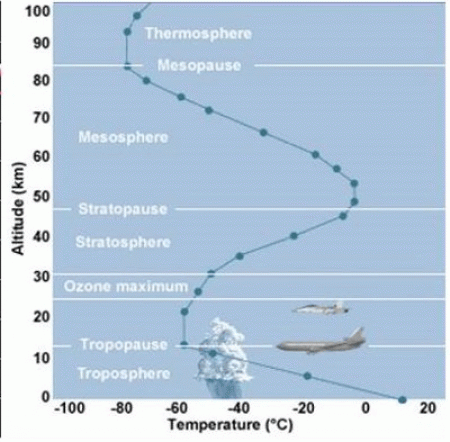 Fortunately, the AMSU's "Channel 5" data, which is nominally focused on the 600 millibar (about 14,000 feet or 4 kilometers in altitude) region of the atmosphere, "sees" the entire region of interest from surface to 5 millibar (up to about 70,000 feet or 20 kilometers).
Why do we want to look at such a large chunk of the atmosphere, even including a bit of the stratosphere?
Mainly because a global mean temperature is a largely meaningless and entirely synthetic metric. There is no "global mean" location where people actually live and experience this fantasy metric. Other than telling us whether we are in an ice age or interglacial period, the global mean temperature isn't really very informative.
On the other hand, a little basic knowledge of the world, namely that the tropics receive the largest amount of solar radiation and do not vary in temperature very much, allows us to infer quite a bit from small changes in bulk atmospheric temperature. How? Because the tropics are so stable temperature-wise, small changes in net atmospheric temperature suggest either larger low-to-high latitude temperature gradients (when the atmosphere is generally cooler) or lower such gradients (when the atmosphere is warmer).
OK. So what?
These temperature gradients are basically the Earth's weather engine — both vertically, as the temperature varies with altitude, and horizontally, as the temperature varies with latitude. "Mother Nature" is a born meddler and hates gradients. She is constantly trying to transfer abundant warmth and moisture from where there is plenty to where there is little.
The greater the disparity, the stronger and faster the winds and the higher the flow of tropical moisture to higher latitudes as "Ma" (Gaia, Pachamama, [insert favored Earth deity here]...) tries to "balance" the planet (or at least rearrange its thermal furniture).
JunkScience.com's Global Thermometer could very well be looking at the birth of a brand new "global storminess and extreme weather event potential" indicator! Perhaps we'll develop an odometer-style readout ranging from green, when the planet is comparatively warmer to red when the net disparity is greatest and extreme weather more likely. Stay tuned for that!
Meanwhile, bear in mind that Earth's surface temperature cycles a couple of degrees Centigrade warmer than the yearly average in the northern summer and a couple below that average in the northern winter, so absolute temperature is not really that important — except for debates about whether the planet has a fever and whether Dr. Obama should bleed it of CO2!
Remember too, that the tropics are relatively stable as far as temperatures go so if the world's atmosphere cools, the potential energy transfer from tropics to poles increases. On the other hand, if the atmosphere is warmer than has historically been the case, then you can expect reduced wind speeds and less extreme precipitation events. If nothing else, JunkScience.com's Global Thermometer might turn out to be useful as a sell signal for wind energy stocks.
Fortunately, the AMSU's "Channel 5" data, which is nominally focused on the 600 millibar (about 14,000 feet or 4 kilometers in altitude) region of the atmosphere, "sees" the entire region of interest from surface to 5 millibar (up to about 70,000 feet or 20 kilometers).
Why do we want to look at such a large chunk of the atmosphere, even including a bit of the stratosphere?
Mainly because a global mean temperature is a largely meaningless and entirely synthetic metric. There is no "global mean" location where people actually live and experience this fantasy metric. Other than telling us whether we are in an ice age or interglacial period, the global mean temperature isn't really very informative.
On the other hand, a little basic knowledge of the world, namely that the tropics receive the largest amount of solar radiation and do not vary in temperature very much, allows us to infer quite a bit from small changes in bulk atmospheric temperature. How? Because the tropics are so stable temperature-wise, small changes in net atmospheric temperature suggest either larger low-to-high latitude temperature gradients (when the atmosphere is generally cooler) or lower such gradients (when the atmosphere is warmer).
OK. So what?
These temperature gradients are basically the Earth's weather engine — both vertically, as the temperature varies with altitude, and horizontally, as the temperature varies with latitude. "Mother Nature" is a born meddler and hates gradients. She is constantly trying to transfer abundant warmth and moisture from where there is plenty to where there is little.
The greater the disparity, the stronger and faster the winds and the higher the flow of tropical moisture to higher latitudes as "Ma" (Gaia, Pachamama, [insert favored Earth deity here]...) tries to "balance" the planet (or at least rearrange its thermal furniture).
JunkScience.com's Global Thermometer could very well be looking at the birth of a brand new "global storminess and extreme weather event potential" indicator! Perhaps we'll develop an odometer-style readout ranging from green, when the planet is comparatively warmer to red when the net disparity is greatest and extreme weather more likely. Stay tuned for that!
Meanwhile, bear in mind that Earth's surface temperature cycles a couple of degrees Centigrade warmer than the yearly average in the northern summer and a couple below that average in the northern winter, so absolute temperature is not really that important — except for debates about whether the planet has a fever and whether Dr. Obama should bleed it of CO2!
Remember too, that the tropics are relatively stable as far as temperatures go so if the world's atmosphere cools, the potential energy transfer from tropics to poles increases. On the other hand, if the atmosphere is warmer than has historically been the case, then you can expect reduced wind speeds and less extreme precipitation events. If nothing else, JunkScience.com's Global Thermometer might turn out to be useful as a sell signal for wind energy stocks.View Comments
Steve Milloy——Bio and Archives
Steve Milloy publishes JunkScience.com and GreenHellBlog.com and is the author of Green Hell: How Environmentalists Plan to Control Your Life and What You Can Do to Stop Them