

Is 80 Percent Renewable Energy by 2050 Possible?—Depends on Who Is Making the Forecast
Special Report on Renewable Energy Sources and Climate Change Mitigation

The Intergovernmental Panel on Climate Change (IPCC) is forecasting that renewable energy could reach almost 80 percent globally by 2050 if the right government incentives and policies are provided. That scenario is just one of 164 scenarios in the IPCC report, but it is being highlighted by the IPCC and the news media even though the assumptions behind it are very unlikely for several reasons.
This overly optimistic scenario starts with the unlikely assumption that amount of energy demand expected in 2050 is less than we consume today. This is despite an expectedpopulation increase of 2 billion and GDP per capita more than doubling. Second, the scenario assumes no deployment of carbon capture and sequestration technology and a phase out of nuclear power by 2045 with no new nuclear plants built after 2008. Third, to attain the results, the scenario must rely on government policies since the cost of renewable technologies are higher than fossil fuel technologies. Thus, one should not be surprised to learn that investigative research found the scenario to be akin to one designed by Greenpeace and published on its website (and one of the lead authors of the IPCC's report was the same Greenpeace campaigner who wrote Greenpeace's report). There are more realistic scenarios in the report that haven't caught the media's attention. In fact, on the opposite end of the spectrum, is a scenario that achieves a 15 percent renewable share by 2050 with a 53 percent increase in global energy demand. That share of renewable energy is 2 percentage points more than the report's 2008 baseline and in line with scenarios produced by the Paris-based International Energy Agency (IEA) and the U.S. Energy Information Administration (EIA). In its International Energy Outlook 2010, the EIA forecasts a 13.5 percent share of renewable energy by 2035. In its World Energy Outlook 2010, the IEA forecasts a 14.5 percent renewable share by 2035 in its current policies case and an 18.7 percent share in its new policies case, which is designed to promote renewable energy given government incentives and policies.
The IPCC Report
The IPCC report contains 164 scenarios, of which 4 are discussed in-depth. Renewable energy in the IPCC study covers:- Biomass including biomass for electricity generation and biofuels for transportation
- Solar energy, including photovoltaics and solar thermal power
- Geothermal energy where heat is extracted from the earth's interior
- Hydropower, including dams with reservoirs, run-of-river and in-stream projects
- Ocean energy, where energy is obtained from tidal waves and temperature differences in seawater
- Wind energy, including both onshore and offshore wind farms
Total Primary Energy Supply by Fuel Type, 2008
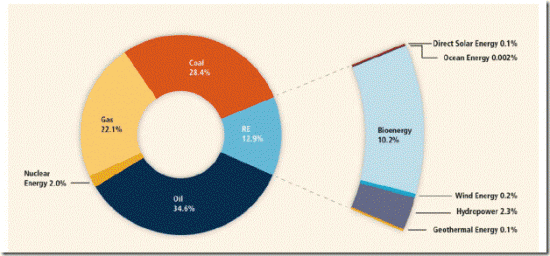 Source: IPCC, Special Report on Renewable Energy Sources and Climate Change Mitigation, srren.ipcc
Some of the highlighted findings of the IPCC report are:
- About 300 gigawatts of new electric generating capacity were added worldwide between 2008 and 2009, of which 140 gigawatts were renewable technologies.
- Wind capacity increased by 30 percent in 2009, grid-connected photovoltaics increased by over 50 percent, geothermal by 4 percent, hydropower by 3 percent, solar water/heating by over 20 percent and ethanol and biodiesel production increased by 10 percent and 9 percent, respectively.
- More than 50 percent of current global renewable energy capacity is in developing countries.
- Renewable energy is more likely to contribute to a low carbon energy supply by 2050 than nuclear power or fossil fuels using carbon capture and storage.
- Accelerating the deployment of renewables will present new technological and institutional challenges, particularly in integrating them into existing energy supply systems.
Conclusion
If one is looking for truly independent analyses of renewable forecasts, the IPCC is not the place to look--at least not in their current report, Special Report on Renewable Energy Sources and Climate Change Mitigation, according to analysts that have traced its work to Greenpeace. In fact, the report does not provide much more information than what is already well established: that without pro renewable energy policies by governments (i.e. large subsidies and mandates), renewable energy cannot compete with fossil fuels. Ramon Pichs, Co-Chair of the Working Group III, stated: "The report shows that it is not the availability of the resource, but the public policies that will either expand or constrain renewable energy development over the coming decades". Andy Revkin of the New York Times wrote: "Of course, my issue with the report from the get-go was the yawn factor. It was yet another study implying that renewable energy choices --in theory, and in the face of high costs and other daunting constraints --could be the dominant source of reductions in emissions by mid-century. Yes, and we could all stop driving tomorrow, but we won't."Read next: International Energy Agency wrong to forecast coal’s demise
View Comments
Institute for Energy Research——Bio and Archives
The Institute for Energy Research (IER) is a not-for-profit organization that conducts intensive research and analysis on the functions, operations, and government regulation of global energy markets. IER maintains that freely-functioning energy markets provide the most efficient and effective solutions to today’s global energy and environmental challenges and, as such, are critical to the well-being of individuals and society.