

Killing an American Industry: Coal
Americans will have to pay much higher electricity prices despite the minuscule benefits of the Clean Power Plan

“And Obama has largely destroyed reliable, low-cost, affordable electricity in America.” Robert E. Murray, Chairman of the Murray Energy Corporation
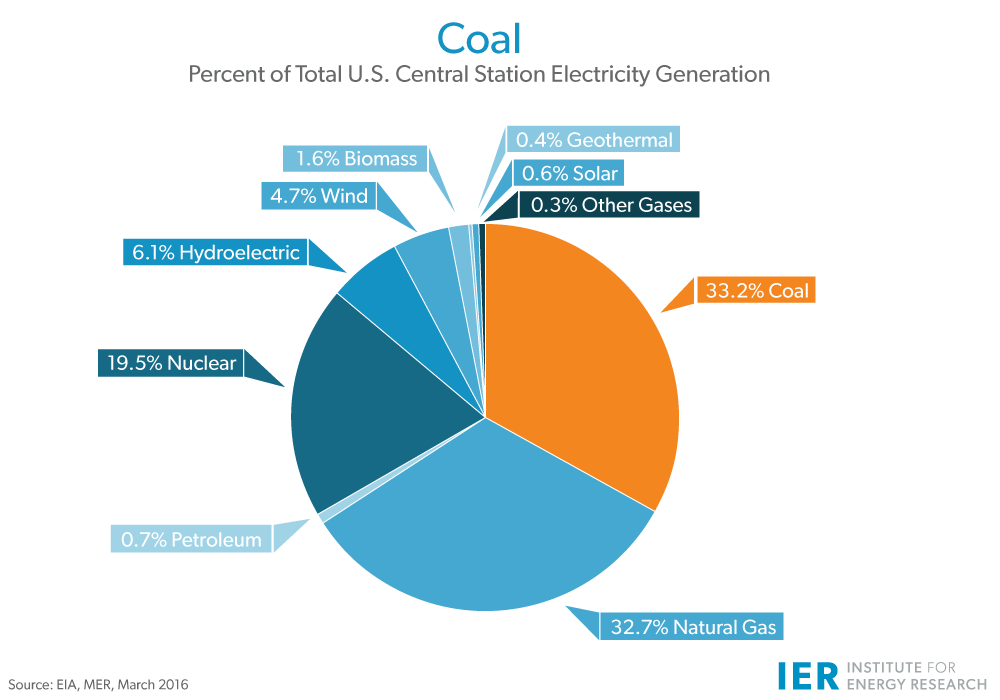
According to the Energy Information Administration’s Short-Term Energy Outlook, natural gas is expected to overtake coal as the major source of electricity generation this year. In 2008, coal’s share of electricity generation was over 50 percent, but it dropped to 33 percent in 2015, as natural gas prices decreased and Obama’s policies against coal began taking effect. President Obama’s regulations have caused electric power companies to shutter over 400 coal-fired power plants that would be too costly to upgrade with the pollution controls required to meet EPA’s newest regulations. According to the Sierra Club, the coal-fired plants retired last year equals the entire coal capacity of Britain.(i]
The shuttering of coal-fired power plants has caused coal production in the United States to fall to its lowest level in 30 years—896 million short tons. It peaked in 2008 at 1.17 billion short tons and is now 24 percent below that peak causing over 40 coal producers to file for bankruptcy protection.
As a result, in just the last 3 years, mine employment has declined by 19 percent to about 75,000. According to the National Mining Association, a typical miner earns $83,700 a year—a salary that cannot be replicated in other fields of work by those miners losing jobs. And yet, the Obama Administration and the Democratic candidates for president seem unconcerned. Their policies are ostensibly directed towards reducing global warming, but Robert Murray, Chairman of Murray Coal Company, disagrees. He emphatically believes that humans are not responsible for climate change.
Electricity Consumption of Coal Plummets
Consumption of coal in the electric power sector fell 29 percent from its peak of 1,047 million short tons in 2007 to 741 million short tons in 2015. Consumption fell in almost every coal generating state, increasing only in Nebraska and Alaska over that period. Western states — including Wyoming, the nation’s top coal producer–had smaller coal declines. In Ohio, Pennsylvania and Indiana, coal consumption fell from 176 million short tons in 2007 to 100 million short tons in 2015. The Utica shale formation in Ohio and the Marcellus shale formation in Pennsylvania provided natural gas to replace most of the coal losses in those states.[ii]



Developments Causing the Demise of the Coal Industry
The natural gas renaissance has helped to cause the decline of the coal industry through its use of hydraulic fracturing and horizontal drilling technology, causing average natural gas prices to electric utilities to decline 64 percent since 2008. But what has pushed the closure of coal power plants is the Obama Administration’s adoption of more stringent standards to regulate carbon dioxide emissions that it believes contribute to climate change, and to further regulate pollutants that it believes are harmful to human health, despite regulations already in place that have been very effective. For example, criteria pollutants (sulfur dioxide, nitrogen dioxide, carbon monoxide, ozone, lead and particular matter) declined by 63 percent between 1980 and 2014, despite gross domestic product increasing 147 percent, population increasing 41 percent and energy consumption increasing 26 percent between those years.
According to a study by NERA Economic Consulting, 47,000 megawatts of coal will be prematurely retired due to the so-called “Clean Power Plan.” The study projected that it will hike electricity prices in all 47 states that are subject to the regulation: 41 states are projected to see double-digit “peak” electricity price increases and 28 states are projected to see “peak” electricity price increases greater than 20 percent.[viii] Another study by Energy Ventures Analysis finds that 41,000 megawatts of perfectly good electric generating capacity will be forced to prematurely retire, forcing the nation’s consumers to pay $64 billion in replacement cost. That study also projects that 45 states will see double digit increases in wholesale electricity costs, and 16 states will see a 25 percent or higher increase in wholesale electricity costs.[ix]
An IER study shows that electricity prices from existing coal-fired power plants being retired are half the cost of a new natural gas combined cycle unit and about a third of the cost of a new wind turbine, which indicates why the above studies project much higher future electricity prices when implementation of the rule is completed.[x]
Americans will have to pay much higher electricity prices despite the minuscule benefits of the Clean Power Plan, which reduces global carbon dioxide emissions by less than 1 percent and global temperatures by 0.02 degrees Celsius by 2100, according to EPA’s own models. Even EPA Administrator Gina McCarthy admitted the fact when she recently told Congress that EPA cannot measure the impact of the proposed Clean Power Plan on global temperatures, because it would likely be incredibly small.[xi]
Conclusion
Obama’s EPA is promulgating regulations that will result in the demise of the U.S. coal industry, creating huge miner unemployment, mining company bankruptcies and regional economic devastation in rural coal mining communities. While the coal impacts have already started, they will get much worse as EPA’s regulations reach full implementation. The result will be much higher electricity prices for American consumers with very little gain in benefits. Consumers, those concerned about coal jobs, and communities should hope that the courts will share the view of those who believe that Americans are just being used as an example so that President Obama’s Paris commitment can proceed unabated. (i] New York Times, A Crusader in the Coal Mine, Taking on President Obama, April 30, 2016, [ii] Energy Information Administration, Power sector coal demand has fallen in nearly every state since 2007, April 28, 2016, [iii] EPA, Air Quality Trends, [iv] National Association of Manufacturers, Ozone Regulations, [v] NERA Economic Consulting, Economic Impacts of a 65 ppb National Ambient Air Quality Standard for Ozone, February 2015, [vi] NERA Economic Consulting, An Economic Impact Analysis of EPA’s Mercury and Air Toxics Standards Rule, March 1, 2012, [vii] Daily Caller, Obama’s War on Coal is Driving Up Energy Costs, March 23, 2016, [viii] NERA Economic Consulting, Energy and Economic Impacts Of EPA’s Clean Power Plan, November 7, 2015, [ix] Energy Ventures Analysis, EPA’s Clean Power Plan An Economic Impact Analysis, November 2015, [x] Institute for Energy Research, July 15, 2015, [xi] Daily Caller, EPA Head Admits Clean Power Plan Wouldn’t Impact Global Warming, April 21, 2016.Read next: International Energy Agency wrong to forecast coal’s demise
Email Us | Reader Friendly | Comments
Institute for Energy Research——Bio and Archives
The Institute for Energy Research (IER) is a not-for-profit organization that conducts intensive research and analysis on the functions, operations, and government regulation of global energy markets. IER maintains that freely-functioning energy markets provide the most efficient and effective solutions to today’s global energy and environmental challenges and, as such, are critical to the well-being of individuals and society.