Kimberly Murray Continues to Perpetuate a “Grave Error”
Rather than being a genocidal project, there is not a single verified case of a child murdered by a staff member at any of Canada’s Indian Residential Schools during their 113-year government-supported operation

Frontier Centre for Public Policy & Hymie Rubenstein , Bio and Archives--December 22, 2024
Canadian News, Opinion | Comments | Reader Friendly | Subscribe | Email Us
A November 29 Blacklocks Reporter post revealed that Kimberly Murray, Independent Special Interlocutor for Missing Children and Unmarked Graves and Burial Sites associated with Indian Residential Schools, advised Canada’s cabinet that she accepts that some Canadians are skeptical that thousands of children were buried at Indian Residential Schools.
But she qualified this assertion by claiming “accusations of deliberate deception are hateful.”
- “It is one thing to say you don’t believe there are burials. That’s your opinion and you can have freedom of speech to say that. But when you say there are no burials, that First Nations people or the Indians are lying because they want you to go burn down churches or they want to take away your cottages, that is inciting hate against Indigenous people. That’s the type of speech we need to stop.”
- “Hate speech is not protected by the Charter and it is getting worse in the country,” said Murray. “We need to ensure survivors and communities are safe. We need to send a clear message to Canadians that it is not okay to incite this kind of hate.”
Testifying at the Senate Indigenous Peoples Committee, Murray said she was personally convinced there are mass graves at Indian Residential Schools. “Cemeteries were part of the Indian Residential Schools from the very outset,” she said. “The government planned for the deaths of the children.”
“When the children died, government and church officials did not return the children home for burial,” said Murray. “They were buried in cemeteries at the institutions, often in unmarked and mass graves which were sometimes dug by the other children.”
Murray’s assertions about the death and burial of students in dedicated Indian Residential School graveyards are so grossly exaggerated that they might be termed both libellous and inciting hatred against the various Canadian Churches and their personnel, many of them indigenous people, charged with running these schools.
Murray even endorsed a private New Democrat bill introduced on September 26 in the House of Commons to criminalize public commentary critical of “mass graves” accounts. Bill C-413, An Act To Amend The Criminal Code, would outlaw public remarks “condoning, denying, downplaying or justifying the Indian Residential School system in Canada or by misrepresenting facts related to it” under threat of two years in jail.
“We have lots of death records,” said Murray. “There are lots of death certificates of the kids who died at Indian Residential Schools that say they are buried at the Indian Residential School cemetery. Many of those death records are signed by the Indian agent or the principal who said what the cause of death was.”
Contrary to Murray’s assertion, most of the extant provincial death records establish that the children’s bodies were returned to their home reserves for burial, where they were interred by family and community members.
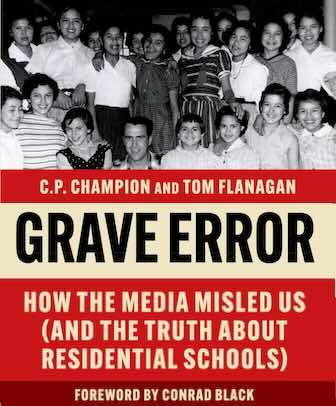
Moreover, a mountain of evidence in Grave Error, a best-selling collection of articles written by seasoned academics, lawyers, and editorialists, has thoroughly discredited the following assertions about the Indian Residential Schools:
- Thousands of “missing children” went away to residential schools and were never heard from again.
- These missing children are buried in unmarked graves underneath or around mission churches and schools.
- Many of these missing children were murdered by school personnel after being subjected to physical and sexual abuse, even outright torture.
- The carnage is appropriately defined as genocide.
- Many human remains have already been located by ground-penetrating radar, and many more will be found as government-funded research progresses.
- Most Indian children attended residential schools.
- Those sent to residential schools did not go voluntarily but were compelled to attend by federal policy and enforcement.
Public scrutiny and questioning of these groundless or exaggerated assertions followed a premature 2021 announcement by the Tk’emlups te Secwepemc First Nation of Kamloops, B.C. that it had discovered 215 children’s graves. The claim was later revised to 200 “potential burials” based on the discovery of soil anomalies using an inconclusive technique called ground penetrating radar that cannot determine the contents of sub ground disturbances.
Likewise, no human remains have been recovered to date despite $7.9 million in federal funding for field work at Kamloops, thereby enhancing public skepticism.
The 2015 Truth and Reconciliation Commission estimated that 4,100 children died at Indian Residential Schools. The number has never been verified through coroners’ files. In a July 25, 2024 report, the Senate committee acknowledged the figures were unsubstantiated.
Countering the assertions of Murray and her followers are the findings in Grave Error and hundreds of articles found here, here, here, and here. These studies have conclusively shown that:
- No more than one-third of indigenous students attended an Indian Residential School for an average of 4.5 years.
- Unless they were orphans or the product of abusive or dysfunctional families, such students attended voluntarily based on a signed application from their parents or guardians.
- Most children who perished while registered in an Indian Residential School died in hospitals or their home communities rather than at their schools. Their cause of death and burials were carefully recorded in Provincial death registers.
- No remains of these children have been found outside known and named Indian Reserve cemeteries or the handful of residential school cemeteries mainly dedicated to memorializing the death of staff members, orphans, and students from remote Indian Reserves.
- Rather than being a genocidal project, there is not a single verified case of a child murdered by a staff member at any of Canada’s Indian Residential Schools during their 113-year government-supported operation.
Hymie Rubenstein is a retired professor of anthropology at the University of Manitoba, Senior Fellow at Frontier Centre and the editor of REAL Indigenous Report.
View Comments
The Frontier Centre for Public Policy (FCPP) is an independent Canadian public policy think tank. Founded in Winnipeg in 1997, the Frontier Centre received charitable status in 1999 and currently has offices in Alberta, Saskatchewan and Manitoba.
Our research aims to analyze current affairs and public policies and develop effective and meaningful ideas for good governance and reform. We provide a platform for public debate and engage with the public through our numerous publications and events.