Less Canada, More Foreign Capital: The Hypocrisy of Carney's Quest for Foreign Investment
Ultimately, Carney is playing a shell game, trading taxpayer money and national sovereignty for foreign approval;

Nick Kossovan , Bio and Archives--September 19, 2026
Canadian News, Opinion | Comments | Reader Friendly | Subscribe | Email Us
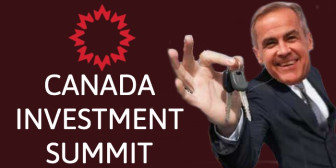
At Tuesday's inaugural Canada Investment Summit, Canadian Prime Minister Mark Carney delivered a masterclass in political sleight of hand, unveiling his headline capital expenditure tax policy. Carney pitched Canada as a secure economic safe harbour, now, to no one's surprise, aggressively seeking to attract global capital, including deep-pocketed American investors, to Canadian mega projects.
Carney hailed his fiscal package as a patriotic step toward true national independence. The truth, however, becomes clear once you strip away the rhetoric. While technically applicable to any business currently operating in Canada, Carney's asset-stripper tax write-off maneuver is an exercise in appeasing Canadians' anxieties about the Canadian economy's direction. In contrast to Carney's claims of bolstering the domestic economy, his initiative is an extravagant, multimillion-dollar corporate handout to foreign private equity firms and multinational corporations capable of initiating massive capital-expenditure surges on their own, funded by Canadians and businesses that elected Carney to look after their best interests.
A key component of Carney's corporate welfare opus is the Productivity Mega Deduction. This policy aims to turbocharge capital spending through sweeping fiscal measures:
- Instant Write-Offs: Instead of writing off major equipment and building costs over many years, companies can now deduct 100% of the cost in the first year.
- Everything Covered: Approximately 65% of business assets are eligible for write-off, including oil pipelines, corporate jets, and factory machinery.
- Permanent Tax Breaks: These write-offs will remain permanent, creating a structural tax shelter.
- The Lowest Tax Rate: Under this plan, Canada will have the lowest tax rate in the G7 at 6.4%, half that of the US.
- A $36-Billion Gamble: Canadian taxpayers are expected to pay $36 billion over five years to chase $1 trillion in investment.
At a post-announcement press conference, Carney defended this staggering giveaway with a rationalization that revealed a profound disconnect from everyday economic reality: "If we're in a race… we're ahead on the incentives, but we have ground to catch up. And what does this mean for Canadians and catching up to that ground? It means more jobs. It means a stronger country. It means more resilience, more independence, more sovereignty."
If Carney truly wanted to build a resilient economy, he'd look inward
It's a neat trick to equate corporate welfare for foreign multinationals with national pride. In an interview after the summit, Centre for Future Work economist Jim Stanford bluntly noted that foreign investment should not be the goal, adding, "we should be looking at these opportunities, carefully, judging them, negotiating with foreign investors to make sure the net benefit to Canada is as positive as it can be."
Instead of cautious pragmatism, Carney has opened the vault. A $36 billion tax write-off for multinational private equity firms and Wall Street asset managers, many of whom would have deployed capital anyway, amounts to a reckless corporate handout. Consequently, billionaire balance sheets are financed by Canadian taxpayers and struggling families, while public services are underfunded.
Furthermore, claiming "national sovereignty" while selling off Canada's economic infrastructure to foreigners is exceedingly hypocritical. Carney's strategy of trading the US, Canada's primary external economic master since Confederation, for multiple others is his bid to mitigate American trade friction while locking Canada into a permanent state of offshore dependency. By rolling out the red carpet for foreign conglomerates while leaving domestic businesses to grapple with persistent inflation, high operating costs, trade and tariff uncertainty, and regulatory burdens, Carney is engaging in nothing more than empty economic tokenism. He wants the political optics of standing up to Washington while pandering to foreign boardrooms—"Look at what I'm doing for Canadians!"—ensuring that Canada remains structurally and economically "less Canada."
If Carney truly wanted to build a resilient economy, he'd look inward.
The math doesn't add up
Canadian prosperity won't come from the transient whims of global asset allocators; rather, it will come from entrepreneurs, business owners, employers, and Canadians who don't feel as financially stressed as they do today. Providing aggressive tax incentives and deep tax cuts for established Canadian businesses would build organic, homegrown wealth that stays within Canada's borders. Instead, Canadian businesses watch with frustration and anger as Carney grants preferential treatment and fast-tracked reviews to foreign corporations, while treating Canadians like second-class citizens in their own country.
The math doesn't add up. Canadian taxpayers will ultimately bear the $36 billion shortfall through reduced public services or future tax hikes. However, Carney's tax enticement has one major problem: Because he failed to secure a long-term trade deal with the US, exporting goods across the border has, for the most part, become cost-prohibitive, a significant deterrent. No amount of tax wizardry can hide the fact that foreign companies have little substantive reason to set up shop in Canada beyond skimming short-term subsidies and flying away.
Ultimately, Carney is playing a shell game, trading taxpayer money and national sovereignty for foreign approval. By prioritizing foreign conglomerates over Canadian companies, he's locking Canada into permanent economic subordination. As long as Ottawa chases global capital ghosts instead of supporting Canadians who live, work, and bleed here, the Canadian economy will remain nothing more than a branch of foreign boardrooms.
______________________________________________________________
Nick Kossovan, a self-described connoisseur of human psychology, writes about what's on his mind from Toronto. You can follow Nick on Twitter and Instagram @NKossovan.
Related:
View Comments