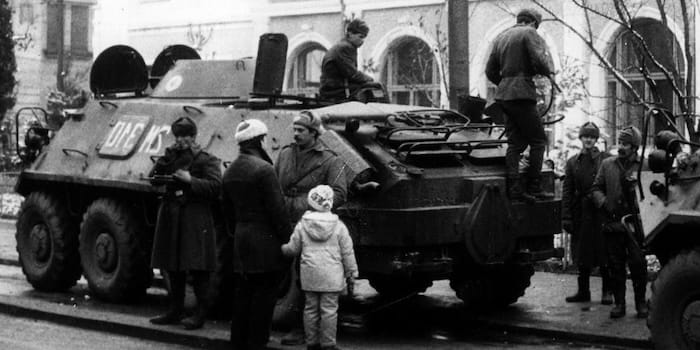
Such woes are small compared to those suffered by Romania last century. The country turned Communist after the Soviet Red Army advanced west to overtake Germany in World War II. General Secretary Nicolae Ceaușescu, who ruled for 24 years, first came to power in 1965.
Ceaușescu’s rule became especially harsh beginning in 1981. That year, he launched an austerity plan to tackle the national debt of USD $10 billion that rationed gas, heat, and food. Infant mortality grew to the highest rates in Europe.
Regardless, Ceaușescu always had enough money for his expensive and grandiose megalomaniac projects in the capital city of Bucharest. This included a House of the Republic for US$1.75 billion, the hotel and mall of the Dâmbovița Center for US$275 million, and the 5.9 square kilometre Centrul Civic area.
To establish Centrul Civic, 40,000 people were given one day’s eviction notice, then relocated to other residences. Buildings plowed to rubble included 3 monasteries, 20 churches, 3 synagogues, 3 hospitals, 2 theatres, and a sports stadium. Common people nicknamed the project Ceaușima, a word fusion of Ceaușescu and Hiroshima. The dictator was destroying his own capital city with the force of an atomic bomb.
Yes, Communist “urban planning” was more draconian than any 15-minute city plans floated today. Under “systematisation”, small villages were declared “irrational”, leading to the forced relocation of people and the destruction of the former buildings, including historic churches and monasteries.
The Securitate, the country’s brutal secret police, was ever-present and quelled opposition. Informants were quick to rat on those spreading anti government messages. However, such oppression cannot last forever, especially when a champion rises up against it.
Despite government dominance over church affairs, Hungarian Reformed Pastor László Tőkés was a consistent critic of the Ceaușescu regime throughout the 1980s, especially regarding systematisation. On July 24, 1989, Hungarian State TV aired a TV interview of Tőkés where he stated that Romanians need not support the Ceaușescu dictatorship.