Let’s Go Over This Polling Thing Again
Survival in Tough Times

Dr. Bruce Smith , Bio and Archives--August 25, 2024
American Politics, News | Comments | Reader Friendly | Subscribe | Email Us
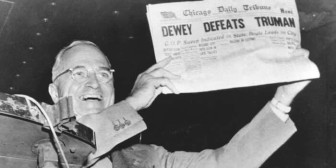
Public polling can be useful, but it often becomes a tool for manipulating public thinking.
Never having been a math person, my skepticism toward polling has only grown more pointed over the years. With polls and samples and surveys, the usual technique is to select a pool of people to sample, then send questionnaires or conduct interviews over the phone to determine results.
The results are then subjected to different kinds of mathematical formulas to allow for variables. Once the math is done, then the responses become legitimate plus or minus a percentage point or two. The math is used to make the survey “scientific” and build its credibility with the public, with the target audience, or with whoever paid for it.
I say this results in a lot of hogwash, and here are some reasons why.
Everything depends on whom you’re asking and how the questions are phrased. Polls must use a question of some kind, and that makes them unreliable and subject to manipulation. One of the few things I actually learned in a Big Ten university school of education many years ago is that test questions are notoriously unreliable as viable tools of testing. ‘Do you think Mayor Bloat should stop beating his wife?’ ‘Did the president know about the Watergate break-in ahead of time?’ Those are very different questions than something like this: ‘Do you prefer butter or margarine on your toast?’ The first two cannot be reliable while the last one isn’t one hundred percent reliable. What if people don’t want anyone to know they eat butter? What if the responder prefers dry toast? What if they don’t care either way? What language is used for the questions? Do people understand that language the same way as other people do? Do we rely on the math people to allow for the misunderstandings that come from language?
Polls are taken with a chosen pool of respondents. Somebody chooses the members of the pool. Choosing the pool makes all the difference because the respondents are supposed to represent a wider societal group whose views matter to someone. Polls are skewed to suit the pollster, so if a pollster wants to show that the public favors soy-based products over animal protein, there are ways to skew the sample to get a preferred result.
Selecting polling groups “randomly” doesn’t help, either. Where does the list come from to select randomly? Licensed drivers? People who live in a particular zip code? The post office? Property owners? We are supposed to take comfort from those who do the math to take the biases out of surveys. Right. That doesn’t help either, because the people doing the math have biases of their own.
Poll answers must come from somebody who is home or who answers the phone, or who sends a reply via text, email, or snail mail. Poll answers do not come from anyone who isn’t home, who travels, who is at work, who sleeps deeply, who doesn’t want to be bothered, or who doesn’t like polling questions. People who answer the phone in the middle of the day at home would not make a typical sample by anyone’s measure, and land lines are mostly a thing of the past. Where I live there are still phone books, and my land line number is in there, but I don’t have a land line phone that works. A phone book random sample isn’t random at all.
Polls assume that the subjects answer truthfully. I was on the Nielson Television viewing Survey list in the early 1990s. On three different occasions they sent me two quarters. I had a land line phone. My address, a tiny student apartment owned by a small college next door to a big college, was on the list. Whoever lived there before me got the survey. I got the survey. Whoever lived there after me got the survey. When I pocketed the two quarters and filled out the diary, I listed every show I liked and none that I didn’t like, whether I watched them or not. Doesn’t sound very scientific, does it?
What are pollsters really after? I had a phone call yesterday from someone whose native language was not English. That call amounted to a sales lead poll. He asked me cheerily how I was feeling. We didn’t have the best connection because I was driving on country roads. Then he began with the poll questions. ‘Are you a business owner?’ (He didn’t ask what my business was, but I already knew his.) ‘Do you need funding to expand your business or pay bills?’ ‘How much could you use?’ ‘One, two, five, ten, a hundred?’ I said, “What do you mean, hundreds, thousands?” ‘Yes, he said cheerily.’ I had the sense I was scoring in the highest percentile in his poll. When I asked him about the interest rate, he balked, saying that the type of business would determine the interest rate, and that I could pay each week or month. I dropped the call, and he immediately called back from a different area code. We spoke a few more minutes when the call dropped again. He called back right away from yet another area code. When I told him I wasn’t interested in borrowing money, he laughed, said “Okay,” then hung up. He was taking a particular type of push poll. He wanted me to commit to using his product. He wasn’t careful about his pool of respondents and let me waste nearly ten minutes of his time. The moral of the story is this: when some pollsters don’t get the answers they want, they hang up and try somebody else.
So polls can be useful, but are often used to manipulate, especially as election time draws near. Polls are widely used to paint images that defy belief. For three years people have been complaining about the lack of substance of some of our political leadership. Just thirty days ago the polls changed completely and now proclaim that the same people are amazing and are just what we need. It’s a miracle!
Political polls that are not based on a sample of likely voters are absolutely useless. A sample from the phone book or from a mall cannot reflect any political reality other than the people being sampled. Yet we hear all kinds of polls telling us that candidate X is the likely winner. None of these polls begins with an explanation of the details of the sample or the technique or the questions. We are reassured that the poll is accurate within 1-3% of blah, blah, blah. It means nothing. Those polls tell us who the winner will be so we will either join the crowd to vote for them or just stay home and not vote at all. Who wants to vote for a loser?
The ironic part of polling is internal polling and private polling. Smart political types really want to know what likely voters will do, so they quietly take polls that only they will see. They aren’t trying to fool anybody. They want the straight dope. In that type of poll they ask the straight questions and try to get straight, reliable answers. That makes them very different and for this reason, we rarely hear about them.
The only poll that counts is the count that’s made at a polling place on election day. In the old days, voting was on election day (with the exception of a very few absentee votes by people who had to be out of town on election day). But let’s say I was given a questionnaire sheet by the Beer Party asking me my preference between lager, brown ale, and stout. Being a fervent fan of brown ale, I decide that I want my side to win the poll, so I make 500 copies of the questionnaire, mark them all by hand checking the brown ale box, fold them, mix them up, and put them in different drop boxes so they don’t all arrive at headquarters in a lump.
Now any voting or polling worth anything must guarantee that the sample is fair, that only the people allowed to vote do the voting, and that somebody can’t just duplicate ballots to make sure their side wins. Let’s hope that never happens!
Before the introduction of the Australian (secret) ballot in this country early in the 20th Century, political parties just printed up ballots any way they liked and handed them to voters to turn in, sometimes with the choices already marked. What could possibly go wrong with that system? The Australian ballot became a feature of American elections because it made cheating much harder. There were known numbers of ballots printed, both parties had people present at the polls to make sure there was no funny business, and there were strict accounting and security protocols.
Electronic voting has negated the protections provided by the old Australian ballot system. These systems can be manipulated by people in distant locations. Other methods like ballot harvesting and ballot box stuffing raise more questions, particularly in swing states with narrow margins of victory. Some cities and states allow non-citizens to vote. This vulnerability to manipulation has called recent elections into question. Some people want the funny business to continue and some want a return to election integrity. Isn’t that interesting!
So when I hear a “news” story about a poll released by Pew or the New York Times, or Fox News, or Quinnipiac, or anybody else, I laugh if it’s early in the campaign season, and I snarl if it’s within 90 days of election day. There’s an unspoken agenda there, guaranteed. Somebody wants to persuade voters to
1. buy something
2. like somebody
3. dislike somebody
4. vote for somebody
5. give up and not vote
6. believe anything they’re told
Remember the old Dewey Defeats Truman headline from the Chicago Tribune held up by Truman the day after he beat Dewey? Me too. That was 1948. So how can anyone still take polls seriously?
View Comments
Dr. Bruce Smith (Inkwell, Hearth and Plow) is a retired professor of history and a lifelong observer of politics and world events. He holds degrees from Indiana University and the University of Notre Dame. In addition to writing, he works as a caretaker and handyman. His non-fiction book The War Comes to Plum Street, about daily life in the 1930s and during World War II, may be ordered from Indiana University Press.