Lighting the Way Against Alzheimer’s
MIT researchers are testing whether synchronized light and sound can slow Alzheimer’s disease;

Chet Nagle , Bio and Archives--July 23, 2026
Health and Medicine | Comments | Reader Friendly | Subscribe | Email Us

Forty Hertz means 40 cycles per second--the rhythm at which the light flashes and the sound pulses. That frequency is one of the brain’s natural gamma-wave rhythms associated with attention, memory, and information processing.”
The idea sounds too simple to be true. You sit comfortably in front of a special screen for an hour each day while synchronized light and sound are delivered at carefully controlled intervals. You can also watch a movie on the screen or other relaxing entertainment on the screen while the treatment simultaneously takes place. Then you go about the rest of your day.
This straightforward routine is the culmination of years of scientific research. What began as laboratory experiments on mice has progressed to large, controlled clinical studies involving volunteers and people with Alzheimer’s disease. The goal is to determine whether this non-drug therapy can slow the progression of the disease while allowing patients to remain in the familiar surroundings of home.

Today’s approved Alzheimer’s medications can provide benefits for some patients, particularly in the early stages of the disease. But those benefits are generally modest, and the medications may not be appropriate for everyone. That reality has encouraged researchers to explore entirely different approaches—ones that work by stimulating the brain itself rather than by introducing another drug.
The work at MIT has become one of the most closely watched of those efforts.
Researchers at MIT discovered that exposing the brain to precisely synchronized light and sound appear to activate natural patterns of brain activity associated with memory and attention. Laboratory studies on mice produced changes that encouraged scientists to move cautiously toward human trials.
What Home Treatment Looks Like
Imagine walking into a comfortable living room instead of a hospital treatment room. A lightweight LED panel, about the size of a large television, stands on a tripod a few feet in front of an easy chair. Nearby, a pair of speakers is synchronized with the light panel. A tablet or small computer controls the treatment and can also play movies or other entertainment while the session is underway.
The patient sits five feet from the panel and relaxes for an hour. During that time, the light flashes and the sound pulses on the screen are produced in a carefully synchronized pattern that is unnoticeable after the first few minutes. There are no needles, no intravenous infusions, and no complicated medical procedures. The goal is to make the treatment as comfortable and convenient as possible so it can become part of a daily routine.
That simplicity is one of the reasons researchers are so interested in the approach. Alzheimer’s disease is a long-term illness, and any successful treatment must be practical enough for patients and caregivers to use consistently. A therapy that can be administered safely at home has obvious advantages over one that requires frequent visits to a medical center.
Scientists call this technique Gamma Entrainment Using Sensory Stimulation, or GENUS. The name sounds technical, but the idea is straightforward. The synchronized light and sound are designed to encourage the brain to produce natural patterns of activity that are associated with healthy memory and thinking. Rather than introducing a new drug into the body, the treatment seeks to stimulate the brain’s own normal rhythms.
To determine whether the therapy truly works, the clinical studies also include a control group. Some participants receive the synchronized stimulation being investigated, while others use devices that appear identical but do not deliver the stimulation that researchers are testing. Neither the participants nor the investigators who evaluate them know which treatment an individual has received until the study is complete. This “blinded” design is one of the most reliable ways to determine whether a new therapy is genuinely effective.
For families living with Alzheimer’s disease, however, the technology itself is only part of the story. The real question is whether this daily routine can make a meaningful difference in memory, thinking, and the ability to remain independent. That question has driven years of laboratory research—and it is what today’s large clinical studies on humans are designed to answer.
From Laboratory Discovery to Human Trials
Every promising medical treatment begins with a question. In this case, MIT researchers wondered whether the gentle rhythms of light and sound might do more than simply stimulate the senses. Could they influence the brain in ways that protect memory?
To find out, they turned to laboratory mice bred to develop changes resembling those seen in Alzheimer’s disease. The results surprised the researchers.
After repeated sessions of synchronized light and sound stimulation, the mice showed significantly fewer amyloid plaques—the sticky protein deposits that have long been associated with Alzheimer’s disease. They also had lower levels of abnormal tau protein, another hallmark of the disease. Equally important, the treatment appeared to reduce inflammation in the brain, a process many scientists now believe plays a major role in the progression of Alzheimer’s.
Benefits did not stop there. The laboratory mice performed better on memory tasks than untreated mice, indicating that the therapy was doing more than changing laboratory measurements. It also appeared to revive important brain functions.
Those encouraging findings prompted a larger question: Would the same approach prove to be safe—and beneficial—for people?
That question could only be answered through carefully designed human studies. The first clinical trials focused primarily on safety and on whether patients could comfortably use the treatment in their own homes every day. Those early studies also looked for signs that the therapy might slow the changes in the brain that accompany Alzheimer’s disease.
The results were encouraging enough for researchers to move forward into much larger, controlled studies involving participants at multiple medical centers. These trials are designed to determine whether the treatment can meaningfully slow cognitive decline and preserve everyday functioning over time.
That progression—from laboratory discovery to pilot studies and then to large, controlled clinical trials—is the path followed by virtually every important medical advance. It is a process designed to protect patients while ensuring that promising ideas are tested rigorously before they become part of routine medical care.
No one can say with certainty whether synchronized light and sound will become the standard treatment for Alzheimer’s disease. That answer will come only after the current studies are completed and carefully analyzed. But the fact that the research has advanced this far reflects the confidence that scientists have gained from years of steadily accumulating evidence.
For families confronting Alzheimer’s today, that may be the most encouraging news of all. What began as an unexpected laboratory observation is now being tested on a scale large enough to answer the question that matters most: Can this treatment help people preserve their memories and independence?
How Can I Participate?
For people living with Alzheimer’s disease—or for families concerned about someone they love—the next question is obvious: Can I receive the treatment?
The answer depends on where you live, your stage of illness, and whether you qualify for one of the ongoing clinical studies.
Researchers at MIT, working with Cognito Therapeutics and medical centers across the country, are conducting large, controlled studies to determine whether synchronized light and sound therapy can safely slow the progression of Alzheimer’s disease. Participation is voluntary, and every prospective participant undergoes a careful screening process to determine whether the study is appropriate for them.
Clinical trials are designed to answer scientific questions as reliably as possible. That means not every volunteer receives the active treatment being evaluated. Some participants use devices that deliver the synchronized light and sound under investigation, while others receive a comparable treatment that appears similar but does not provide the specific stimulation researchers are testing. Neither the participants nor the clinicians evaluating their progress know who is in which group until the study has ended.
Although that may seem disappointing at first, it is the only way researchers can determine with confidence whether a new treatment is truly making a difference. Every volunteer, regardless of group assignment, contributes valuable information that helps answer questions for future patients.
If you are interested in learning more about current studies, the easiest place to begin is ClinicalTrials.gov, the U.S. government’s public registry of clinical research. Searching for “GENUS,” “Cognito Therapeutics,” or “Alzheimer’s light and sound therapy” will identify studies that are currently recruiting or planning to recruit participants. The MIT Picower Institute and Cognito Therapeutics also provide updates on their research and clinical programs.
Not everyone, however, lives near a participating medical center. Others may not qualify for a clinical trial because of age, stage of disease, or other medical considerations. Understandably, many families wonder whether a similar treatment is available outside the research setting.
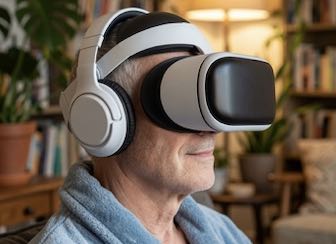
That question has encouraged growing interest in wearable devices that combine synchronized light and sound in a headset designed for home use.
Some systems use specialized light-delivery glasses together with headphones, making the treatment more portable than the larger panel-and-speaker setup used in many early studies. These devices are intended to make daily therapy easier while still delivering the synchronized stimulation being evaluated by researchers.
It is important to recognize, however, that not every product marketed with claims about brain stimulation has been tested in rigorous clinical trials. Families considering any commercial device should ask whether its design and claims are supported by published scientific evidence and should discuss the decision with their physician, memory specialist, and the MIT group conducting research on large groups of volunteers and Alzheimer patients.
The story of synchronized light and sound therapy is still being written. The ongoing studies will determine whether this approach ultimately becomes part of standard Alzheimer’s care. But for the first time, many families have an opportunity to follow the research as it unfolds—and, for some, to become part of a scientific effort to answer one of medicine’s most urgent questions.
Questions Readers May Ask
Will I see the flashing light? Yes. The light pulses rapidly, but most participants report that they become accustomed to it quickly. The stimulation is designed to be comfortable for daily use.
Is the treatment painful? No. The therapy is completely non-invasive. There are no needles, injections, or surgery. Participants simply sit comfortably while synchronized light and sound are delivered.
How long does a treatment session last? Most current research protocols involve one session a day, typically lasting one hour, although exact procedures slightly vary from one study to another.
Can healthy people use this treatment to prevent Alzheimer’s disease? Researchers do not yet know. Current clinical studies are designed to determine whether the treatment is safe and effective for people who already have Alzheimer’s disease or mild cognitive impairment. Whether the treatment might one day help prevent the disease remains an important question for future research.
Where can I learn more? The best starting point is ClinicalTrials.gov, where ongoing studies can be found by searching for GENUS, Cognito Therapeutics, or Alzheimer’s light and sound therapy. The MIT Picower Institute and Cognito Therapeutics also provide updates on current research and clinical studies.
A New Light on an Old Challenge
For more than a century, Alzheimer’s disease has remained one of medicine’s most difficult challenges. It has taken memories, independence, and precious years away from millions of individuals and families. Despite remarkable advances in understanding the disease, effective treatments that can substantially change its course have remained elusive.
The search has led researchers down many paths. Some approaches have focused on developing drugs that target the biological changes associated with Alzheimer’s. Others have explored ways to strengthen the brain’s own ability to adapt and maintain function. The work at MIT represents one of the most intriguing examples of this second approach: rather than introducing another chemical into the body, researchers are investigating whether carefully timed patterns of light and sound can influence the brain itself.
What makes this research especially compelling is the journey it has taken. The idea began with observations in the laboratory, moved through studies involving mice, progressed to early human safety studies, and has now advanced into large, carefully controlled clinical trials. At each step, researchers have asked the same essential question: Does this approach truly help people?
The answer is not yet known.
That answer will come only after the current studies are completed and the results are carefully analyzed. Some promising treatments succeed because early observations prove to be the beginning of something much greater. The purpose of rigorous clinical trials is to find out which path a new therapy will follow.
But even before those final answers are available, the story of synchronized light and sound stimulation offers something important: a reminder that medical progress often begins with unexpected ideas. A simple observation in a laboratory can eventually lead to a treatment that is tested in the homes of patients around the world.
For families affected by Alzheimer’s disease, hope must always be balanced with evidence. Yet hope is also what drives scientific discovery. Researchers continue to explore new approaches because every patient and every family deserve better options than those available today.
Whether forty-hertz sensory stimulation becomes a major advance in Alzheimer’s care remains to be determined. But the possibility that a non-invasive therapy—delivered simply through light and sound—could help preserve memory and independence represents one of the most fascinating developments in the ongoing effort against this devastating disease.
Progress begins by seeing an old problem in a new light.
View Comments
Chet Nagle is an experienced analyst and commentator on international commerce, geopolitics, national security matters, the Middle East, and strategic communications. He has been on radio, has appeared in documentary films and has been a guest on television news programs. His columns have appeared in the Daily Caller, The Hill, Roll Call, and many other publications. He is a contributing editor for ANDmagazine.com and the European Security & Defense magazine.