Madison Calls Out Biden
Survival in Tough Times: To the pushers of this kind of political chicanery, YOU’RE BUSTED

Dr. Bruce Smith , Bio and Archives--November 3, 2024
American Politics, News | Comments | Reader Friendly | Subscribe | Email Us
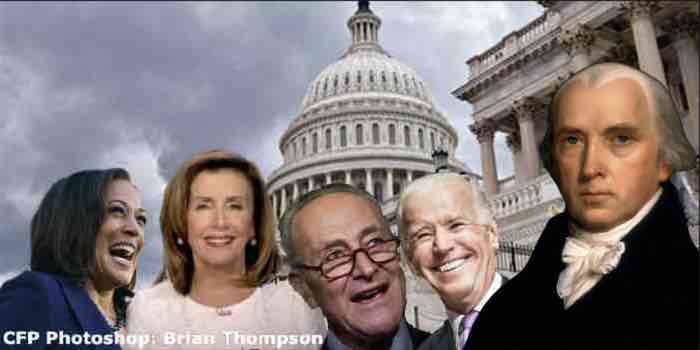
The American republic was blessed at its founding with a group of remarkable founders, among them Jefferson, Franklin, Madison, and many others. James Madison became known as the Father of the Constitution for his contributions at the Constitutional Convention of 1787 and his advocacy for adoption by the states. His private diaries written during the proceedings of the Convention formed the basis for understanding what had happened in secret in Philadelphia that summer. Published in 1840 as The Madison Papers, they opened the door to later scholars who began to explore the proceedings of that famous gathering.
Federalist #51--Championing the idea of the separation of powers in the federal government
Once the Constitution had been written and published, it was necessary for nine of the thirteen states to ratify it before it could go into effect. In the weeks and months following the end of the Convention, advocates and antagonists set to work forming their arguments for and against ratification. Among the best known and most influential writings were the eighty-five essays offered by James Madison, John Jay, and Alexander Hamilton favoring adoption, and titled The Federalist.
Understanding what happened at the Convention and why it happened requires spending time with The Federalist. Nothing else explains better the thinking of the founders than these essays. In my student days and later on teaching the first half of the American history survey, in colonial and early national history classes, and especially when teaching government, Madison, Hamilton, and Jay continue to explain the genius and benefits of the Constitution in ways that resonate with each new generation of scholars and students. In other words, they are essential reading in these classes and for everyone interested in governance in the American republic.
There are famous numbers of The Federalist and more obscure ones. Among the most famous are Federalist #10 and Federalist #51, both written by Madison. Federalist #51 focuses on the creation of a government divided into sections that may not control each other but instead function as a system of checks and balances. This separation of powers served as a necessary restraint on the branches and officials of the new government which would prevent them from gaining too much power in the future. We can summarize #51 as championing the idea of the separation of powers in the federal government.
Federalist #10--Prevent the accumulation of too much power in one branch or the other
Federalist #10, published in February 1788, was about how factions would prevent the accumulation of too much power in one branch or the other. A large republic like the new United States would necessarily see its people spread over a vast expanse of territory. This large area was a key safeguard for the new nation because it would provide a wide variety of factions based in far-flung portions of the country to be represented in the new government. Power was not concentrated in a capital city or region, meaning that it would be difficult or impossible to coordinate so many different interests and factions into a powerful majority to promote questionable ideas. The very size of the country along with the great distances between the states and the population centers would make the concentration of power unlikely at worst, and well-nigh impossible at best.
In the next-to-last paragraph of Federalist #10, Madison gave examples of the ways in which factions would serve to check bad ideas.
- The influence of factious leaders may kindle a flame within their particular states, but will be unable to spread a general conflagration through the other states: A religious sect, may degenerate into a political faction in a part of the confederacy; but the variety of sects dispersed over the entire face of it, must secure the national councils against any danger from that source…
It’s important to go back now and then to reread The Federalist
It’s so brilliant and so easy to understand. There are lots of bad ideas that may be pushed by a faction intent on its own political gain. Madison took time in the next sentence to actually list some of these. I have read and taught Federalist #10 many times, but I always thought that the closest examples we could find of the dangers he listed were the efforts by the Greenback party and later the Populists of the 1890s to create inflation via the issuance of paper money resulting in inflation. There was some of this in the New Deal in the 1930s as well.
It’s important to go back now and then to reread The Federalist. Like all good reads, we often find new gems of wisdom reading it again with recent events now behind us and new ones unfolding each day.
In this way I did a double take recently when reading Federalist #10. Madison has just stated that the “variety of sects dispersed over the entire face of [the nation], must secure the national councils against any danger from” a malevolent political faction. Then he listed some of the dangerous ideas that might be promoted.
Improper and wicked: Biden's proposed student loan forgiveness schemes
Here is the passage that shocked me. (Italics added) “…A rage for paper money, for an abolition of debts, for an equal division of property, or for any other improper or wicked project, will be less apt to pervade the whole body of the union, than a particular member of it; in the same proportion as such a malady is more likely to taint a particular county or district, than an entire state.”
Read it again. “…an abolition of debts…or for any other improper or wicked project…” Then look at today’s headlines. The Biden administration has proposed on three separate occasions that it intends to forgive varying totals of student loan debt. Two of those the Supreme Court declared invalid. The third one began in the last few months in defiance of the Court’s rulings and has not moved into the court system yet. They have decreed by executive order that billions of dollars of student loan debt will be “forgiven” for those who borrowed the money. It’s beautiful. James Madison himself declared that schemes for the abolition of debts could only be called “improper or wicked.” Madison didn’t mince words. He has long been famous for the careful use of language.
To those members of the Biden administration who proposed and advocated the various student loan forgiveness schemes, James Madison himself said they were improper and wicked.
James Madison considered this kind of scheme a matter of evildoing. To the pushers of this kind of political chicanery, YOU’RE BUSTED. You ought to be ashamed, but you’re probably hoping instead that nobody goes back to read Federalist #10.
View Comments
Dr. Bruce Smith (Inkwell, Hearth and Plow) is a retired professor of history and a lifelong observer of politics and world events. He holds degrees from Indiana University and the University of Notre Dame. In addition to writing, he works as a caretaker and handyman. His non-fiction book The War Comes to Plum Street, about daily life in the 1930s and during World War II, may be ordered from Indiana University Press.