Malign Neglect: What Calgary's Water-Main Break Reveals About The Failure of City Government
Rupture of Calgary’s biggest water main revealed more than the problems of aging infrastructure. It showed a civic bureaucracy unable to provide basic services or fix things when they break, A mayor eager to blame others and scold citizens

Frontier Centre for Public Policy , George Koch, Bio and Archives--June 29, 2024
Canadian News, Opinion | Comments | Reader Friendly | Subscribe | Email Us
As the enormous task forces of the U.S. Navy steamed westward across the Pacific Ocean in the final year of the Second World War, aiming ultimately for Japan but with some of the most vicious fighting still to come on islands like Okinawa and Iwo Jima, commanding admirals issued orders that any man who fell overboard would be left behind.
No ship was to slow down for search-and-rescue; nothing was to get in the way of the mission. Several weeks ago, during one of the Stanley Cup semi-final games, a player was hit hard, fell to the ice, got up with difficulty, hobbled towards the bench and disappeared down the “tunnel”. The game went on, uninterrupted. Here too, the mission – entertaining millions – took precedence.
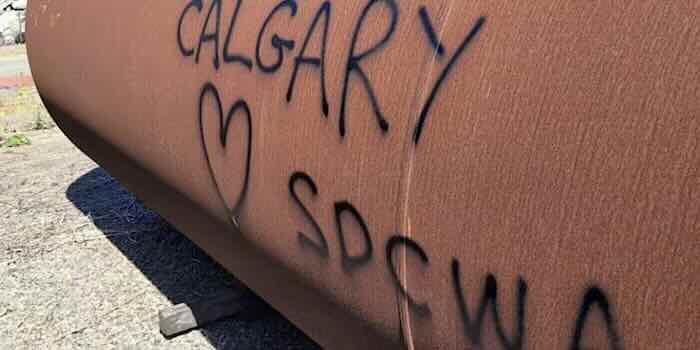
But when two municipal workers on a crew attempting to repair a catastrophic infrastructure failure in a major North American city are injured, the work immediately halts. Although the broken item serves a function vital to civilization and life itself, the mission of restoring water supply as quickly as possible becomes secondary. This happened 10 days ago, a week after the rupture of a high-pressure water main in Calgary had sent water shooting up out of busy 16th Avenue, triggering frantic 911 calls and initiating a “one week” repair saga that as of this writing is still weeks from completion.
The two injured workers were taken to hospital (thankfully, with non-life-threatening injuries) and the repair work eventually resumed the next day. But the interruption, piled atop days of confusing, contradictory, self-serving and at times seemingly false explanations and promises from senior city officials and embattled mayor Jyoti Gondek, generated further mistrust and anger among Calgarians over their city bureaucracy’s inability to operate the basics and get things fixed when something breaks down. The safety stand-down came on the very day the city had originally promised to restore water service, a time when every hour was precious, when the sacrifices by city residents and businesses were still bearable, when a return to normality seemed imminent. So why imperil the mission with nearly 24 hours of navel-gazing?
Though soon forgotten as new problems arose, the decision is emblematic of governments’ misplaced priorities, subordination of their core mission to their social policy fetishes and confusion over whose interests they exist to serve. Governing a city appears to have become primarily about keeping city workers, senior officials and elected politicians happy. Above all, to shield them against real accountability. Residents and businesses – the people who vote and pay the bills – are basically problems to be managed.
A few key facts for readers distant from Calgary. The 2-metre-diameter Bearspaw South feeder main burst its concrete casing on the afternoon of June 5. Installed in 1975, it draws from the Bearspaw Water Treatment Facility on the Bow River in the city’s northwest, and normally supplies up to 60 percent of the city’s drinking water. The break required the city to rely on a much older but very reliable plant drawing on the Glenmore Reservoir, which dams the Elbow River in the city’s southwest. The rupture prompted Stage 4 water restrictions with various bans and recommendations (more on that below), including a call for Calgarians to collectively cut the city’s water consumption by 25 percent, to 480 million litres per day. People immediately responded and, within several days, the city was reporting a water surplus. (For those seeking more details, the Calgary Herald has logged the key daily events.)
From the beginning, the city’s attempts to explain things did not quite add up. The water main had been inspected and tested regularly, officials said, or at least once for sure, and had received “maintenance” as recently as April. Most people probably assumed this involved physically examining it from the inside, then subjecting it to excessive pressure to see if it would hold, and patching up any weak areas. But all that would require first draining a pipe that, after all, 1.6 million people depend on every minute of every day. Later it came out that the line had last been drained and inspected in 2007.
- For a few days it seemed as if water service would be restored within the promised one week. But on June 15 it was announced that line inspections (which apparently had occurred in the physical world and not merely in city officials’ media narrative) had found five more ‘hot spots’ – i.e., potentially calamitous weaknesses. Tweet
So then it was explained that sophisticated external sensors had not detected any leaks in the most recent inspection. But then someone pointed out that catastrophic failures of an entire multi-layered structure of inner concrete core, steel piping, wire tension coils and outer concrete don’t usually begin with small leaks. And then someone else let slip that the line’s robustness had been confirmed by modelling, i.e., relying on theory.
“This pipe is only at the halfway point in its life cycle,” lamented Sue Henry, Chief of the Calgary Emergency Management Agency. “By all accounts, this should not have happened, but it did.” But others pointed out that the 100-year-lifespan claim was itself bogus. Lines of this type, said Tricia Stadnyk, Canada Research Chair in hydrologic modelling with the University of Calgary’s Schulich School of Engineering, are rated to last 50 years. And the Bearspaw South line was built…49 years ago. (The lifespan issue gets even worse – more on that below.)
Gondek, for her part, extended her track record of blaming anyone but herself by claiming the disaster could have been averted if only Alberta’s UCP government had “paid enough attention” and not denied Calgary the money it desperately needed for preventative maintenance and repair. The implications of her claim didn’t quite gibe with city officials’ assurances that the line was considered just fine. And Alberta Premier Danielle Smith shot back that Gondek “has never asked us for funding to repair their water supply infrastructure,” and that the province is providing the city with $224 million to allocate as it pleases. Others noted it was never a question of money at all, because Calgary has generated successive annual budget surpluses but either spends those funds on more congenial pursuits or carries them over into future years.
Still, for a few days it seemed as if water service would be restored within, or very soon after, the promised one week. But on June 15 it was announced that line inspections (which apparently had occurred in the physical world and not merely in city officials’ media narrative) had found five more “hot spots” – i.e., potentially calamitous weaknesses. The repair timeframe was abruptly extended to three to five weeks, well into July. And with that, the City of Calgary declared a State of Local Emergency.
There is an emergency in Calgary – and virtually every city across North America and the Western world. At least two types of emergency, actually. The first type is the open, at times almost gleeful refusal to focus on the basic responsibilities of municipal government. Such as paving roads – Calgary’s are notoriously cracked and potholed – instead of removing lanes from busy thoroughfares and lowering speed limits in order to create still more unused bike lanes. Or ensuring that public transit facilities are clean and safe for law-abiding users, as opposed to all-but abandoning buses and C-Trains to drug addicts, while still pushing for funding of the next multi-billion-dollar transit line.
Read the rest at: Frontier Centre for Public Policy
First published here.
George Koch is Editor-in-Chief of C2C Journal.
View Comments
The Frontier Centre for Public Policy (FCPP) is an independent Canadian public policy think tank. Founded in Winnipeg in 1997, the Frontier Centre received charitable status in 1999 and currently has offices in Alberta, Saskatchewan and Manitoba.
Our research aims to analyze current affairs and public policies and develop effective and meaningful ideas for good governance and reform. We provide a platform for public debate and engage with the public through our numerous publications and events.