Manufacturing is Here Again
It takes all of us to participate. To innovate. To manufacture. I have faith, and I hope that America has the will

Douglas V. Gibbs , Bio and Archives--October 11, 2025
American Politics, News | Comments | Reader Friendly | Subscribe | Email Us
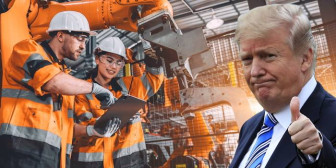
The United States emerged out of the Revolutionary War as a developing country in a world of empires. By the time the Constitution was written the machinery to sustain the Union had been slowly moving into place. Even back then the leadership in America realized that to survive in such a hostile world, the foundation of its international interactions must be girded by industry.
The rise of American industry went beyond mere commerce. It was constitutional destiny
Manufacturing was seen as the key component for establishing a self-reliant republic. Production, innovation and the ability to export were requirements if America was going to compete on the world stage while also ensuring that the states were not gobbled up empires eager for power and determined to end America before it gained its footing. To depend on foreign goods would be to invite foreign influence, but to build at home was to secure sovereignty.
America began as an agrarian, fractured, and vulnerable society. The fledgling country was not capable early on of producing its own arms, textiles and tools; and if that condition remained in place the new country would remain shackled to the whims of empires and a world that squabbled over lands and resources. Manufacturing was the ignition, and ultimately the muscle, behind independence. It became the engine of expansion, and the bulwark against economic servitude.
By the mid-1800s the Industrial Revolution had transformed the United States from a developing third-world union of states to a major global force. Ironworks, textile mills, locomotive factories, the Erie Canal, the railroads, and the telegraph all stitched together a continental economy that launched America from being a passive consumer to a producer, builder, and major worldwide economic giant.
The rise of American industry went beyond mere commerce. It was constitutional destiny. The young republic refused to outsource its future, and instead invested in it. Tariffs protected America’s fledgling industries, patents rewarded invention, a foundation of self-reliance fueled innovation, infrastructure enabled distribution, and the U.S. Navy protected international trade routes. The Founding Fathers did not envision a country bound by dependency, but unshackled by a dynamic free market coupled with a dynamic industrial resilience.
Manufacturing breeds innovation, and innovation breeds economic success
Manifest Destiny reached deeper than geography. To manufacture was to manifest. Industrial dominance shapes raw materials into meaning—it is an act of creation, transformation, and dominion over chaos and enemy threats. In the American context the ability to manufacture is the embodiment of freedom, be it economic, political, or spiritual—or all three combined.
Manufacturing breeds innovation, and innovation breeds economic success. Therefore, manufacturing is the foundation of all things that is America, and what America has been destined to be.
The greatest powers of history rose through economic means. Free market industrial dominance. Innovation. Trade. Exports valued by the rest of the world’s consumers. And with that industrial strength comes the ability to build a military to protect it, a transportation network to transport the goods, and a global network of trading partners that guarantees global economic influence. All of these things gave America the opportunity for its dollar to replace Britain’s pound as the reserve currency of the world. The dollar has remained in that position, not just because of trust, but because of America’s economic and military power. We can produce what we need, and we can protect it with our strength. And if a war or crisis emerges, we can produce what we need to survive that, as well. But if America ever loses that edge, and allows the global communists to compromise our dominance with their redistribution of wealth schemes as they had been doing with unbalanced tariffs, we could very well lose our position, lose the dollar’s central place in the global system, and suffer an economic decline never experienced before by this country.
Mark Twain once said that while history doesn’t repeat itself, it often rhymes
Mark Twain once said that while history doesn’t repeat itself, it often rhymes. The song of change is being changed by a swinging pendulum. The greatest empires and even the most benevolent world powers eventually always lose their grip on their dominant positions. Global leadership changes over time. Tytler’s Cycle always seems to work its way back to bondage.
Civilizations after reaching a level of unmatched prosperity suffer from selfishness, complacency, apathy and ultimately the collective wiles of utopianism only to thrust themselves back into the bondage they had freed themselves from hundreds of years before.
Liberty, economic strength and greatness requires great labor to maintain it and all societies become weary from the labors of maintaining their greatness eventually. As with the proverbial raft on the raging river with the roaring waterfall in the distance, the rowing must never stop or the boat goes over the falls—but even the most dedicated rowers become weary. And eventually, even if they are able to replace themselves with series after series of replacements, not only do their arms eventually become too weary to row against the current that pushes them toward destruction, eventually the message becomes lost and the laborers lay down their oars having forgotten why they were rowing in the first place.
President Trump, however, recognizes the urgency to become a country that manufactures again
Manufacturing stops. Innovation ceases. Dominance crumbles. Strength becomes lost in weariness, forgetfulness, and the illusion of comfort. The possibility of destruction becomes a story that nobody believes, until the raft topples over the edge of the falls, and the passengers all fall to their demise.
President Trump, however, recognizes the urgency to become a country that manufactures again. He has slapped back the communist schemes mixed into the Marxist tactics of unfair tariffs. He has brought investments into the United States, encouraging domestic production, industrialization, and a desire to innovate. Even though the game is late, and the powerful pull of the falls tugs at us, we have not yet passed the point of no return. But we have only a small window to make it all work, to innovate, to manufacture and restore our place as the economic superpower of the world. But, it will take more than a President who is a great negotiator and a political class that understands what is at stake. It takes all of us to participate. To innovate. To manufacture. I have faith in America, despite the presence of a mentally ill opposition who wants nothing more than to destroy America and from the rubble birth a collective state doomed to fail. I have faith that in the end, we will recognize the late hour, roll up our sleeves, and do what it takes. I have faith, and I hope that America has the will.
View Comments
Douglas V. Gibbs of Political Pistachio Conservative News and Commentary, has been featured on “Hannity” and “Fox and Friends” on Fox News Channel, and other television shows and networks. Doug is a Radio Host on KMET 1490-AM on Saturdays with his Constitution Radio program, as well as a longtime podcaster, conservative political activist, writer and commentator. Doug can be reached at douglasvgibbs [at] yahoo.com or constitutionspeaker [at] yahoo.com.