Mapping the Swamp to Drain the Swamp
The land of the free must be reclaimed from time to time from the swamps of bureaucracy

David Robb , Bio and Archives--January 12, 2025
American Politics, News | Comments | Reader Friendly | Subscribe | Email Us
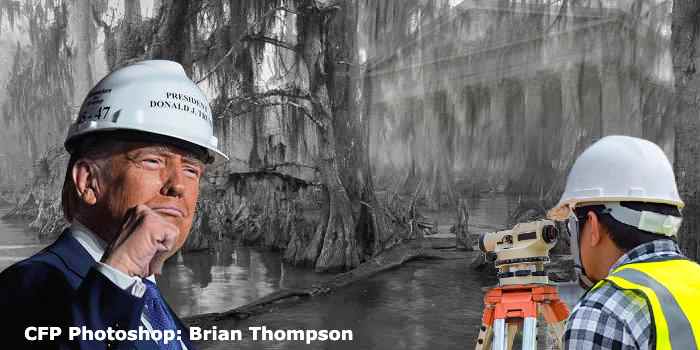
Our DC swamp clearly needs to be drained. There are now fourth and even fifth generation bureaucrats who have been passing down institutional knowledge on how to preserve their privilege and do things as they see fit regardless of who might hold elective offices.
It is well established that the purpose of a bureaucracy is to employ bureaucrats—anything else is secondary at best. And employ they do! The average income of a DC bureaucrat is nearly three times the average income of anyone in the rest of the country. Of course, this is justified because all the DC bureaucrats are all so much smarter and superior to everyone else—just ask them.
Bureaucratic infection can prove lethal to an entire country
Now we have Donald Trump, with his sidekicks Ramaswamy and Musk threatening to pull the plug on all those cushy jobs, forcing our elite betters to actually seek employment elsewhere. Heavens!! They may actually have to get real jobs where they might be required to produce real results that have real value to real people. What a terrifying thought! No wonder they are scared and are mobilizing to try to Trump-proof their turf.
Before we get to mapping the swamp, though, we can ask why we might want to do that. If the bulk of the rot is confined to a few square miles in the Eastern US, might it not be better to keep it contained there rather than spreading it throughout the rest of the country? Trouble is, that it doesn't stay put.
Just like an infection in some part of the body, like the liver for example, the effects manifest throughout the rest of the body, and may even have a lethal outcome for the entire organism. Exactly as an infection in one part of a body can kill the whole, so a bureaucratic infection can prove lethal to an entire country. Just look at the Byzantine Empire, or Rome, or so many other examples of history.
Why are bureaucracies so harmful? Thanks for asking. The primary reason is that bureaucracies see their role as one of regulation. From their perspective, if it moves it must be regulated. It has to be regulated to ensure that it is predictable and under control. Uncontrolled and unpredictable are dangerous and VERY BAD WORDS in the bureaucratic lexicon. If things are not properly regulated, why anything could happen!
The difference between laws and regulations
Some might say that we are a nation of laws that serve to protect us and guide our actions so as to preserve our society, and aren't laws and regulations just two names for the same thing? Not so!
The difference between laws and regulations is the difference between proscriptive and prescriptive. Proscriptive means to forbid something. Anything not specifically prohibited is allowed. Most of our laws are proscriptive.
Changing one letter turns the meaning on its head. Prescriptive means that something is required. If something is prescriptive it must be done, and anything else is forbidden. Most of our regulations are prescriptive.
To see the difference, take a law that says you shouldn't steal. It is pretty clear that you shouldn't take something that doesn't belong to you. You can lend, borrow, make, buy, sell, or do almost anything else with property so long as it doesn't involve theft.
If someone were to write a regulation regarding stealing, though, it might look something like this:
- "Every citizen is required to prove that they have not taken something that does not belong to them. In order to ensure that this regulation is followed, each citizen must submit an annual report listing the things they have not stolen in the previous year, along with the value of the things not stolen. Items less than $1 in value do not need to be listed. Failure to submit the required form, as well as failure to provide a full and complete list is a violation which may be subject to fine or imprisonment Completion of the form is mandatory and necessary to ensure compliance. This constitutes the Paperwork Reduction Act notice."
Proscriptive laws preserve freedom
As we can see, even if someone hasn't stolen something, they can be found guilty of a crime by not providing proof they haven't stolen anything. Failure to document honesty would itself be a crime. Of course, a bureaucracy is required to process all those no-theft forms, to determine if a crime has been reported, and to maintain all necessary records. Furthermore, additional regulations may be needed to clarify or to close any loopholes in the original regulations.
Proscriptive laws preserve freedom by allowing the vast array of activities which are not forbidden by the law.
Prescriptive regulations eliminate freedom by constraining acceptable activities to those prescribed. This attitude has been expressed in literature by T, H. White, and Robert Heinlein as "Everything not compulsory is forbidden".
Now we can see why the swamp needs to be drained. The growth of the regulatory corps, otherwise known as the administrative or "deep" state has resulted in the curtailment of many of the freedoms that were taken for granted through most of our history. The freedom to assemble, to speak openly, to publish our thoughts, to own property and use it as we see fit, to conduct our businesses as we wish, even to decide if we wish to be vaccinated or not, all have been seriously compromised in the last few decades.
It is time to do some serious weeding
Norm Augustine pointed out that the growth of regulations follows the same pattern as the growth of a weed. It is time to do some serious weeding, or in this case, swamp draining. The swamp doesn't want to be drained, though, and will fight back.
They will claim that everything they do is necessary to the health of the nation, and that if Trump carries out his plans, there will be irreplaceable loss of institutional knowledge.
For those who don't know, institutional knowledge is knowledge of how to get things done in the current swamp environment. You know, how to slow walk implementation of laws they don't like, how to wait out elected officials hostile to the swamp, how to point out all the reasons why something can't be done, and all the other swampish knowledge.
Somehow, though, the elimination of much of that institutional knowledge is rather the point. The way things are being done now is destructive to the country. Yes, the disease will object to the antibiotic, but the patient needs the disease gone. The alligators and snakes don't want the swamp drained, but the people who live near the swamp don't want their kids dragged off and eaten.
Some systems are useful. It is hard to think of some examples at this time, but with a bit of thought, I am sure I can come up with a few. Some might be useful if they were modified a bit. The National Park Service could be cleaned up with a little effort.
A good compass to use would be the list of enumerated powers given in Article I, Section 8 of our Constitution
Others, like the Department of Education could be eliminated entirely with a net gain. NIST serves a reasonable purpose, but it might be better done through private organizations, such as SAE, IEEE, and others. Removing anything having to do with DEI goes without saying.
Clearly, we need a good map of the swamp to know what is worth keeping, what should be drained, and where the landscape can be reshaped to better serve the country. There is little question that things cannot continue as they are if we wish to have a free and prosperous country.
A good compass to use in creating the map would be the list of enumerated powers given in Article I, Section 8 of our Constitution. The framers of our Constitution had a far better understanding and knowledge of the theory and practice of good government than anyone I have seen today. They knew well the dangers of overreaching bureaucracies.
In 1787, Thomas Jefferson wrote: “The tree of liberty must be refreshed from time to time with the blood of patriots and tyrants.”. Today he might write that the land of the free must be reclaimed from time to time from the swamps of bureaucracy.
View Comments