Media can't get its brains around Trump's waterboarding statements
So we'll try to explain it slowly for them.

Dan Calabrese , Bio and Archives--March 7, 2016
American Politics, News | Comments | Reader Friendly | Subscribe | Email Us
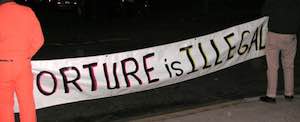 One of the reasons for the rise of ISIS is that America has no consensus on the matter of how we deal with terrorism, and I'm not even talking about specific tactics here. I'm talking about what exactly are our broader priorities, and the exchange at last Thursday night's debate over waterboarding between Donald Trump and Bret Baier - along with the subsequent media coverage of the story - is a perfect case in point.
The issue is not so much waterboarding per se. It's the much broader question of how we want to present ourselves to the terrorists. The priority of the political class and the media is to make sure candidates promise they will never do certain icky things to terrorists, because these icky things are not who we are! But the priority of a president - by which I mean a serious president, not Obama - is to put fear and doubt in the minds of enemies. The best way to do that is, at least rhetorically, not to concede your right to use any option. Waterboard? Hey, why not? Something worse? Could be. Kill the terrorists' families? Boy, you never know. Order the military to do something illegal? Hey, they won't tell me no.
One of the reasons for the rise of ISIS is that America has no consensus on the matter of how we deal with terrorism, and I'm not even talking about specific tactics here. I'm talking about what exactly are our broader priorities, and the exchange at last Thursday night's debate over waterboarding between Donald Trump and Bret Baier - along with the subsequent media coverage of the story - is a perfect case in point.
The issue is not so much waterboarding per se. It's the much broader question of how we want to present ourselves to the terrorists. The priority of the political class and the media is to make sure candidates promise they will never do certain icky things to terrorists, because these icky things are not who we are! But the priority of a president - by which I mean a serious president, not Obama - is to put fear and doubt in the minds of enemies. The best way to do that is, at least rhetorically, not to concede your right to use any option. Waterboard? Hey, why not? Something worse? Could be. Kill the terrorists' families? Boy, you never know. Order the military to do something illegal? Hey, they won't tell me no.Every one of Trump's answers is perfectly reasonable if you think of it in terms of how the terrorists are receiving the message. It doesn't necessarily mean he intends to do any of it. It just means that, as far as the terrorists are concerned, you want to plant the seed of fear that he just might. But the political class and the media want to help the terrorists by eliminating that fear, and they do so by demanding that presidential candidates pre-emptively disavow the option of ever using such tactics. This is completely insane. It speaks to a complete lack of seriousness about the threat this nation faces. Trump, under fire after the debate for supposedly wanting to give the military illegal orders, tried his best to walk the line between respecting the law and still striking fear in the heart of the terrorists. That attempt, predictably, was completely misrepresented by the media:
Trump, the Republican front-runner, has said repeatedly that he wants to waterboard suspected terrorists, kill the family members of those who carry out terrorism and commit other acts that would leave U.S. troops with a quandary if Trump is elected: Do they follow the orders of their commander in chief, or the Uniform Code of Military Justice that governs their actions?
In a letter Friday, Sen. Lindsey Graham (R.-S.C.), a frequent critic of Trump’s who withdrew from the Republican presidential race earlier this year, asked Marine Gen. Joseph F. Dunford, chairman of the Joint Chiefs of Staff, to weigh in on the issue. Graham did not mention Trump by name. But he asked the general for his opinion on intentionally targeting the family members of terrorists, whether waterboarding and “other extreme interrogation techniques” are authorized and legal in the military, whether he would view orders to target children and other noncombatants as lawful, and what advice he would offer to service members who were issued such orders. “One of the things I most admire about you is that your warrior spirit coexists with an ethical underpinning,” Graham wrote Dunford. “It makes you, and all who serve in the armed forces, the finest fighting force the world has known.” Dunford could not immediately be reached for comment. In a statement Friday, Trump clarified that he would not order a military officer to disobey the law. If elected, he said, he will be bound by laws “just like all Americans” and will meet those responsibilities. He added that he feels very strongly about the need to attack and kill terrorists who target the United States and its people, and will not forget the attacks of Sept. 11, 2001. “I will use every legal power that I have to stop these terrorist enemies,” Trump said. “I do, however, understand that the United States is bound by laws and treaties and I will not order our military or other officials to violate those laws and will seek their advice on such matters.” Trump has made regular references to waterboarding on the campaign trail, assuring his supporters that the would reinstate the practice, along with other “tougher” interrogation techniques. He has been steadfast in his belief that those techniques are highly effective and has dismissed concerns about their legality under international law.So the Post wants us to believe that Trump "backed away" from his willingness to waterboard and possibly do certain other things with his assurance that he would respect the law. But Trump did no such thing. As an experienced negotiator, Trump understands that you don't just give away leverage at the onset of the process. He may be willing to respect the law, but he isn't necessarily conceding in public where the law limits him, nor should he. Behind closed doors, of course, but it does nothing to help the United States when you announce in advance that you won't do this and you won't do that. For all the media's shrieking about Trump being irresponsible and unfit for office, this is actually a case of Trump being much more responsible than they are about the battle with terrorists - simply because he's not willing to publicly tell the terrorists what they don't have to fear, while the media are trying everything they can think of to get him to do exactly that. This is also a situation that makes Trump's recent criticism of George W. Bush all the more lamentable. What Trump wants to do is the exact same thing Bush and Cheney did, before the nation got soft and lost its stomach for the tough-but-necessary steps that put us in a position to defeat Al Qaeda - and would have kept ISIS out of Iraq had Obama not abandoned them. In the immediate aftermath of 9/11, the consensus of the nation was that nothing we could do to the terrorists was too harsh. But over time we lost our nerve and forgot the reality of what they had done to us, and when the media started embracing Democrat talking points about how we were being too mean to the terrorists, politicians became more concerned with assuring everyone they would play nice than they were with being tough and winning. Bush and Cheney never did, but just about everyone else did. So give Trump credit for wanting to go back to an approach that strikes fear in the hearts of terrorists rather than wanting to first reassure United Nations types that we wouldn't be meanies. He ought to give Bush credit for having done the same thing, but at least he's way ahead of the news media in his understanding of what needs to happen.
View Comments
Dan Calabrese——Bio and Archives
Dan Calabrese’s column is distributed by HermanCain.com, which can be found at HermanCain
Follow all of Dan’s work, including his series of Christian spiritual warfare novels, by liking his page on Facebook.