Monkey Puzzle Tree
Alas, not withstanding British popular nomenclature, there are no monkeys in Chile
Wes Porter , Bio and Archives--July 26, 2018
Lifestyles | Comments | Reader Friendly | Subscribe | Email Us
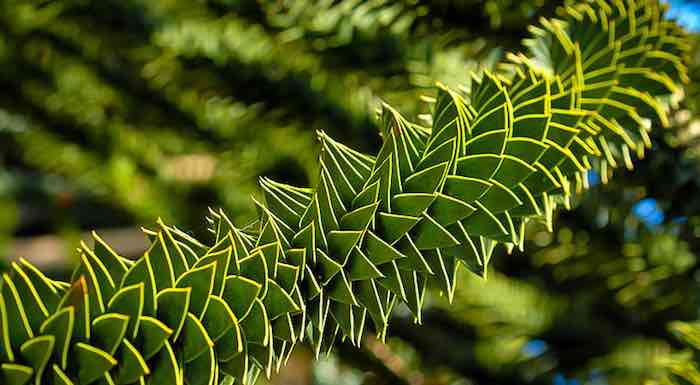 Victorians loved the unusual. So, when Araucaria imbricata trees first arrived on British shores, they were eagerly installed in newly designed gardens. Many continue to flourish there to this day.
The story of how they arrived from South America is as fascinating as the tree itself. Archibald Menzies (1754-1842) was one of those seemingly innumerable restless residents of Scotland who became successful surgeons--and, on the side, keen plant collectors and botanists.
Victorians loved the unusual. So, when Araucaria imbricata trees first arrived on British shores, they were eagerly installed in newly designed gardens. Many continue to flourish there to this day.
The story of how they arrived from South America is as fascinating as the tree itself. Archibald Menzies (1754-1842) was one of those seemingly innumerable restless residents of Scotland who became successful surgeons--and, on the side, keen plant collectors and botanists.Joining the Royal Navy after training in Edinburgh, he served in battle assistant surgeon HMS Nonsuch, in peace on the Halifax Station in Nova Scotia. Shore-side does not seem to have held much allure as in 1786 he joined a private venture as surgeon on the Prince of Wales fur trading northern Pacific accompanied by the Princess Royal, and also visiting Hawaii (then called the Sandwich Islands) and China. He had gained this position as a result of a friendship struck up with Sir Joseph Banks of Cook's First Voyage and subsequently Kew Gardens fame, sending him seed from the United States and West Indies. The two ships rounded Cape Horn and sailed up the Pacific coast of South America. While the ships' officers including Menzies, attended an official dinner with the Viceroy of Chile, the botanist in him observed unusual nuts being offered. He managed to obtain some of these. Planted, they grew successfully, and the saplings arrived back in England for Banks. One of them was planted at his own house, Spring Grove. This then was how Araucaria imbricata, the Monkey Puzzle Tree, arrived far from its Chilean home. Banks was so impressed with Menzies abilities that he used his influence to have him appointed in 1791 as naturalist on board the HMS Discovery under the command of Captain George Vancouver to survey the west coast of North America. While his associations with Vancouver were not exactly happy--Vancouver was reputed to have a prickly personality--Menzies was able to observe and collect in the vast coniferous forests of British Columbia and Washington State, collecting there and further south in California. Gardeners owe Eschscholzia californica the California Poppy, Lupinus arboreus the Tree Lupine and Picea sitchensis the Sitka Spruce to his collective abilities. He is also recognized botanical in Pseudotsuga menziesii Douglas Fir, and Arbutus menziesii Pacific Madrone Despite his uncertain relations with Captain Vancouver, Menzies continued to serve with the Royal Navy in the West Indies during the Napoleonic Wars. He retired and settled in London, there practising medicine until he died at the ripe old age of eighty-eight. By this time Monkey Puzzle Trees were to be found far and wide in British gardens. But why the name Monkey Puzzle Tree? According to writers Mary and John Gribbin, it received the popular designation when a visitor to the gardens at Pencarrow, Sir William Molesworth's garden in Cornwall, commented that the outward pointing spikes of the leaves would make a real puzzle for any monkey that tried to climb it. Alas, not withstanding British popular nomenclature, there are no monkeys in Chile.
View Comments
Wes Porter——Bio and Archives
Wes Porter is a horticultural consultant and writer based in Toronto. Wes has over 40 years of experience in both temperate and tropical horticulture from three continents.