Musical Perfection: Puffin' Billy
Survival in Tough Times: Feel free, dear reader, to post your own reactions and memories evoked by this music
Dr. Bruce Smith , Bio and Archives--August 22, 2022
HeartlandLifestyles | Comments | Reader Friendly | Subscribe | Email Us

Seeing as how I'm not quite sure how to do this, I hope you will be patient with me, dear reader. I've planned several of these for some time, but when I ran across this one recently, I really wanted to try it as the first one. The miracle of the internet allows us to have darn near everything ever recorded at our fingertips. Not too long ago, I would have had to own this record to hear it. No more. We can all enjoy it now. So I hope to do an occasional column under the theme Musical Perfection. In the columns I'll take a piece of music, post a link so the reader can listen, give some thoughts about it, and ask the readers to respond with their thoughts.
Puffin' Billy
I've done a little choral music, but I'm not a musician, and I don't play an instrument. Well, I did serve as the bass drummer in a pick-up junior high pep band, consisting of me, a clarinet, and a trombone. The other two could play the national anthem so I could contribute the beat and a drum roll at the end (Here I take a bow). Other than that, I'll be writing about the way some music affects me from a strictly amateur, impressionistic perspective. With luck, the readers will hear something familiar, or the music will evoke a response. Please consider these questions, then play the music at the link. You might recognize it or you might not. If you don't recognize it, or can't recall where you've heard it, what does the music suggest to you? Is it happy? Is it sad? Is it charming? Does it seem weird? Does it suggest any kind of activity? Walking? Running? Swimming? Sailing? Does it sound optimistic? Foreboding? If you recognize it, from where do you remember it? Have you heard it recently? Do you remember it from the recent past or way back? What does the music suggest to you? Are the memories it brings back good ones or bad ones? Here's the link to Puffin' Billy. Please play it now before reading ahead. Headphones or quality sound always enhance any recording, in my experience, if only by reducing background noise.Captain Kangaroo
Every time I hear this I smile. Composed by Edward White, the version we have here was recorded in 1952, and it always suggests innocent times before the cares of the world edged a little closer. It was written in a major key, so that makes it more positive to my ear, never sad. There are eighth notes and syncopation, which brings a playfulness and a jauntiness that I find uplifting. I get a sense of well-being and contentment when I hear it. Once I discovered, not so long ago, that the title was Puffin' Billy, I wanted to know what the music was written about. It turns out that Puffing Billy was a steam locomotive on the Isle of Wight, off the south coast of England. In Australia a tea kettle is a billy. Look up the lyrics to Waltzing Matilda to confirm that. Was the engine nicknamed Billy because steam came out the spout? Was the engine named after William the Conquerer? William Wilberforce? I don't know, but it's all very interesting! After finding the original name, the music might suggest a confident engine gliding across the countryside and leaving puffs of smoke to mark the progress. There's plenty of coal and water on board, so we'll make it to our destination in good time, I'd wager. For others, now that we're down the page a bit, the music puts us back to our childhoods, to specific memories of the 1950s and 1960s. For years, this was the theme music for the opening and closing of every weekday episode of Captain Kangaroo. It was Bob Keeshan who played the Captain, with Lumpy Brannam as Mr. Green Jeans. There was Bunny Rabbit and Dancing Bear and Grandfather Clock, plus guests and fun and science experiments and reading. Later on there were ping pong balls. Lots of them. Mostly I remember Keeshan's grandfatherly kindness and good humor. He had a ready smile and a natural curiosity which led him and his audience into all kinds of adventures and discoveries.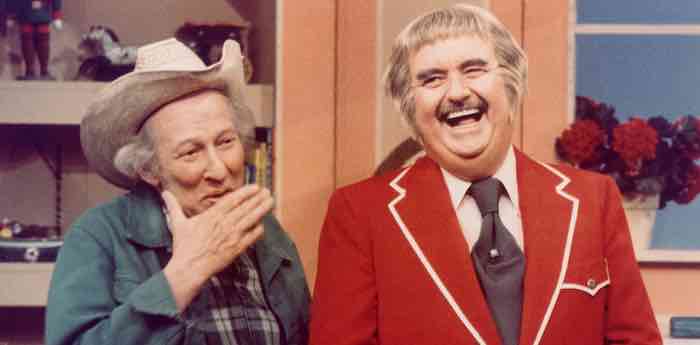
Music can bring all kinds of memories
Brannam was a vocalist, arranger, and composer, so he often featured in musical segments of the show. He spent time singing with Fred Waring's Pennsylvanians. I will never forget seeing Brannam on the show one morning put a string bass across his lap and then play it like a guitar. He was good. He was the person on the show who would explain things. He was multitalented and much loved by the audience. There's a very good chance that, since the music was used as a theme for the show, that I associate those good things with the show itself. Either way, the memories are good, and the emotions it brings are soothing and calming. There are serious books that make the argument that music can act on the brain almost like a drug, that it stimulates endorphins and really affects mood in a positive way. Think of ‘Whistle a happy tune' from The King and I. But when you hear The Flight of the Valkyries, you might think it's time to pack up and move, or head to the cellar, or make sure the machine guns in the wings are charged as you fly toward the cloud of Me-109s you see ahead. Don't think about it now, but, being Germans, they might be playing the same music in their headphones! Where's some John Williams attack music when you need it? Music can bring all kinds of memories, so there are plenty of compositions to explore in the years to come. When you hear a song for the first time, you might remember where you were, or what you were doing. Memories stick better when they're connected to emotion and emotional events. There were plenty of those in the 1950s and 1960s. Emotion in music really came into its own with the Romantic movement. It became acceptable to portray extreme emotional states from real life or from literary themes. Using music to express emotions and to recreate feelings of fright or danger came into its own early in the 19th Century and continues today. Once composed, and especially once popularized, music can be used to inspire or recreate feelings in other times and places. Cartoons from the 1930s at least through the 1960s often used snippets of classical music to support specific scenes and characters. That worked then because much classical music was known to a large part of the population. We don't see that kind of music in kids' entertainment these days, at least not so much. That's a pity. So we can use the music which is easily at hand these days to soothe our frazzled feelings or to fire us up for a challenge. Whatever image you need and whatever emotion you feel, there's probably music for it composed over the previous 180 years. Call on it when you need inspiration or a walk beside the still waters. Be sure to bookmark the site and put it in your music folder. Feel free, dear reader, to post your own reactions and memories evoked by this music.View Comments
Dr. Bruce Smith——Bio and Archives
Dr. Bruce Smith (Inkwell, Hearth and Plow) is a retired professor of history and a lifelong observer of politics and world events. He holds degrees from Indiana University and the University of Notre Dame. In addition to writing, he works as a caretaker and handyman. His non-fiction book The War Comes to Plum Street, about daily life in the 1930s and during World War II, may be ordered from Indiana University Press.