Musical Perfection: Up, Up and Away, The Fifth Dimension
Survival in Tough Times: So many songs can take me back to a specific place and time, like this one does
Dr. Bruce Smith , Bio and Archives--July 29, 2024
HeartlandLifestyles | Comments | Reader Friendly | Subscribe | Email Us
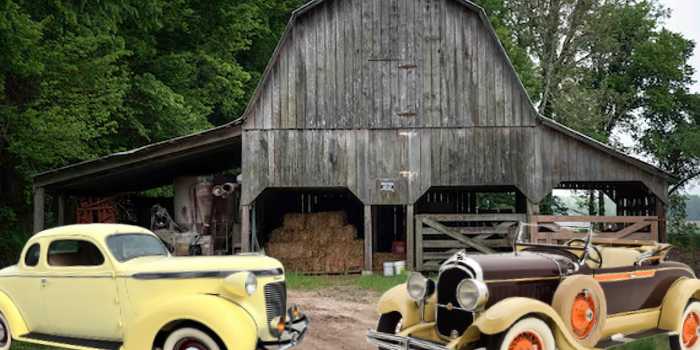
There is a context memory that makes this song very special to me. Both my grandfathers retired from the Chrysler machining and forging plant in New Castle, Indiana in the 1960s. So while I was growing up we had a parade of Plymouths, Dodges, and Chryslers in our driveway. The tradition had begun with my grandfather’s ’28 Chrysler 70 to the ’37 Chrysler Royal, a Plymouth truck, the other grandfather’s ’34 Plymouth, and a succession of Mopars after the war through the 1960s, 1970s, and 1980s.
There were no legendary cars, and unfortunately no 426 Hemis or Challengers or ‘Cudas, but it’s probably how we survived those years. Riding and driving big cars with Chrysler 383s under their hoods was good enough, even for me.
Naturally, when my brothers began to reach the age where they could afford their own cars, Dodges and Plymouths became an option. In the middle 1960s Chrysler Corporation had become serious about making muscle cars, and already had a reputation for powerful engines. The engines with hemispherical heads above the pistons were the Hemis. We were used to car jingles and even songs featuring our favorites. Shutdown, by the Beach Boys, featured a ’62 Dodge Dart with the famous 413cid engine versus a ’63 Corvette with the 327cid engine. The song doesn’t actually report which car won, but we Mopar fans noticed that it didn’t say the Corvette won. Then there was ‘The Little Old Lady From Pasadena’. Her bright red super stock Dodge was a ’64, and we all assumed it had come with the 426 Max Wedge hemi. Even in the song Jan and Dean confirmed there was nobody meaner. The Little Old Lady would give ‘em a length, then shut them down. My middle brother tended to lean toward the Chevys, but you heard recently about the Plymouth Sport Fury, so he qualifies. My older brother looked around for a new ride in 1966 and ended up buying a ’65 Dodge 880 Custom convertible. It turned out to be a rare bird with few convertibles built that year as 880s.
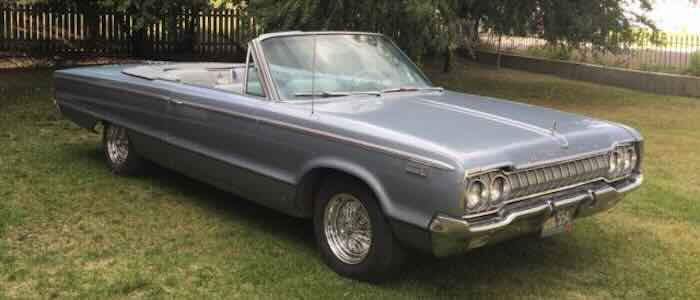
Having grown up riding in cars like this one sixty-odd years ago, it’s hard for me to imagine that everyone can’t remember what it was like. They were long, large, heavy cars. The ’65 Dodge 880 weighed just a little over 4100 pounds. Two tons! It was 17 ½ feet long and only four inches short of seven feet wide. The wheelbase was an inch over ten feet! It had a long hood and a long trunk, with a rather flat grille and flat back end, all within square corners. When driving, I could see the hood all the way to the front. It was easy to see where the corners were because there was a lot of sheet metal out there in front. The main aerodynamic part was the sloped windshield. By this time, cars came new with seat belts. Some wore them, some did not. On a convertible, the top was powered so it could be raised from the driver’s seat, then there were two manual latches to pull down to keep it from popping up when driving
Different engines were available, with the 383 cid engine perhaps the most common choice. This car came with the 383, an automatic transmission, and a 4bbl carburetor. It was almost effortless to drive. There was plenty of power to move two tons of steel around on wide tires, and power steering made it possible to literally steer it with a finger. When stopped, hold the brake a bit with a foot, push the accelerator down a little, then stand on it as you let the brake off to hear the engine roar and the rear tires scream as they pour smoke behind the wedge-shaped tail lights. For car enthusiasts, it’s an adrenaline rush.
Cars carrying that much weight have hefty suspensions. Wide bias-ply tires added to the cushioning effect for a velvety-smooth ride. It took a big pothole to really feel much from the road’s surface. There was a feeling of luxury and comfort cruising at 70 mph on a four-lane highway or on any banked and graded road. Distractions were few, and the new radios came with rear speakers that surrounded the passengers with rich sound.
This family car context had a setting in the 1960s. I turned ten in December of ’62 and remembered the music my older brothers had played and enjoyed from the time I could recall anything at all. When I watched the Beatles on the Ed Sullivan show on Sunday night, February 9, 1964, I was eleven. From there it was perfect timing to listen to the radio and play records for the remarkable 1960s. Even so, when I look at the Billboard charts for those years I’m shocked at the outpouring of memorable songs, hundreds of them. Each year seemed to produce more and more of them, and they spoke to many of the emotions and dilemmas we faced in our own lives. Among the best songwriters of the era was Jimmy Webb. I don’t have to mention the recording artists, just the songs to give an idea of his songwriting skill. There was ‘By The Time I Get To Phoenix, MacArthur Park, The Worst That Could Happen, Wichita Lineman, Didn’t We?, All I Know, and dozens of others.
In May, 1967, just as the Summer of Love was about to begin The Fifth Dimension, a group I had never heard of, released a song called Up Up and Away. It allows me to place this story in its correct time slot. It was all turmoil in my world by then. 1967 was the year of Khe Sanh and terrible fighting in South Vietnam. Lyndon Johnson was president. There was the Six Day War and riots and unrest and cultural turmoil and worries about the future. I had met the most remarkable girl the previous fall on the first day of 8th grade, and that weighed heavily on my mind, too. She was at music camp for another couple of weeks, then we’d be back at school. Where was all this going?
I lived with the folks on the southeast side of my small town in the heartland. My older brother Jim, the one with the ’65 Dodge 880 convertible, came to the house with his bride of a year Karin, my sister-in-law. That evening, when the discussion turned to a visit to her hometown of Aurora, Indiana, the offer was made that I could ride down there, stay the night, then get a ride home the next day when my folks came down for a visit. Would I go? Sure, I said. By the time we left it was already toward dusk and the light was fading fast. Jim put the top down on the convertible, Karin sat in the middle of the front seats close to him, and I got into the back seat on the right side, then we set out on the 90 minute trip.
It wasn’t far over to US 27 South which took us through Liberty, Indiana, then down 101 to Brookville. From Brookville it’s US 52, and then onto Indiana 1 before getting to Cedar Grove. From there to our destination south of Indiana 48 was another 40 minutes or so, all in the dark. It was warm, but the air kept us cool, almost chilly, as we glided through the hills and ridges of southeastern Indiana. We knew how to enjoy a convertible, so the windows were all down and no one wore a hat. The whole idea was to feel the wind in the hair and enjoy the sensation that was almost like flight. The back roads twisted and turned a bit as we went through South Gate, St. Leon, and Dover striking cross country to find Collier Ridge Road and come out on Indiana 48.
Somewhere between US 52 and Indiana 48, deep in the darkness, the only song I remember from that trip came on the radio. There were no city or town lights, and only occasionally a glimmer shone from little farmhouses along the way. It was Up Up and Away, a song I already knew. It has a very modern sound with close harmonies that gave that edgy, contemporary feeling. It isn’t a hymn. There were two women and three men in The Fifth Dimension, with the women usually leading the phrases. It’s high-pitched and airy. A flute provides guidance along the way with airy, hissing notes that add to the sense of being airborne, with power, at elevation. I was soaring.
Above me I could just make out tree leaves from the indirect glow of the headlights, with frequent gaps that showed stars in the Prussian blue sky. It was as though we were flying at low altitude, like an owl would glide, never touching the branches. The lyrics repeated it: “We can fly!” Then “If you’ll hold my hand we’ll chase your dream across the sky. . . The song put images in my head. It was magical.
First verse
Would you like to ride in my beautiful balloon?
Would you like to ride in my beautiful balloon?
We could float among the stars together, you and I
For we can fly (we can fly)
[Chorus]
Up, up and away
My beautiful, my beautiful balloon
Second verse
The world's a nicer place in my beautiful balloon
It wears a nicer face in my beautiful balloon
We can sing a song and sail along the silver sky
For we can fly (we can fly)
[Chorus]
Up, up and away
My beautiful, my beautiful balloon
[Bridge]
Suspended under a twilight canopy
We’ll search the clouds for a star to guide us
If by some chance you find yourself loving me
We’ll find a cloud to hide us
We’ll keep the moon beside us
[Verse 3]
Love is waiting there in my beautiful balloon
Way up in the air in my beautiful balloon
If you'll hold my hand we'll chase your dream across the sky
For we can fly (we can fly)
[Chorus]
Up, up and away
My beautiful, my beautiful balloon
Up, up, and away
Up, up, and away
Up, up, and away...
So many songs can take me back to a specific place and time, like this one does. May you be blessed with the same gift from the past at all the best times, and just when you need a lift up up and away from it all.
View Comments
Dr. Bruce Smith (Inkwell, Hearth and Plow) is a retired professor of history and a lifelong observer of politics and world events. He holds degrees from Indiana University and the University of Notre Dame. In addition to writing, he works as a caretaker and handyman. His non-fiction book The War Comes to Plum Street, about daily life in the 1930s and during World War II, may be ordered from Indiana University Press.