Not Bluffing—Trump and North American Defense
Then along comes a new American administration, focused like a laser on North American security. Suddenly we are in a new world with new priorities. And not a moment too soon.

Capt. Barry Sheehy CD. , Bio and Archives--January 10, 2025
American Politics, News | Comments | Reader Friendly | Subscribe | Email Us
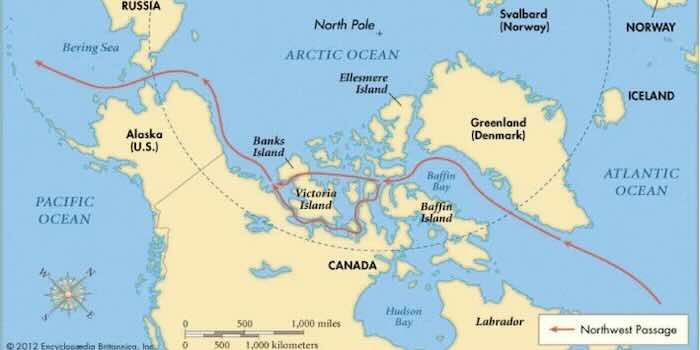
The Trump Administration is serious about bolstering the Defense of North America from the Panama Canal to the Arctic Ocean. Some have suggested this is a reincarnation of the 19th century Monroe Doctrine but that is a facile interpretation of the facts. We are a long way from the blustering of President Monroe in 1823. The world has turned over many times since. Trump’s instincts on defense of North America are sound and rooted in a desire to avoid war. Yes, avoid war. Hear me out.
China’s projection of influence into the Arctic is enabled by Russia’s powerful northern fleet
The US has always viewed itself as protected from invasion by two oceans. American involvement in both World Wars was a matter of choice. But that world has changed, especially in the past decade. China has asserted itself on the world stage and is not disguising its regional and global ambitions, boldly proclaiming “red lines” not to be crossed.
Meanwhile in the north, Russia has come to dominate the high Arctic with a series of bases supporting an immense fleet of ice breakers and ice capable vessels. The Russian Federation has nearly 40 ice breakers, many of them nuclear, and a “Northern Fleet” of over 30 surface vessels and submarines; all supported by a sophisticated network of Arctic naval bases. It is an astonishing strategic apparatus for an economy not much larger than Canada. But unlike Canada, Russia takes its sovereign frontier seriously.
Suddenly, we see China exerting its influence in the Arctic, despite having no Arctic shoreline and not being a member of the Arctic Council (Canada, USA, Denmark (Greenland), Iceland, Finland, Norway, Sweden, and Russia). China’s interest in the Arctic is strategic, focusing on global transit routes and vital resources. China’s projection of influence into the Arctic is enabled by Russia’s powerful northern fleet. How the US drove Russia and China into this unnatural alliance is one the great sins of the last American administration.
The End of Splendid Isolation
For the United States the stakes couldn’t be higher. No longer protected by two vast oceans, the world’s threats are now lapping at its shores. The days of splendid isolation are over. The world’s dangers are closing fast. Millions of unvetted illegals are pouring across their southern border, mostly young military-age males. This is, by any measure or definition, an invasion. No one knows who these invaders are. Most are economic migrants but criminals and terrorists are inevitably among them. The criminals have already made themselves felt on the streets and subways of America; the terrorists will do so in time. Fentanyl, the precursors coming from abroad, especially China, is killing 100,000 Americans a year, most of them young people. This is twice the loss of soldiers in Vietnam over ten years. A novel Coronavirus escaped a dangerous biolab in Wuhan China and sickened millions of Americans and shuttered a booming economy. Oceans did not protect America from these threats. The lesson has been learned. The next war will be fought closer to home.
Panama Canal
Meanwhile, China effectively controls both ends of the vital Panama Canal via private contracts. The Canal was built by Teddy Roosevelt over a ten-year period (1903-1913) at the astronomical cost of nearly 400 million dollars. (Ten million was paid to Panama and forty million to the French company that had started but failed to complete the canal.) Fifty-six thousand workers labored on the project for a decade with ten percent of them perishing. The gifting of the Canal to Panama by President Jimmy Carter in 1999 was folly. Surrendering control of the most strategic transportation route in the western hemisphere, built and paid for by the United States, was virtue signaling run amok. Commercial considerations aside, the Canal is too strategic a transit point to be controlled by China or any other potential adversary. The alternative route from the Atlantic to the Pacific around Cape Horn requires a journey of 20,000 nautical miles. This is the reason the Panama Canal was built in the first place. Without the Panama Canal the only alternative to move vessels quickly from the Pacific to the Atlantic is across the Arctic’s Northwest Passage. Does anyone see a theme emerging here?
In the end, this Panama Canal stand-off will come down to negotiations, something Trump is a good at, involving lots of give and take. Be assured, when the smoke clears the status quo will be gone and a new arrangement will be in place.
Securing the Arctic
This brings us full circle to the Arctic which remains woefully undefended. In the face of Russia’s mighty Northern Fleet and its new Chinese allies, Canada’s Arctic is largely naked. A few isolated bases supported by 500 intrepid Inuit Rangers armed with Lee Enfield rifles is hardly a deterrent to a superpower. The recent Northern Viking Exercise in and around Iceland in 2022-24 was an attempt by NATO to project strength into northern waters but, tellingly, Canada did not participate. During recent large scale NATO exercises in Europe the Canadian Air Force stood down, having no fighter jets to deploy. It is all so sad.
The steady disintegration of Canada’s proud military over the past decades has been heartbreaking for many Canadians. But this neglect reflected public policy. We let it happen. And now this planned neglect has come back to haunt us. Canada will never reach its 2% of GDP goal without a push…and that push is coming.
Even today Canada insists that vessels traversing the Northwest Passage seek permission to do so without any capacity or will to enforce this high-toned sovereignty. It is all a charade, but the game is up. If Canada does not step up and defend its immensely rich Arctic Archipelago, it will lose it. That is the iron rule of history.
Canada urgently needs to leverage its geography before it loses it
Canada has the capacity. It emerged from WW II with the third largest navy in the world after the US and Great Britain. Today, it isn’t just a matter of building and buying ships and patrol aircraft, although that would be a good place to start. Canada urgently needs to leverage its geography before it loses it.
A forward operating base connected to continental road and rail, as close to the Northwest Passage as possible, is a prerequisite to any Arctic Strategy. This base would support ice breakers, patrol ships, and ice reinforced cargo vessels. It would also serve as a supply and warehousing center for northern communities and forward operating bases. This requires a large footprint on deep water connected to continental road and rail. Russia has shown us you cannot deploy a fleet into the hostile Arctic Ocean without a strong supporting base infrastructure. And this infrastructure must come before the fleet.
This Canadian Arctic base could be the home port of Canadian and US Coast Guard vessels, as well as ships of other NATO Arctic-facing nations, including Denmark and Norway. Plans for such an Arctic base are not new. They have been circulating in Canada for years. But no one has been willing to make the investment. Then along comes a new American administration, focused like a laser on North American security. Suddenly we are in a new world with new priorities. And not a moment too soon.
View Comments
An accomplished speaker and author, Mr. Sheehy‘s works have appeared along side of those of Presidents Clinton and Bush, Alan Greenspan, Robert Rubin and business leaders such as Lou Gerstner, Jack Welch, and Michael Dell, Edwards Deming, Stephen R. Covey, Rosabeth Moss Kanter, Gary Hamel, Peter Senge and Tom Peters. His speaking tours have taken him to Europe, Latin America, the Middle East, India, Singapore, Hong Kong, Mexico, Canada, and the United States. He is the author of six books.