NPR Adds More Excuses for Solyndra
Massive failures in support for "clean energy" in country after country, including (now) the United States with Solyndra as the poster child.

Institute for Energy Research , Bio and Archives--February 10, 2012
Global Warming-Energy-Environment | Comments | Reader Friendly | Subscribe | Email Us
Much to the chagrin of supporters of government intervention into the energy markets, the Solyndra scandal won't go away. Because it's such a big story, the defenders of the Obama Administration can't simply ignore it. Instead they have been offering a host of ever-shifting excuses for the colossal failure. In this post I'll walk through a recent example of a "Fresh Air" NPR interview.
Fresh Air or Hot Air?
On the February 2 episode of the popular NPR show Fresh Air, host Terry Gross interviewed Washington Post environmental correspondent Juliet Eilperin, who had written a Wired article on the Solyndra scandal entitled "Why the Clean-Tech Boom Went Bust." Although much of the interview was standard stuff--explaining that Solyndra's innovative business model relied on "CIGS" cylindrical solar panels rather than traditional flat silicon panels, etc.--the listener certainly didn't walk away with the message that the government has no business supporting "clean-tech." Instead, the listener was treated to excuses that ignored the glaring lessons of the Solyndra episode.Before delving into the specifics, let's remind the reader that the Institute for Energy Research has been warning for years that massive government support for "green energy" is a disaster waiting to happen. That was the clear lesson from Spain's renewables program, documented in this famous study. IER also publicized a study documenting the failure of the German government's support for renewables. Therefore, the collapse of the "clean-tech boom" in the United States shouldn't come as a shock. When an industry is artificially propped up by massive government intervention, that's a signal that the industry is vulnerable.
U.S. Government Out-Planned by Chinese Government?
The most amusing part of the NPR interview occurs at the 5:50 mark, after Eilperin explains that Chinese output of silicon panels has led to a collapse in the price.TERRY GROSS: So China is really dominating now when it comes to solar power cells. How did they get the edge over the U.S.? JULIET EILPERIN: Well it was a combination of things. One is that they have a coherent industrial policy that encouraged the manufacture of solar panels. So what you've seen is everything from providing relatively inexpensive land, for people who are interested in solar panel manufacturing, lines of credit from the national bank, which has made it cheap for them to borrow money, and obviously they do have relatively inexpensive labor... You've seen an incredible reversal, where for example, in the mid-90s you had the U.S. provided roughly 40% of the world's solar panels--that's now down to 6%. And by contrast China at this point is providing roughly half of the world's solar panels.Imagine that! China's "coherent industrial policy" relies, among other things, on below-market rate loans to encourage growth in the solar sector. I seem to recall President Obama and Vice President Biden discussing a similar policy for the U.S. solar sector. The Chinese government's artificial support for solar technology is just as inefficient as any other government's. If it continues these policies, it will simply magnify the divergence between what goods and services consumers could have gotten, and what they will get in reality. People who are enamored with the "success" of China's central planning should keep in mind that as a result of its previous "stimulus" spending China now has entire cities that are empty, because government does a very poor job of allocating resources.
Fossil Fuels Get More Government Support than Renewables?
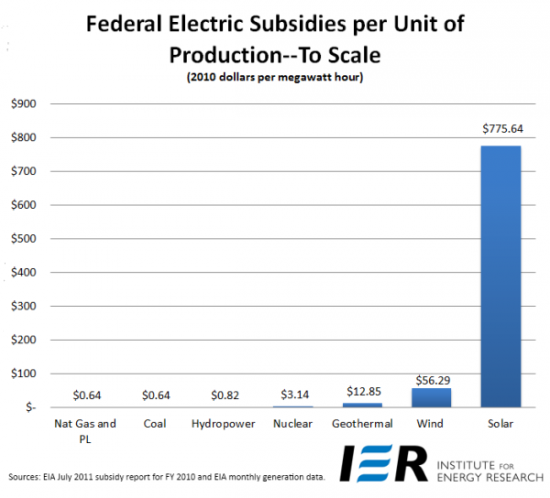
At one point in the interview, Eilperin tries to make it clear that there isn't a level playing field when it comes to the energy sector. Indeed, the folks at NPR liked this quote so much, they pulled it out to put in the margin of the article accompanying the interview. Eilperin said: "There is no question that when it comes to federal support, traditional fossil fuel energy gets more support than the renewable energy industry." Actually Ms. Eilperin, there is a question on this issue. It depends which units and which years you are using. The Congressional Research Service reported that in 2009 energy tax provisions were four times greater for renewables than fossil fuels.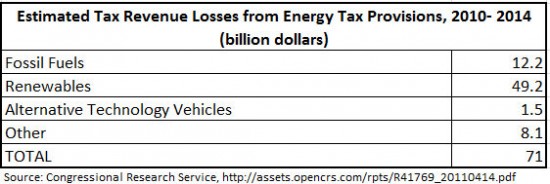 The comparison gets much worse for renewables when we make an apples-to-apples analysis based on the amount of energy produced per dollar of subsidy. The problem is that renewable energy accounts for just a tiny fraction of total output in the U.S.--that's because at best it is a niche sector. When adjusted on a unit-of-electricity-output basis, federal support for various technologies looks like this (note: the following two graphs show the same data, but the first is not to scale because the solar subsides are so massive):
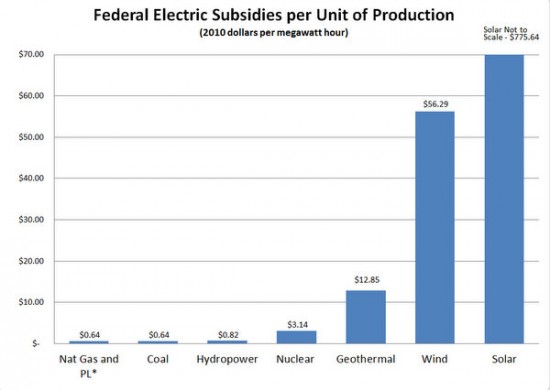 Sources: EIA July 2011 subsidy report for FY 2010 and EIA monthly generation data.
Conclusion
Free-market economists have argued since the early 20th century that there are institutional problems with central planning. Government officials do not allocate resources as effectively as markets. We have seen massive failures in support for "clean energy" in country after country, including (now) the United States with Solyndra as the poster child. And yet the supporters of intervention look at China as the way to "do it right."View Comments
Institute for Energy Research——Bio and Archives
The Institute for Energy Research (IER) is a not-for-profit organization that conducts intensive research and analysis on the functions, operations, and government regulation of global energy markets. IER maintains that freely-functioning energy markets provide the most efficient and effective solutions to today’s global energy and environmental challenges and, as such, are critical to the well-being of individuals and society.