Observations Traveling To Turkey And Greece Over Easter
During this Easter season I plan to ponder not only the resurrection of Jesus, but the admiration for the civilization built upon what He left.

Col. Bill Connor , Bio and Archives--April 19, 2025
World News | Comments | Reader Friendly | Subscribe | Email Us
During the past couple of weeks, I’ve had the unique opportunity to visit Istanbul for around a week before heading to Greece. Though I have been to Greece and Ephesus, Turkey, this was my first time to Istanbul. This trip was particularly poignant during Lent leading to Easter.
During our time in Istanbul, we were able to speak with the different Turks I now call friends and gather a general perception of the people. Note: We arrived shortly after the Mayor of Istanbul (political opponent to Turkish President Erdogan) had been arrested for alleged financial malfeasance, making this a unique time. Thankfully, the protests did not affect our trip. In having travelled throughout Western Europe and North America, this visit allowed for my view of the contrast between east and west.
One of my noteworthy first impressions was of the unique pride and affinity those in Turkey have of their national history as compared with so many of those in the West. Turks are quite proud of the history of the Ottoman Empire and the succeeded Turkish Republic under Kamel Atatürk, the Father of the Republic after the end of the Ottomans. That’s despite Ottoman history including dark times, like centuries of slavery, autocracy and subjugation of many different nationalities in Europe, Africa, and the Middle East. Around three million Armenian Christians of the Ottoman Empire were massacred during World War I. A century ago over 20% of Turkey was Christian, yet through forced displacement after WWI that number went below 1%.
In mentioning these “warts” of the past it is not my intent to malign Turkey, as many nations throughout the world, including the West, have unflattering periods of history. The point is the contrast between many western nations and Turkey in the way history is handled. Many western nations have moved from a fair self-criticism of certain aspects of history into unhealthy self-loathing of almost all its history. For example, the British Empire brought many positive developments to the world in regards to medicine, engineering, science, justice and democratic governance.
Over two hundred years ago, the British Empire became the first empire or nation in history to end the slave trade, enforcing that ban throughout much of the world with the British Navy. Like the Ottoman Empire, the British Empire had certain dark periods, like the Opium Wars in China or treatment of Indians. Regardless, the British should be proud of their history and not the all-to-common self-loathing. Most Americans have experienced this same self-loathing in attempts to turn all American history into racism and oppression.
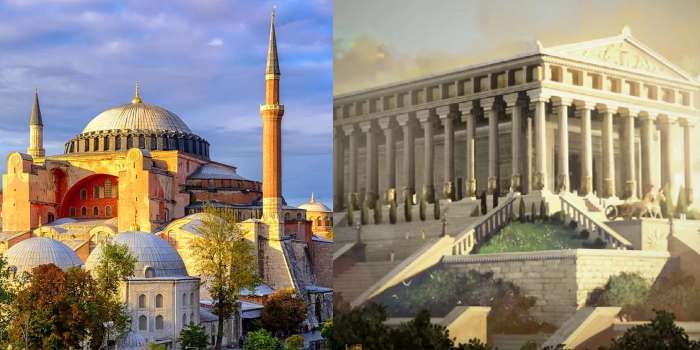
Visiting the famous Hagia Sophia in Istanbul put a spotlight on this dynamic. Hagia Sophia was built as a domed Christian Cathedral in the 6th century AD by the Eastern Roman Empire, and for centuries was the most colossal domed Cathedral throughout Christendom. In AD 1453, after the Ottoman Empire seized what was then Christian Constantinople, ending the Eastern (Byzantine) Empire, the Hagia Sophia was taken intact and converted into a Mosque. After the Ottoman Empire fell in 1923 and the Turkish Republic was declared, Hagia Sophia was de-commissioned as a Mosque and a year later, 1935, made a museum so that all could appreciate the history. In 2020, the current Turkish President Erdogan turned Hagia Sophia back into a Mosque. When I went to visit Hagia Sophia, I could only see it from the upper chambers as a non-Muslim. Only Muslims could enter the ground floor to get a full view of this international historic site. The Christian artwork was covered. While I visited, we noticed the Muslims on the ground floor were tourists taking the best pictures and seeing all Hagia Sophia. We all paid the same entrance fee.
In Western Countries, all historic Cathedrals are open to visitors whether Christian or not. That’s despite the histories of the Cathedrals being solely Christian. Any attempt to divide tourists by Christian and non-Christian in the manner currently happening with Hagia Sophia would be met with a deafening worldwide outcry. Most in the West have no idea of the Hagia Sophia discrimination, while being inundated by self-loathing allegations of an alleged uniquely discriminatory West. The West isn’t perfect.
Like those in Turkey with pride in their history, however, Westerners should quit the self-loathing and take pride in Western history. The focus should be on Western emphasis on the rights of individuals over the collective. Also, rationalism, science, medicine, justice, and democracy associated with the West.
While in Ephesus during this trip, I was reminded of the Apostle Paul’s time there. In the Book of Acts, we read about Paul making such a difference with the character and hearts of the individuals of that city that the idol merchants turned against him. The massive city was affected by Christian teachings. It was through that influence of individuals, through the importance of individual hearts and minds, that Judeo-Christian Western civilization was built.
During this Easter season I plan to ponder not only the resurrection of Jesus, but the admiration for the civilization built upon what He left.
View Comments