Offshore Wind Blowing Away
The Renewable Rejection Database brings the data by documenting the backlash to alt-energy

Jack Dini , Bio and Archives--February 25, 2025
Global Warming-Energy-Environment | Comments | Reader Friendly | Subscribe | Email Us
President Trump has long been a supporter of traditional energy. During his campaign, he spoke negatively about electric vehicles, wind and other renewable energy sources. In his first day in office, the new president began a historic shift in US energy policy, away from green energy and back to hydrocarbon energy. (1)
Offshore wind in big trouble
On January 20, 2025, he signed five wide-ranging executive orders that radically change the United States energy and climate policy. These actions restore efforts to promote coal, natural gas, oil, hydropower, nuclear, and biofuels, while curtailing support for wind and electric vehicles. The Trump executive orders also rescinded orders issued by President Biden and closed federal departments established to promote climate change policies and green energy.
The executive order regarding offshore wind and wind projects immediately impacted the world wind industry. The US government owns all land from three miles to 200 miles offshore, so wind companies require a federal lease to build offshore systems.
Wind energy markets were shocked by Trump’s order. The stock price of Orsted, a Danish wind system supplier, dropped 17% to its lowest price in seven years. Orsted proposed to build Sunrise Wind, the largest planned US offshore wind system, to be located southeast of New York city. The company immediately took a $1.69 billion impairment charge on its US wind projects.
Wind suppliers RWE of Germany, Equinor of Norway, Renovaveis of Portugal and Vestas of Denmark also suffered stock price declines. Italy’s Prysmian announced that it would abandon a plan to build a plant in the US to make cables for offshore wind systems because solar and wind generation might not be available when needed. (1)
Recent cancellation of offshore wind in the US
Wind and solar systems are intermittent, use 100 times the land area, and require at least double the transmission infrastructure compared to traditional coal, gas, or nuclear power plants. Few utilities would build wind and solar systems if not for the fear of human caused global warming. But the new executive orders make it clear that the US will no longer pursue efforts to mitigate climate change. (2)
Wind energy plans for several states have been crippled. In January, Orsted A/S recorded a $1.7 billion hit on its earning as the cost of offshore wind farms, particularly in the US, kept rising. Also in January, Shell disclosed a $996 million write off following its withdrawal from the Atlantic Shores Offshore Wind project.
In early February, the New Jersey State Board of Public Utilities cancelled the bidding process for the state’s fourth offshore wind solicitation, citing the uncertainty driven by recent federal actions affecting the industry. (2)
The nation’s largest proposed offshore wind power facility in Virginia is encountering rough seas, with its developer acknowledging it will need at least $2 billion more than originally estimated. (3)
Dominion Energy, an electric utility based in Richmond, Virginia, announced its original estimate of $8 billion would not cover the cost of the project off the coast of Virginia Beach, Virginia, which the company now puts in the neighborhood of $10 billion.
The decision follows Connecticut’s refusal to participate in a tri-state wind energy agreement, leaving Vineyard unable to secure contracts for the full 1,200 MW Vineyard Wind 2 project. (4)
The controversial Lava Ridge wind project in Idaho was killed by a Trump executive order and won’t be revived. Offshore projects in the US and around the world are being cancelled or delayed. Rural resistance against wind power remains fierce. The new Congress could repeal the lavish tax credits that have long fuelled the industry’s growth. Further, as discussed later, in December, the Osage Nation secured a massive win over Enel in federal court in the longest running battle over wind energy in US history. (5)
It is easy enough to blame Donald Trump’s recent executive order withdrawing from disposition for wind energy leasing all areas within the Offshore Continental Shelf (OCS), but that is a new symptom of a far more fundamental reality. Offshore wind power is even less economic than other forms of unconventional electricity, ultimately the excess costs for all of them must be paid by power consumers and taxpayers.
Consider the Energy Information Administration’s estimates of the levellized costs of electricity production (per megawatt hour in 2022 dollars) with alternative technologies. Combined cycle natural gas generation: $42.72, ultra super critical coal: $89.33, nuclear: $71.00, photovoltaic solar: $36.27, onshore wind: $31.07, offshore wind: $100.34. (2)
For solar and wind power, those cost estimates ignore the cost of backup generation, $128.82 per megawatt hour, needed to avoid service interruptions because solar and wind generation might not be available when needed.
Wind power currently provides about 10% of the electricity generated in the United States. (6)
World -Wide Offshore Systems
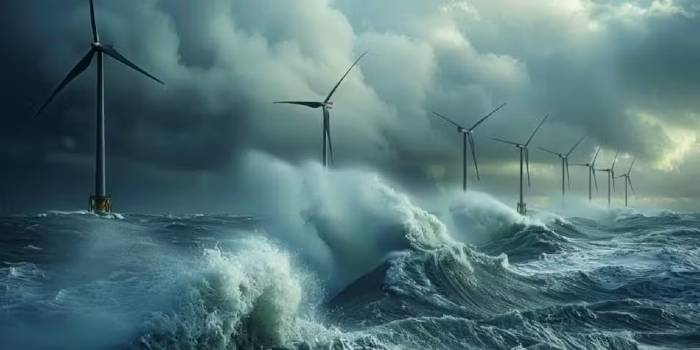
To date, most offshore wind systems have been deployed in China, Europe, and Vietnam. These systems suffer typhoon wreckage. Eighty percent of the turbines installed in Europe’s North Sea have required repairs due to weather damage. (7)
The London Array, east of England, the world’s largest offshore wind system required extensive repairs after only five years of operation. Danish wind operator Orsted needed to repair underseas cables to offshore wind systems in the North Seas at a cost that exceeded $100 million.
But turbines sited off the East Coast must survive brutal weather, more severe than offshore turbines in Europe. Tropical storms, hurricanes, and nor’easters periodically traverse the coastal sites planned for new offshore wind systems. (7)
Europe is starting to reach its limit when it comes to wind power. Countries like Denmark and Sweden, once leaders in expanding offshore wind capacity, are now hitting obstacles as power prices and incentives fall too low to support new projects. (8)
A recent Danish auction for offshore wind saw no bids, highlighting the issue. This slowdown in wind development risks prolonging reliance on fossil fuels, as rising costs challenge the sector’s earlier success in driving down prices.
Denmark, which generated a world leading 58% of its electricity from wind last year, saw no bids in its largest-ever offshore wind tender. Companies like state owned Orsted A/S cited unattractive investment conditions, with low electricity prices driven by an oversupply of wind power. (8)
Wind Turbine Ecological Damage
Evidence continues to grow that onshore wind turbines are causing heavy ecological carnage, with increasing concern focused on the removal of a vast tonnage of insect life. (9)
Work in Germany in 2016 put the loss across the country at 1,200 tons a year. Recently, the Heartland Institute extrapolated the individual annual insect loss worldwide at 13.64 quadrillion insects, but of course, these figures are nearly a decade out of date.
Recent work from researchers at the University of Wyoming suggests that moths, butterflies, beetles, flies and true bugs may be the most vulnerable to the giant revolving blades.
The loss of insects is particularly disastrous since they are decomposers, crop pollinators and a crucial basis of the entire food chain. (9)
Non-Offshore Wind items
Osage Tribe Verdict
The Osage Nation prevailed in federal court in Tulsa, winning a decisive ruling in the longest running legal battle over wind energy in American history.
Enel must spend $300 million to remove wind turbines and pay $36 million in damages and attorney’s fees. (10)
For years, Big Wind has played hardball with rural communities. In some cases, Big Wind has sued rural governments to try and force them to accept wind projects they don’t want. In 2022, two turbines in Falmouth, Massachusetts were dismantled after numerous complaints from local homeowners about the noise from the turbines and a year long legal battle.
But an order to remove 84 wind turbines, by a federal judge, no less—is nothing short of gobsmacking. It is a colossal black eye for the wind industry, which has collected tens of billions of dollars in federal tax credits by claiming its landscape blighting, bird and bat killing property value destroying turbines are an essential part of the effort to avert catastrophic climate change. (10)
Global Rejection Database
The resistance to the landscape destroying sprawl of big wind and big solar is real, it’s growing, and it’s global. This new database provides proof.
Since 2015, Robert Bryce has been documenting the backlash in rural America against the encroachment of wind and solar projects in the Renewable Rejection Database. It is the only free, searchable, online resource of its kind. Over the past decade, Bryce has documented 771 rejections or restrictions of solar and wind projects in communities from Maine to Hawaii. (11)
The Renewable Rejection Database brings the data by documenting the backlash to alt-energy. It provides clear proof that land use conflicts are the binding constraint on the expansion of wind and solar in the US. These hundreds of examples show that despite the never ending hype about wind and solar that we hear from academics, climate activists and legacy media outlets, those forms of weather dependent power generation cannot, and will not, ever be able to provide the vast amounts of reliable electricity our country needs.
Why not? There isn’t enough available land.
Bryce has a new data base that provides proof of the raging opposition to wind and solar happening all around the world. Since 2023, there have been at least 72 rejections or restrictions of wind and solar projects, and that is an absolute minimum number. Those rejections are happening all across Europe, as well as in India, Australia, South Korea, Greece, and Canada. (11)
References
- Steve Gorham, “Trump drops a bomb on green energy,” cornwallalliance.org, February 8, 2025
- Benjamin Zycher, “The collapse of offshore wind power is only the beginning,” nationalinterest.org, February 11, 2025
- Bonner R. Cohen, “Virginia offshore wind project hit by massive cost overrun, “Environment & Climate News, January 2022
- Charles Rotter, “Vineyard Offshore halts 1200 MW wind project amid economic and policy challenges,” windtaskforce.org, December 23, 2024
- Robert Bryce, “Big wind is in big trouble,” rodmartin.org, February 11, 2025
- Jennifer McDermott, “Trump temporarily halts leasing and permitting for wind projects,” whyy.org, January 21, 2025
- Steve Gorham, “Wind and solar are fragile,” saltbushclub.com, December 16, 2024
- Tyler Durden, “Wind power has hit its limit in Europe,” zerohedge.com, December 12, 2024
- Chris Morrison, “The devastating ecological carnage wrought by wind turbines,” climate-science.press, February 11, 2025
- Robert Bryce, “Osage tribe wins again, federal, judge orders ejectment of 84 wind turbines by next December,” robertbryce.substack.com, December 20, 2024
- Robert Bryce, “Introducing the global renewable rejection database: At least 72 rejections of wind/solar since 2023,” robertbryce.substack.com, February 5, 2025
View Comments
John William Dini, know to all as ‘Jack’, passed away at the age of 89 on June 17, 2026. He was born in Cleveland, Ohio on Nov. 14, 1936.
He published two books, a technical book on materials science and coatings and another on environmental issues. In retirement, he wrote extensively on various environmental issues for online publications.
He was a skilled leaded glass hobbyist, creating more than 20 lamps and many panels. He was a jogger for many years, competing in over 300 long distance races. He was a slow runner, not wanting to take the glory away from others. His secret was to start slow and taper. He and Anne traveled extensively, visiting over 70 countries.
He is survived by his wife, Anne, of 67 years, and sons Mike, Steve, and Paul. If you were to meet him somewhere, he would sum up his life as ‘peaches and cream’.