Oil and Gas Growth Outpaces Wind and Solar 9-Fold
Gas, oil, Solar, Wind

Institute for Energy Research , Bio and Archives--May 14, 2015
Global Warming-Energy-Environment | Comments | Reader Friendly | Subscribe | Email Us
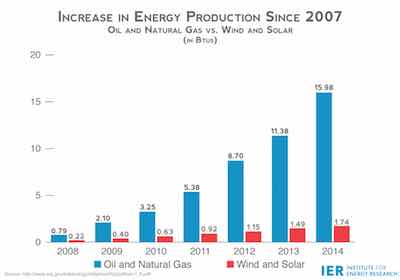
President Obama has bragged that during his time in office “wind and solar electricity production has doubled” and should play a major role in the future energy mix of the country. So, let’s examine how much wind and solar have contributed to U.S. energy growth and how that growth compares to the growth in oil and natural gas production during the same time period. Examining data on energy production from the Energy Information Administration (EIA), it turns out that oil and natural gas production increased more than 9 times faster than wind and solar production.
Since 2007, wind production grew by 452 percent and solar production grew by 462 percent.[1] These percentage increases are impressive, but that’s because they produced a relatively small amount of energy in 2007 and still produce a small fraction of the energy that the U.S. economy needs. When compared with the energy produced by oil and natural gas during the same time period, wind and solar energy production clearly have a long way to go to demonstrate their relevance in the energy industry as the chart below shows. According to EIA data, since 2007, wind and solar production increased by 1.74 quadrillion BTUs. Over the same time period, natural gas and oil production increased by 15.98 quadrillion BTUs—a factor of 9 difference. Not only is the amount of energy produced by natural gas and oil increasing much faster than wind and solar energy, but the increase in solar and wind energy is due to massive government subsidies and state mandates. According to EIA, in fiscal year 2013—just one year, wind and solar received $11.26 billion in federal subsidies compared with $2.35 billion for oil and gas—almost 5 times more. In fiscal year 2010, EIA reports that wind and solar received $6.54 billion compared to $2.92 billion for oil and natural gas, which means that wind and solar received more than double the subsidies of the oil and gas industry. [2] When compared on a unit of production basis to produce electricity, the federal subsidy for solar in fiscal year 2013 cost $231 per megawatt hour, while the federal wind subsidy cost $35 per megawatt hour. These federal subsidies for wind and solar compare to federal oil and gas subsidies for electricity production of just $0.67 per megawatt hour. So, on a unit of production basis for electricity generation, solar subsidies are 345 times more than oil and gas subsidies and wind subsidies are 52 times more. [3]
 Source: Energy Information Administration
Further, more than half the states have Renewable Portfolio Standards that require renewable power be used to generate electricity within the state by specific dates. Government compulsion to buy renewable generation sources obviously has also spurred the growth of solar and wind power.
The boom in oil and natural gas production in the United States has been mainly due to technology—hydraulic fracturing and horizontal drilling. The environmental lobby claims that this growth in natural gas and oil production was only possible because of large amounts of government backing. However, this is not true.
The Breakthrough Institute produced a report highlighting the government’s role in developing hydraulic fracturing and the expansion of the natural gas industry into shale formations. Alex Trembath, a researcher who worked on that report, estimated that the U.S. Department of Energy invested only $137 million in research and development for the natural gas sector over a 30-year span.[4] The purpose of the program was “to assess the resource base, in terms of volume, distribution, and character and to introduce more sophisticated logging and completion technology to an industry made up mostly of small, independent producers. The goal was to substantially increase production from these basins at a time when increased national supply was critically important.” [5]
Lately much of the focus in the energy discussion has been centered on the growth and development of renewables while less notice has been given to the truly impressive growth of the United States in oil production. Between 2008 and 2014, the United States increased oil production by 3.7 million barrels per day, bringing total U.S. oil production to 8.7 million barrels per day. The increase alone equates to more oil than the total production of Canada, Iraq, Iran, the United Arab Emirates, Kuwait, Venezuela, Mexico, Nigeria, or Brazil—to name just a few of the world’s oil producing countries. Put another way, this increase in U.S. oil production is equivalent to the total production of six and a half Ecuador’s—an OPEC member country.[6] In fact, the increase in U.S. oil production since 2008 is greater than the oil production of every OPEC country except Saudi Arabia.
Source: Energy Information Administration
Further, more than half the states have Renewable Portfolio Standards that require renewable power be used to generate electricity within the state by specific dates. Government compulsion to buy renewable generation sources obviously has also spurred the growth of solar and wind power.
The boom in oil and natural gas production in the United States has been mainly due to technology—hydraulic fracturing and horizontal drilling. The environmental lobby claims that this growth in natural gas and oil production was only possible because of large amounts of government backing. However, this is not true.
The Breakthrough Institute produced a report highlighting the government’s role in developing hydraulic fracturing and the expansion of the natural gas industry into shale formations. Alex Trembath, a researcher who worked on that report, estimated that the U.S. Department of Energy invested only $137 million in research and development for the natural gas sector over a 30-year span.[4] The purpose of the program was “to assess the resource base, in terms of volume, distribution, and character and to introduce more sophisticated logging and completion technology to an industry made up mostly of small, independent producers. The goal was to substantially increase production from these basins at a time when increased national supply was critically important.” [5]
Lately much of the focus in the energy discussion has been centered on the growth and development of renewables while less notice has been given to the truly impressive growth of the United States in oil production. Between 2008 and 2014, the United States increased oil production by 3.7 million barrels per day, bringing total U.S. oil production to 8.7 million barrels per day. The increase alone equates to more oil than the total production of Canada, Iraq, Iran, the United Arab Emirates, Kuwait, Venezuela, Mexico, Nigeria, or Brazil—to name just a few of the world’s oil producing countries. Put another way, this increase in U.S. oil production is equivalent to the total production of six and a half Ecuador’s—an OPEC member country.[6] In fact, the increase in U.S. oil production since 2008 is greater than the oil production of every OPEC country except Saudi Arabia.
 Source: Energy Information Administration
As the President sets out to enact his energy plan, it is essential for policy makers, taxpayers, and industry leaders to recognize the limitations of the green revolution and to simultaneously acknowledge the magnitude of the oil and gas renaissance taking place in the country. Understanding this relationship will lead to lower energy costs for consumers and greater economic growth nationwide. Recognizing the relative effect future policies will have on our energy security, economy and international relations is critical for America to realize fully its new found status as a world power in energy production.
[1] Energy Information Administration,
[2] Energy Information Administration, Direct Federal Financial Interventions and Subsidies in Energy in Fiscal Year 2013, March 12, 2015,
[3] Institute for Energy Research, EIA Report: Subsidies Continue to Roll In For Wind and Solar, March 18, 2015,
[4] Yahoo, Decades of federal dollars helped fuel gas boom, September 23, 2012,
[5] Resources for the Future, A Retrospective Review of Shale Gas Development in the United States, April 2013,
[6] Energy Information Administration, International Energy Statistics,
Source: Energy Information Administration
As the President sets out to enact his energy plan, it is essential for policy makers, taxpayers, and industry leaders to recognize the limitations of the green revolution and to simultaneously acknowledge the magnitude of the oil and gas renaissance taking place in the country. Understanding this relationship will lead to lower energy costs for consumers and greater economic growth nationwide. Recognizing the relative effect future policies will have on our energy security, economy and international relations is critical for America to realize fully its new found status as a world power in energy production.
[1] Energy Information Administration,
[2] Energy Information Administration, Direct Federal Financial Interventions and Subsidies in Energy in Fiscal Year 2013, March 12, 2015,
[3] Institute for Energy Research, EIA Report: Subsidies Continue to Roll In For Wind and Solar, March 18, 2015,
[4] Yahoo, Decades of federal dollars helped fuel gas boom, September 23, 2012,
[5] Resources for the Future, A Retrospective Review of Shale Gas Development in the United States, April 2013,
[6] Energy Information Administration, International Energy Statistics,
View Comments
Institute for Energy Research——Bio and Archives
The Institute for Energy Research (IER) is a not-for-profit organization that conducts intensive research and analysis on the functions, operations, and government regulation of global energy markets. IER maintains that freely-functioning energy markets provide the most efficient and effective solutions to today’s global energy and environmental challenges and, as such, are critical to the well-being of individuals and society.