Oil and gas Production on Federal Lands Boosts Jobs and Revenues in Several Key States
Banning production on federal lands would curtail jobs and revenue in states that are prospering from energy production

Institute for Energy Research , Bio and Archives--January 20, 2020
Global Warming-Energy-Environment | Comments | Reader Friendly | Subscribe | Email Us
 Oil and gas production on public lands has increased significantly since President Trump took office. President Trump has opened up millions of acres of land administered by the U.S. Bureau of Land Management (BLM) for resource development. Drilling permits have increased almost 40 percent under the Trump administration, according to BLM data. Several states (e.g., New Mexico, Wyoming, and Colorado) have benefited from the increased activity on federal lands. Forty-eight percent of the revenue from lease sales goes to the state where the oil and gas activity is occurring for their roads, schools, and public services; the rest goes to the U.S. Treasury. If the leases result in producing oil or natural gas wells, revenue from royalties are also shared with the state.
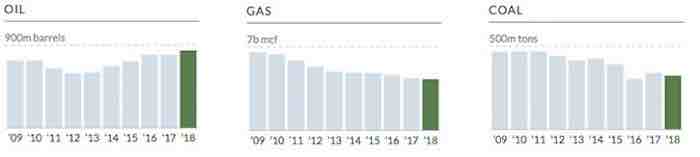
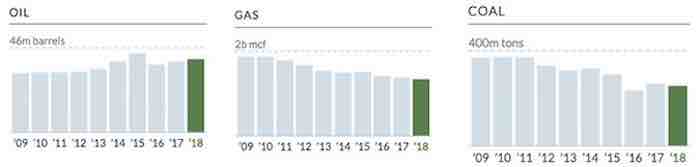
Despite the benefits of energy production on federal lands, many of the Democratic Party’s presidential candidates oppose it and the Democrats in the House of Representatives have proposed a bill to temporarily halt leases. Federal lands account for about a quarter of our nation’s oil, natural gas, and coal production. In 2018, oil production on federal lands was 815 million barrels, natural gas production was 4.2 trillion cubic feet, and coal production was 310 million tons.
Oil and gas production on public lands has increased significantly since President Trump took office. President Trump has opened up millions of acres of land administered by the U.S. Bureau of Land Management (BLM) for resource development. Drilling permits have increased almost 40 percent under the Trump administration, according to BLM data. Several states (e.g., New Mexico, Wyoming, and Colorado) have benefited from the increased activity on federal lands. Forty-eight percent of the revenue from lease sales goes to the state where the oil and gas activity is occurring for their roads, schools, and public services; the rest goes to the U.S. Treasury. If the leases result in producing oil or natural gas wells, revenue from royalties are also shared with the state.
Despite the benefits of energy production on federal lands, many of the Democratic Party’s presidential candidates oppose it and the Democrats in the House of Representatives have proposed a bill to temporarily halt leases. Federal lands account for about a quarter of our nation’s oil, natural gas, and coal production. In 2018, oil production on federal lands was 815 million barrels, natural gas production was 4.2 trillion cubic feet, and coal production was 310 million tons.
U.S. Oil, Natural Gas and Coal Production on Federal Lands
 Source: Department of Interior
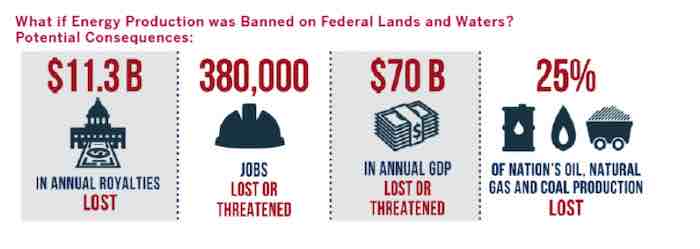
A study by the Global Energy Institute found that if energy production were banned from federal lands and waters, through a ban on future federal-lands leasing and prohibiting the current production of these resources, the result would be an increase in energy prices for consumers due to the removal of low-cost resources from the available supply stream. The ban would lead to the loss of hundreds of thousands of American jobs and billions of dollars in revenues to the U.S. Treasury and to many western states. Besides losing almost a quarter of the nation’s current production of coal, oil and natural gas, the nation would lose over $11.3 billion per year in annual royalties and rental fees for federal and state governments; over $70 billion in annual U.S. GDP; and over 100,000 direct jobs associated with energy development on federal lands (both onshore and offshore), which would impact another 280,000 indirect and induced jobs across the broader economy.
What If Energy Production was Banned On Federal Lands and Waters?
 Source: Global Energy Institute
New Mexico
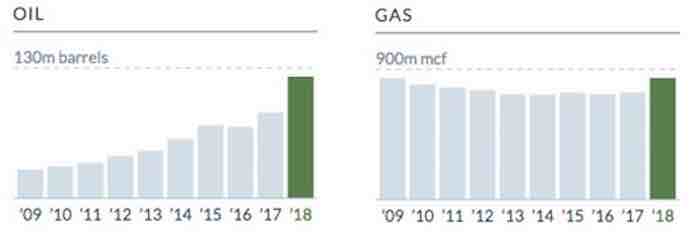
In 2019, the Permian Basin, a geologic formation in West Texas and southeastern New Mexico that includes about 2 million acres of land and 3 million acres of minerals, became the world’s most productive oil field. As a result, New Mexico emerged as a top oil-producing state, becoming the third-largest oil producing state in the nation, with 249 million barrels of crude oil produced—six percent of the nation’s crude oil production. New Mexico also has over four percent of the nation’s total proved natural gas reserves, producing 1.36 trillion cubic feet of natural gas in 2018—4.4 percent of U.S. natural gas production. On federal lands in 2018, New Mexico produced 121 million barrels of oil and 895 billion cubic feet of natural gas.Oil and Natural Gas Production on Federal Lands in New Mexico
 Source: Department of Interior
Oil and gas lease sales in New Mexico’s two fossil fuel producing regions—the Four Corners area in the northwest part of the state, and in the Permian Basin in the southeast—quadrupled since President Trump took office. According to the Bureau of Land Management (BLM), in 2018, a two-day lease sale in New Mexico brought in more revenue than all BLM oil and gas sales in 2017 combined. Revenue from the sale totaled $972,483,619.50, of which roughly $500 million was returned to New Mexico for its roads, schools, and public services. Federal land represents 34.7 percent of the land in New Mexico.
In fiscal year 2019, New Mexico received the highest disbursement of any state and it was the greatest allocation received in the state’s history at $1.17 billion.
According to the study by the Global Energy Institute, if energy production on federal lands were banned, New Mexico would lose 24,300 jobs (10,000 direct, 14,300 indirect and induced) and $496 million in annual royalty collections (2015), representing eight percent of the state’s total General Fund Revenues. That would be a major blow to state just beginning to proper from the state’s oil and gas boom.
Source: Department of Interior
Oil and gas lease sales in New Mexico’s two fossil fuel producing regions—the Four Corners area in the northwest part of the state, and in the Permian Basin in the southeast—quadrupled since President Trump took office. According to the Bureau of Land Management (BLM), in 2018, a two-day lease sale in New Mexico brought in more revenue than all BLM oil and gas sales in 2017 combined. Revenue from the sale totaled $972,483,619.50, of which roughly $500 million was returned to New Mexico for its roads, schools, and public services. Federal land represents 34.7 percent of the land in New Mexico.
In fiscal year 2019, New Mexico received the highest disbursement of any state and it was the greatest allocation received in the state’s history at $1.17 billion.
According to the study by the Global Energy Institute, if energy production on federal lands were banned, New Mexico would lose 24,300 jobs (10,000 direct, 14,300 indirect and induced) and $496 million in annual royalty collections (2015), representing eight percent of the state’s total General Fund Revenues. That would be a major blow to state just beginning to proper from the state’s oil and gas boom.Wyoming
Wyoming is number one in federal onshore gas production and number two in federal onshore oil production. In fiscal year 2017, 38.7 million barrels of oil, were produced from 13,095 leases (covering 8.4 million acres) on federal lands managed by BLM. Revenue from oil and gas lease sales in Wyoming, both federal and state, increased 800 percent from 2016 to 2017. In 2018, BLM raised nearly $117 million through oil and gas lease sales in Wyoming. Production on federal lands in Wyoming in 2018 included 40 million barrels of oil, almost 1.4 trillion cubic feet of natural gas and 264 million tons of coal.Oil, Natural Gas and Coal Production on Federal Lands in Wyoming
 Source: Department of Interior
In fiscal year 2019, Wyoming received the second largest disbursement of any state at $641.11 million.
According to the study by the Global Energy Institute, if energy production on federal lands were banned, Wyoming would lose 32,600 jobs (13,300 direct, 19,300 indirect and induced) and almost $900 million in annual royalty collections (2015), representing about 20 percent of the state’s education-related expenditures.
Source: Department of Interior
In fiscal year 2019, Wyoming received the second largest disbursement of any state at $641.11 million.
According to the study by the Global Energy Institute, if energy production on federal lands were banned, Wyoming would lose 32,600 jobs (13,300 direct, 19,300 indirect and induced) and almost $900 million in annual royalty collections (2015), representing about 20 percent of the state’s education-related expenditures.
Colorado
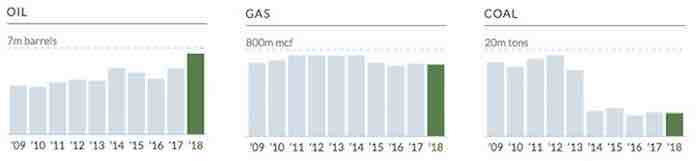
About 36 percent of Colorado’s land surface—24 million acres—is managed by the federal government, according to the Congressional Research Service. Only 3.7 million acres, or about 15 percent of all the state’s federal land, is open to drilling. The BLM currently manages nearly 5,000 leases on that acreage. In 2018, Colorado produced 6.6 million barrels of oil, 646 billion cubic feet of natural gas, and 5 million tons of coal on federal land. The state ranks behind New Mexico, Wyoming, North Dakota, California, and Utah for oil production and behind Wyoming and New Mexico for gas production produced on federal lands.Oil, Natural Gas and Coal Production on Federal Lands in Colorado
 Source: Department of Interior
In fiscal year 2019, Colorado received the third-highest disbursement of any state at $108.05 million.
According to the study by the Global Energy Institute, if energy production on federal lands were banned, Colorado would lose 50,000 jobs (15,300 direct, 34,700 indirect and induced), and as much as $125 million in annual royalty collections (2015).
Source: Department of Interior
In fiscal year 2019, Colorado received the third-highest disbursement of any state at $108.05 million.
According to the study by the Global Energy Institute, if energy production on federal lands were banned, Colorado would lose 50,000 jobs (15,300 direct, 34,700 indirect and induced), and as much as $125 million in annual royalty collections (2015).
Other States Receiving Disbursements
Other states receiving fiscal year 2019 revenues were:- Louisiana $101.33 million
- North Dakota $93.65 million
- Utah $71.69 million
- Texas $65.12 million
- California $47.27 million
- Alabama $34.04 million
- Mississippi $33.18 million
- Montana $29.99 million
- Alaska $25.91 million
Conclusion
Much has been done to create jobs and to produce energy on federal lands under the Trump administration. Oil and gas production on federal lands has increased and so have the revenues from leasing and production that benefit not only the U.S. Treasury, but also many western states. Those state revenues are used for infrastructure, schools, and other public services. Banning production on federal lands would curtail jobs and revenue in states that are prospering from energy production.View Comments
Institute for Energy Research——Bio and Archives
The Institute for Energy Research (IER) is a not-for-profit organization that conducts intensive research and analysis on the functions, operations, and government regulation of global energy markets. IER maintains that freely-functioning energy markets provide the most efficient and effective solutions to today’s global energy and environmental challenges and, as such, are critical to the well-being of individuals and society.