On Climate Catastrophe, Show Your Work, Dr. Krugman
Over time, the U.S. is going to be less and less influential on future climate outcomes, because its own emissions will be a smaller portion of the global total.
Institute for Energy Research , Bio and Archives--December 14, 2015
Global Warming-Energy-Environment | Comments | Reader Friendly | Subscribe | Email Us
Krugman: This Meeting Is Critical, Even Though It Won’t Work
First let’s reinforce the message of my earlier post, where I quoted progressives who admitted that the Paris meetings won’t produce anything to save the planet, according to their own worldview. Here’s Krugman saying the same thing:Future historians — if there are any future historians — will almost surely say that the most important thing happening in the world during December 2015 was the climate talks in Paris. True, nothing agreed to in Paris will be enough, by itself, to solve the problem of global warming. But the talks could mark a turning point, the beginning of the kind of international action needed to avert catastrophe. Then again, they might not; we may be doomed. And if we are, you know who will be responsible: the Republican Party. [Bold added.]Notice the absurdity, and we’re still in Krugman’s first two paragraphs. The existence of humanity itself is allegedly on the line—Krugman wonders if there will even be future historians—and yet this Paris meeting won’t solve the problem. Isn’t it weird that a handful of “deniers” in the United States apparently have the power to tell the whole world what to do with their economies? If this is such an open and shut scientific case, why won’t the Paris talks achieve anything beyond symbolism? Would Krugman be bestowing such honors and prestige on, say, the Captain and crew of the Titanic having a meeting where they agreed to start thinking about icebergs?
U.S. Not a Big Player In Climate Change
According to the type of computer simulations that Krugman favors, even if the United States were to cease emissions altogether by 2050, while the rest of the world continued with the business-as-usual growth in emissions, the total effect on global temperature in the year 2100 would be 0.1 degrees Celsius cooler than otherwise. So it is clear that the real driver in computer simulations of future climate change are emissions in developing economies like India and China. So for Krugman’s story to work, we have to believe something like the following: The fate of humanity rests largely in the hands of political officials in other countries, because it is the emissions from their economies that will ultimately determine how high atmospheric concentrations of CO2 will go. Over time, the U.S. is going to be less and less influential on future climate outcomes, because its own emissions will be a smaller portion of the global total. Nonetheless—in order for Krugman’s article to work—these countries are going to ignore the “obvious” scientific findings and condemn their own people to literal extermination, because those obstinate Republicans in 2015 wouldn’t agree to share some of the burden of going green. Does that make any sense at all?“Cost of Inaction” No Threat, If Krugman and IPCC Are Right
In a previous post, I used the most recent UN Intergovernmental Panel on Climate Change (IPCC) report to show that Krugman’s over-the-top rhetoric was completely unsupported by the ostensible “scientific consensus on climate change.” In this post, let me try a different tack. Let’s stipulate for the sake of argument that the opponents of aggressive U.S. federal action on carbon dioxide emissions are all wrong, and that as time passes the computer models predicting warming will start matching reality better than they’ve done in recent years. (See page 3 of John Christy’s May 2015 testimony to see a graphical depiction of how drastically a suite of climate models has so far overpredicted temperature increases.) So, what happens if U.S. politicians drag their feet for, say, another 15 years and “do nothing” until the year 2030, at which point they realize how horrible they have been to ignore Krugman’s wisdom all those years? Well, according to Krugman’s rhetoric, you would think it was too late at that point, right? Surely if the Republicans today hold the fate of humanity itself in their hands, it can’t possibly be the case that a Congress in the year 2030 could do much about the alleged problem of climate change. And yet, that’s not what the latest IPCC report says. I made this point back in 2014, but I’ll repeat it here. If you go to page 16 of the Working Group III’s Summary for Policymakers, you’ll find the following table: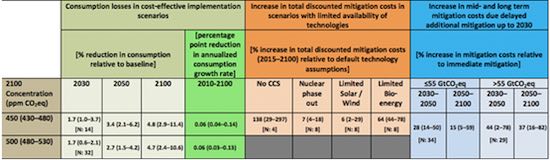 The far right cells (in blue) show how much the cost of mitigation measures increase, if humanity delays action until the year 2030. Specifically, they show the percentage increases in the total (undiscounted) mitigation costs necessary to achieve the far-left (brown cells) atmospheric concentrations of greenhouse gases in the year 2100, for the years 2030-2050 and also for 2050-2100, for two different scenarios of total emissions (either below 55 gigatons of CO2-equivalent, or above).
In other words, these blue cells show us how much a delay of government action through the year 2030 will increase the cost necessary to achieve the specified (and very aggressive) atmospheric concentrations for the year 2100, shown on the far left of the table in the brown cells. Specifically, the blue cells show that by “doing nothing” about climate change until the year 2030, even in a high-emission baseline scenario, the IPCC’s best guess of the cost of achieving the aggressive outcome rises by 44% in the years 2030-2050 and 37% in the years 2050-2100.
Don’t get me wrong, if you believe the computer simulations that the UN IPCC report is based on, then you would conclude that it would be wiser to start implementing mitigation measures—which restrict carbon dioxide emissions—sooner rather than later. The blue cells in the above table are saying that dealing with the problem will become more expensive, the longer humanity waits.
But notice that the blue cells are at most saying the fix will be 44 percent more expensive, not infinitely more expensive. And elsewhere, we have Paul Krugman himself telling us that the baseline cost to the economy of “saving the planet” is so cheap, it might even be free! I’m not putting words in his mouth. Back in September 2014, Krugman opened a column in the New York Times by writing: “This just in: Saving the planet would be cheap; it might even be free. But will anyone believe the good news?”
So to summarize, we’ve got Krugman in 2014 telling us that saving the planet will be cheap and possibly free, and we’ve got the latest UN report on the scientific consensus telling us that delaying all action until 2030 will raise the price of mitigation measures by 44 percent. Krugman is a Nobel laureate in economics, so I’m guessing he knows that “free” times 1.44 is still free. And “cheap” times 1.44 is certainly not equal to “end of humanity.”
The far right cells (in blue) show how much the cost of mitigation measures increase, if humanity delays action until the year 2030. Specifically, they show the percentage increases in the total (undiscounted) mitigation costs necessary to achieve the far-left (brown cells) atmospheric concentrations of greenhouse gases in the year 2100, for the years 2030-2050 and also for 2050-2100, for two different scenarios of total emissions (either below 55 gigatons of CO2-equivalent, or above).
In other words, these blue cells show us how much a delay of government action through the year 2030 will increase the cost necessary to achieve the specified (and very aggressive) atmospheric concentrations for the year 2100, shown on the far left of the table in the brown cells. Specifically, the blue cells show that by “doing nothing” about climate change until the year 2030, even in a high-emission baseline scenario, the IPCC’s best guess of the cost of achieving the aggressive outcome rises by 44% in the years 2030-2050 and 37% in the years 2050-2100.
Don’t get me wrong, if you believe the computer simulations that the UN IPCC report is based on, then you would conclude that it would be wiser to start implementing mitigation measures—which restrict carbon dioxide emissions—sooner rather than later. The blue cells in the above table are saying that dealing with the problem will become more expensive, the longer humanity waits.
But notice that the blue cells are at most saying the fix will be 44 percent more expensive, not infinitely more expensive. And elsewhere, we have Paul Krugman himself telling us that the baseline cost to the economy of “saving the planet” is so cheap, it might even be free! I’m not putting words in his mouth. Back in September 2014, Krugman opened a column in the New York Times by writing: “This just in: Saving the planet would be cheap; it might even be free. But will anyone believe the good news?”
So to summarize, we’ve got Krugman in 2014 telling us that saving the planet will be cheap and possibly free, and we’ve got the latest UN report on the scientific consensus telling us that delaying all action until 2030 will raise the price of mitigation measures by 44 percent. Krugman is a Nobel laureate in economics, so I’m guessing he knows that “free” times 1.44 is still free. And “cheap” times 1.44 is certainly not equal to “end of humanity.”
Conclusion
In other areas, Krugman writes provocative claims but usually links to data sources and/or provides at least back-of-the-envelope calculations to back up what he’s saying. But lately when it comes to discussing climate change, Krugman doesn’t even bother doing that. It’s because he can’t. The most cited economists talking about catastrophe are merely pointing out that it’s possible—they aren’t making the ridiculous claim (as Krugman does) that catastrophe is inevitable if the Republicans get their way. Nobody knows the future, and we must admit that any government policy might destroy the world. I mean look, Krugman is in favor of government funding of physics—but particle accelerators might create a black hole. Does Krugman want to wipe out humanity?View Comments
The Institute for Energy Research (IER) is a not-for-profit organization that conducts intensive research and analysis on the functions, operations, and government regulation of global energy markets. IER maintains that freely-functioning energy markets provide the most efficient and effective solutions to today’s global energy and environmental challenges and, as such, are critical to the well-being of individuals and society.