

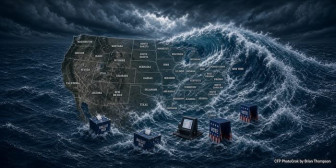
Our Vulnerable Election Systems or Was There Really a Blue Wave?
Part I --Where it all began;

Our once reliable elections have been slowly compromised to the point where we no longer can know if the results can be trusted
Now think about our modern elections. You went to the polls expecting to see a red win, only to be told that it was really a huge blue wave. You think the election was stolen, and you talk to election officials who say that they have counted the ballots and you are wrong. They tell you that if you persist with your claims that they will have you arrested for attempted election fraud.
What do these two scenarios have in common? Our once reliable elections have been slowly compromised to the point where we no longer can know if the results can be trusted, or are merely a story we are told that we can't check. This series will lead you through the changes and show you where we stand today, and what we must do to restore matters while we still have a country to call our own.
Our election systems have changed dramatically over the last forty years, and not for the better. As a result of these changes, our elections have become less transparent, more controversial, less reliable, more vulnerable to massive fraud, more subject to manipulation, and unable to identify the real will of the people. A case in point is the recent midterm elections of just two weeks ago.
A few major changes work together to destroy the integrity of our elections: centralization of election systems and processes, substitution of electronic records for harder to alter paper records, mass absentee and mail-in voting, and elimination of meaningful voter identification. There are other changes, but these account for the great majority of problems. I will summarize these below and describe how they contribute to the problem we now face of an inability to actually know who won the midterms. The reported totals are meaningless if they are not real, and there is good reason to question them.
Over thirty different forms of identification can be used as proof--only a few of which require a photo ID or proof of citizenship
At the core of the problem is the centralization of voter records, largely in the form of electronic voter rolls. Congress passed the National Voter Registration Act in 1993 that effectively required states to create central voter registration databases in each state. In addition to information on who is eligible to vote, these also contain information on who has voted in each election.
In every state, these records are poorly maintained, in part because the law requires poor maintenance. By law, voter registrations must be accepted with only minimal evidence that the registration is from a citizen of legal age and otherwise entitled to vote. Over thirty different forms of identification can be used as proof--only a few of which require a photo ID or proof of citizenship. Even a copy of a utility bill or a bank statement can suffice.
Once entered in the rolls, they can only be legally removed by proof of death, a felony conviction, a voter's request for removal, or proof of a permanent move. If those cannot be provided, the registration remains, and remains active.
Multiple investigators across the country, myself included, have found our voter rolls to be filled with duplicate registrations, registrations that are identical except for a day or two difference in birth date, millions of likely non-citizens, active registrations for people who moved away years earlier, voters registered at invalid addresses such as businesses and vacant lots, and yes, a few real legal voters. Does anyone really wonder how elections today can turn up a few million extra voters to change the outcome of an election?
The subsequent additions of motor-voter laws, online registration systems, registration by mail, registration drives by NGOs and other organizations that turn in stacks of completed registrations with no assurance that the forms were completed by legal citizens has made a mockery of any attempt to ensure that our voter rolls are honest.
Bad registrations support many forms of election fraud
The problem is compounded by the fact that master voter rolls are maintained by each state. Even if a local county is diligent about keeping its rolls clean, they can be overridden by the state. Voters removed at the county level can be restored to the rolls from the state master. Likewise, new additions in counties can be kept off the master rolls.
The result is that no county controls its own elections--the state rolls and records explain why millions of bad registrations can be removed, only to have them reappear some time later, either as restored registrations or as new registrations using the old data. This has been observed on multiple occasions, but has always been dismissed as unimportant or even as legitimate activity.
Some will question why it matters if there are bad registrations in the rolls--they don't show up to vote, after all. Actually they do. The people who put the bad registrations in place know which ones they are, but the election officials usually don't. All that most local officials know is that there are active voter registrations in their rolls, but don't know if they are valid, or if they are for non-citizens, dead people, people who have moved, or any number of other unqualified registrations.
These bad registrations support many forms of election fraud. For example, assume a fraudster buys hundreds or even thousands of mail-in ballots from people who who think it is ok to sell a ballot, or who need the money. The fraudster fills out the ballots and returns them. The officials receive the ballot and check the name on the return envelope. If the name matches a name in the voter rolls, then that registration is credited with having voted, and the ballot choices are added to the totals. There is no way at that point to undo the false counts even if it is later proven that the voter was unqualified, or even fictional.
Ballot trafficking is just one way that dirty voter rolls combine with other changes such as widespread vote by mail systems to make our elections unreliable
We have reports from multiple law enforcement officials and investigations in multiple states that ballot selling is commonplace, with prices ranging from $20 to over $200 per ballot sold. The prices are high enough to even encourage ballot theft from mailboxes, apartment complexes, nursing homes, and other locations. Steal and sell 100 or 200 ballots, make a month's income--tax free! It is even attractive to cartels and gangs as an additional source of revenue.
Multiple investigations show it happens regularly, and multiple reports get buried or dismissed. It only takes a few of these to sway an election. Even at $50 per ballot, 5,000 ballots would only cost $259,000. In many races, that is enough to elect a Representative, or even a Senator--small change in contests that often spend millions to win. Imagine what you could do if you owned a Senator.
Sadly, about a quarter of the voters think it is legal to sell a ballot to someone. We have conducted multiple polls, all with the same results. How many people see their ballots as a source of extra cash? How many don't intend to vote and don't care who uses their ballot? What does it matter?
In the olden days of in-person voting on a single day, this was a much smaller problem. People filled out their ballots on site, put them in the ballot boxes themselves, and had to sign the poll pads themselves. Poll workers often knew who was in their precinct, so it was hard for fraudsters to submit multiple ballots. All those safeguards have been eliminated or nullified by law. Now, the only requirement for a ballot to be accepted and counted is an entry in the voter rolls. Dirty rolls mean dirty elections.
Ballot trafficking is just one way that dirty voter rolls combine with other changes such as widespread vote by mail systems to make our elections unreliable. The next part will look at a second major change that makes further use of corrupted voter rolls. We will begin to see why a number of officials haven't wanted their voter rolls looked at too closely.
Read next: Stolen Elections: The Era of Rage Politics
Email Us | Reader Friendly | Comments
David Robb——Bio and Archives
David Robb is a practicing scientist and CTO of a small firm developing new security technologies for detection of drugs and other contraband. Dave has published extensively in TheBlueStateConservative, and occasionally in American Thinker.