Paris Climate Agreement in Serious Trouble
Is there any doubt why President Trump withdrew the United States from the Paris Climate Agreement on his first day back in office

Jack Dini , Bio and Archives--October 12, 2025
Global Warming-Energy-Environment | Comments | Reader Friendly | Subscribe | Email Us
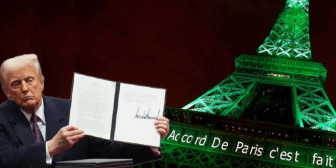
It has taken a full decade, but the mainstream media is finally catching up to what some folks have been saying since the day the Paris Agreement was signed. It was built on sand, unenforceable, and destined to crumble under the weight of its own political posturing.
The age of Paris is over, and the world has lost its appetite for climate politics
Anthony Watts reports, “In a remarkable piece of candor, the New York Times admits what has long been obvious to anyone outside the climate activist bubble: the age of Paris is over, and the world has lost its appetite for climate politics.” (1)
The New York Post also reported, “It’s long past time for the entire West to admit it. The whole anti-carbon crusade declared in the 2015 Paris Climate Agreement has proved a disaster—wrecking economies and worsening lives without making a real difference on climate change.” (2)
In a sprawling retrospective, David Wallace-Wells, who once branded himself the chronicler of ‘climate catastrophe’ now concedes: “A decade later, we are living in a very different world, an official UN report declared that no climate progress at all had been made over the previous year, and several of the most prominent architects of the whole diplomatic process, published an open letter declaring the agreement’s architecture out of date and in need of major reforms.”
This is the same Wallace-Wells who made his name spinning apocalyptic scenarios of climate collapse. His Book, The Uninhabitable Earth, was practically a handbook for the Greta Thunberg generation. Yet now, even he is conceding that the global political consensus on climate action has dissolved into indifference and backsliding. (1)
A decade ago, Paris was sold as nothing less than the salvation of humanity. Barack Obama declared the agreement was ‘the best chance we have to save the one planet we’ve got’. UN Secretary General Ban Ki-moon claimed sustainability would define the 21st century the way human rights had defined the 20th. His successor, António Guterres, elevated the treaty to near-scriptural status, suggesting a significance rivaled the UN charter itself. Pundits, activists, and world leaders congratulated themselves on ushering in a new era of global solidarity.
It was obvious then, and it is undeniable now, that this was a recipe for failure
When the 2015 Paris Agreement was signed, it marked a consensus, agreed to by nearly all the countries in the world, that global temperature rise should be limited to well below 2 degrees Celsius over preindustrial levels. But the treaty hinges on those almost 200 countries periodically submitting goals outlining just how much they’ll individually cut emissions in the coming years, and then following through. Although the Paris Agreement didn’t stipulate a formal accountability mechanism, these plans—called Nationally Determined Contributions, or NDCs, and submitted every five years—were envisioned as catalysts that would signal national priorities, guide policy, and match the ambition required by the rapidly approaching 2 degree target.
Ten years on, however, that ambition is lagging. The vast majority of countries missed a February deadline to submit updated NCCs, and many now appear likely to miss a September deadline, too. Roughly, 50 countries have formally submitted their third NDCs—the first two were due in 2015 and 2020—and 50 or so made announcements about their new emissions targets at the climate summit during the United Nations General Assembly recently. Many of the latter have not formally submitted their NDCs. (3)
The agreement contained no enforcement mechanism, no penalties for failure and relied entirely on the good faith of politicians whose careers depended on short-term voter approval. It was obvious then, and it is undeniable now, that this was a recipe for failure.
The UN’s own report admits ‘no climate progress at all.” Why? Because when push came to shove, voters simply weren’t willing to pay. Polls show that while people will tell surveyors they ‘care about climate change,’ it ranks dead last in voter priorities, and support collapses when costs are attached. When forced to choose between freezing in the dark or burning more coal, people chose warmth and light every time.
After $2 Trillion Spent--World dependence on fossil fuels for its primary energy demand ‘plunged’ all the way down to 84% from 86%
But even those commitments that have come in on time don’t appear likely to substantially move the needle on global temperature rise. According to one preliminary analysis by the World Resources Institute, a nonprofit that tracks NDC pledges, the new plans so far would only reduce emissions by 2 gigatons—just 10 percent of what experts say is needed to stay on track for the 2 degree threshold. (3)
Anyone faintly familiar with global energy trends would know that the world’s largest emitters of CO2 in Asia, such as China, India, Indonesia and Vietnam, have in fact gained momentum in capacity additions to their coal mining and coal power generation sectors. Global coal reached an all-time high in 2024, marking the third consecutive year of record-breaking consumption. (4)
To put the $2.1 trillion spent on the ‘energy transition’ in context, look at a 2021 speech by Chris Wright, the recently appointed Energy Secretary of the Trump administration. He asked, “How has the energy transition gone so far”? And he answered, that after $2 trillion in subsidies over the 2 decades from 2000, the world dependence on fossil fuels for its primary energy demand ‘plunged’ all the way down to 84% from 86%.
Is there any doubt why President Trump withdrew the United States from the Paris Climate Agreement on his first day back in office (he also withdrew in 2017). (5)
References
- Anthony Watts, “The Paris delusion collapses: even the New York Times admits it,” wattsupwiththat.com, September 19, 2025
- “Paris Accord was a disastrous mistake,” nypost.com, March 1, 2025
- Naveena Sadasivam, “10 years after the Paris Agreement countries are still missing climate deadlines,” grist.org, September 30, 2025
- “The Paris Agreement ten years on is a house of cards ready for the toppling,” clintel.org, February 14, 2025
- Sterling Burnett, “Paris Climate Treaty is going down,” cornwallalliance.com, February 25, 2025
View Comments
John William Dini, know to all as ‘Jack’, passed away at the age of 89 on June 17, 2026. He was born in Cleveland, Ohio on Nov. 14, 1936.
He published two books, a technical book on materials science and coatings and another on environmental issues. In retirement, he wrote extensively on various environmental issues for online publications.
He was a skilled leaded glass hobbyist, creating more than 20 lamps and many panels. He was a jogger for many years, competing in over 300 long distance races. He was a slow runner, not wanting to take the glory away from others. His secret was to start slow and taper. He and Anne traveled extensively, visiting over 70 countries.
He is survived by his wife, Anne, of 67 years, and sons Mike, Steve, and Paul. If you were to meet him somewhere, he would sum up his life as ‘peaches and cream’.